I’ve thought about this for years. And I’ll start by saying something that might make some people uncomfortable.
There’s a part of me that has always wondered whether Magic Johnson really had HIV. Not because I have medical evidence proving that he didn’t.
I don’t. And that’s important to establish immediately.
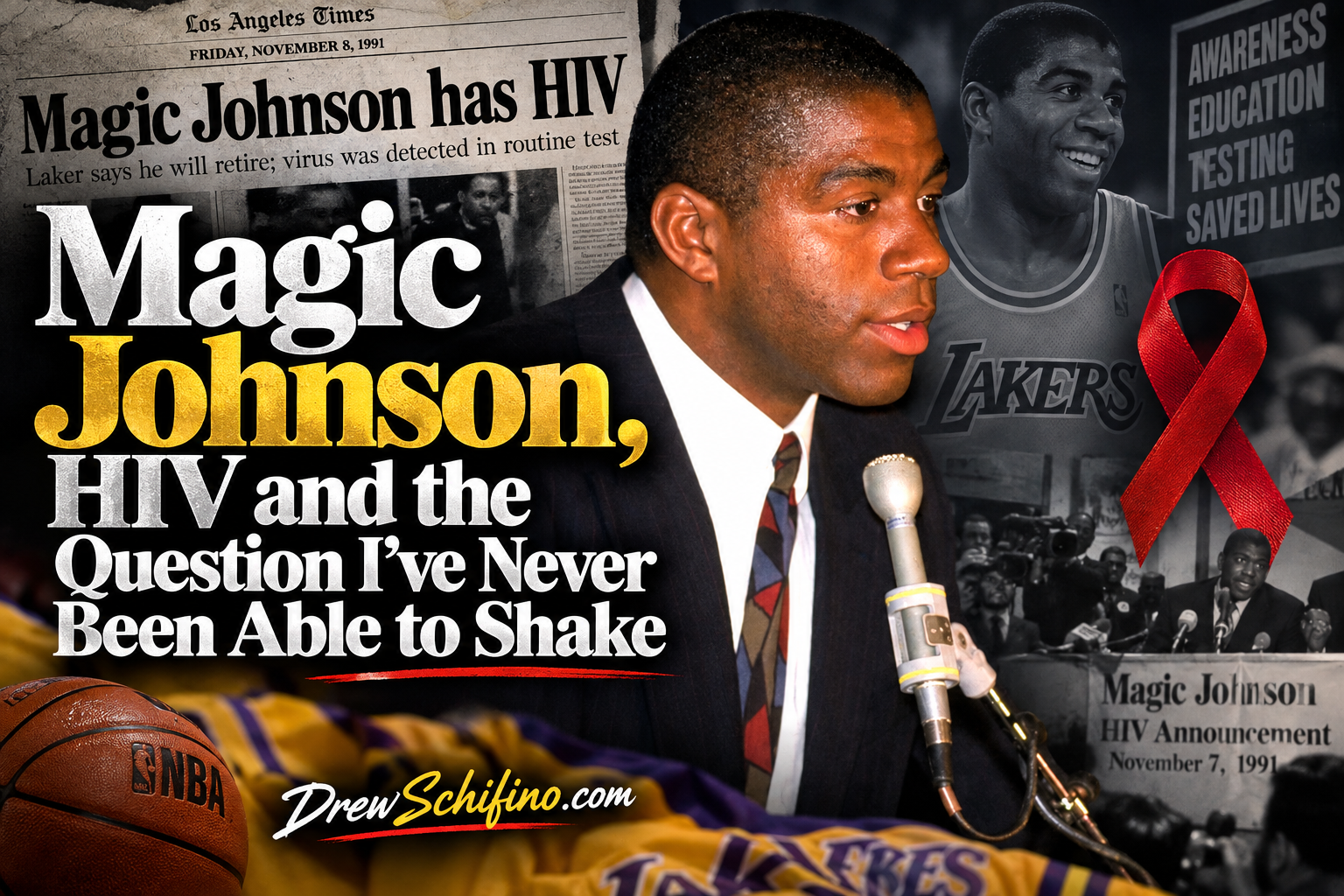
Magic Johnson announced on November 7, 1991, that he had tested positive for HIV. He has maintained that diagnosis ever since, and there is no credible evidence I can find showing that the diagnosis was fabricated.
But I’ve always been fascinated by the timing and what happened afterward.
Because whether you believe every part of Magic’s story or question it, one thing is undeniable: America desperately needed somebody like Magic Johnson at that exact moment.
Before Magic, America Had Put HIV in a Box
You have to understand what HIV/AIDS represented culturally in the 1980s and early 1990s.
Fear. Death. Confusion. And enormous stigma.
For many Americans, HIV/AIDS had become associated almost exclusively with gay men and intravenous drug users. That perception wasn’t medically accurate, but culturally it was incredibly powerful.
There were heterosexual people who essentially believed: That isn’t something I have to worry about.
Then Magic Johnson walked to a microphone.
Suddenly, HIV had the face of one of the most recognizable heterosexual male athletes on Earth. Not somebody wasting away in a hospital bed.
Magic Johnson. Five NBA championships. Three MVPs. The smile. The Lakers. Showtime. One of the most famous Black men in America.
And suddenly millions of heterosexual Americans had to confront something they had previously convinced themselves didn’t apply to them.
America Paid Attention Immediately
This is where the historical record gets incredible.
Magic’s announcement didn’t merely make headlines. It changed behavior almost overnight.
HIV testing centers around the country reported huge increases in calls and people requesting tests. In San Diego, AIDS organizations reported calls tripling. Other cities experienced similar surges.
The CDC’s AIDS hotline normally received around 3,000 calls per day. According to contemporary reporting, between 5 p.m. and midnight after Magic’s announcement, its equipment registered more than 40,000 attempted calls.
Think about that.
One athlete spoke. America reacted.
A Los Angeles Times poll later found that 99% of Americans surveyed had heard or read something about Magic’s announcement. Concern about personally contracting AIDS had also increased compared with earlier polling.
That is extraordinary cultural influence.
He Became the Messenger HIV Awareness Needed
And this is the part that originally made me think deeper about the story.
Magic wasn’t merely somebody diagnosed with HIV. He became one of its most important public messengers.
At his original press conference, Magic said he intended to become a spokesman for HIV and educate young people about safer sex.
Health officials immediately understood how significant that could be. Because Magic could reach people they had struggled to reach. Especially heterosexual men.
One HIV outreach specialist told the Los Angeles Times that Magic’s announcement had “probably saved thousands of lives.”
That’s incredible.
But here’s where we have to separate two different ideas.
Magic becoming the perfect messenger does not prove that somebody invented his diagnosis to make him the messenger.
Those aren’t the same thing.
History is filled with unexpected events that produce exactly the person a movement needs.
Sometimes the messenger isn’t selected. Circumstances select him.
Why Didn’t Magic Die?
This is probably the biggest reason conspiracy theories surrounding Magic have survived.
People remember what HIV/AIDS looked like in the 1980s.
People got sick. People lost tremendous amounts of weight. People died.
Then Magic announced he had HIV in 1991. And more than three decades later, he’s still here.
To somebody who remembers the terror surrounding AIDS at the time but doesn’t understand how HIV treatment changed, that can look suspicious.
But HIV and AIDS aren’t synonymous.
Magic specifically emphasized in 1991 that he was HIV-positive but did not have AIDS.
And medicine changed dramatically.
By the middle of the 1990s, combination antiretroviral therapy transformed HIV treatment. AIDS-related deaths and hospitalizations subsequently declined sharply in developed countries.
Magic had enormous resources, elite doctors, early detection and access to treatment.
His survival isn’t evidence that he never had HIV. If anything, he eventually became a highly visible example of what effective HIV treatment could accomplish.
But I Understand Why People Question It
I don’t automatically dismiss people for questioning historical events. Questions are healthy. Especially when something fundamentally changes society.
Magic’s announcement was almost too perfect culturally.
America had spent years stigmatizing HIV as somebody else’s disease.
Then one of the most masculine, famous, heterosexual athletes in America announced: I have it.
And immediately the conversation changed.
Young people started talking about HIV. Athletes started reconsidering their sexual behavior. Parents started talking to their children. Heterosexual men started calling testing centers.
People who previously believed they weren’t at risk suddenly realized: If Magic Johnson can get HIV, so can I.
Contemporary reporting documented exactly that reaction.
So I understand why someone looking backward might wonder whether Magic was intentionally made the face of the epidemic.
It’s a fascinating question. But a fascinating question isn’t evidence.
The Bigger Story Might Be Better Than the Conspiracy
After researching it, I actually think the documented story is more powerful.
Magic Johnson didn’t need to have a fake diagnosis to change America’s understanding of HIV. A real diagnosis did it.
One of America’s most famous athletes suddenly found himself carrying a virus that millions of people wrongly believed couldn’t affect somebody like him.
And instead of disappearing, he stood in front of cameras.
That’s what changed things.
He gave HIV a face that contradicted almost every stereotype surrounding the disease.
Straight. Athletic. Famous. Successful. Strong. Healthy-looking. Black.
Magic Johnson didn’t fit America’s image of HIV. And that’s precisely why his announcement mattered so much.
Maybe That’s the Real Legacy
More than 35 years later, people remember November 7, 1991, because Magic Johnson announced that he had HIV.
But perhaps the bigger historical story is what happened November 8.
People woke up thinking differently. Phones started ringing. Testing increased. Conversations happened in homes, locker rooms and schools that hadn’t happened before. People who thought HIV couldn’t happen to them suddenly understood that it could.
That’s enormous cultural impact.
So yes, I’ve questioned Magic Johnson’s story. I understand why others have too.
But questioning something and discovering evidence supporting the suspicion are two different things.
I haven’t found that evidence.
What I did find was something equally fascinating: America needed somebody who could destroy the stereotype surrounding HIV/AIDS—and whether by circumstance, fate or terrible luck, Magic Johnson became that person.
And he may have saved countless lives because of it.