
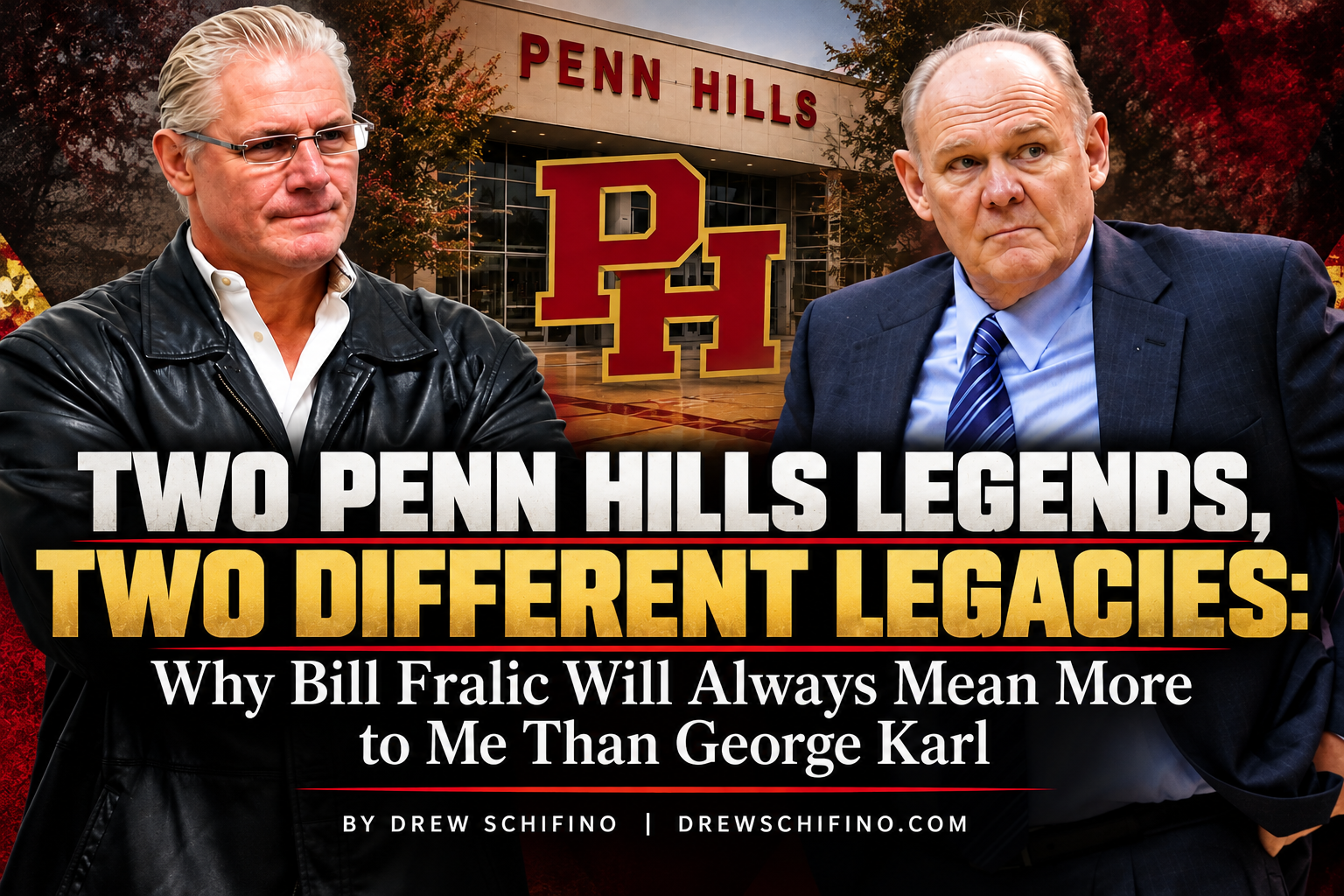
Growing up in Penn Hills and playing sports there, there were two names you heard over and over again.
Bill Fralic. George Karl. They were the standard.
Before Aaron Donald became one of the greatest defensive players in NFL history and before another generation of Penn Hills athletes made their names nationally, Fralic and Karl were two of the guys every young athlete in Penn Hills knew about.
They weren’t just successful athletes. They were Penn Hills athletes.
Fralic became an All-American at Pitt, the No. 2 overall pick in the 1985 NFL Draft, a four-time Pro Bowler and a two-time first-team All-Pro.
Karl went from Penn Hills to North Carolina, became a professional basketball player and eventually built a Hall of Fame coaching career that included more than 1,100 NBA victories.
Two incredible sports careers. Two Penn Hills legends.
But growing up there and eventually becoming one of those athletes trying to create my own legacy, I came to view the two men very differently.
And it really has nothing to do with who accomplished more.
It has everything to do with how they treated the place that helped produce them.
Bill Fralic Never Forgot Penn Hills
I had the honor of meeting Bill Fralic around 1999.
I was still at Penn Hills, making a name for myself in basketball, and Bill would come back around for football games.
Remember, this wasn’t the social-media era. There was no Instagram. No Hudl. No YouTube highlights getting passed around the country.
If somebody who lived in Georgia knew about a high school basketball player in Penn Hills, Pennsylvania, they probably heard about you through newspapers, people talking or somebody who had actually watched you play.
Bill told me he had heard about me. That meant something to me.
Here was Bill Fralic, one of the greatest athletes Penn Hills had ever produced, telling this young basketball player that he had heard I was an amazing player and that I had the ability to accomplish the goals I had set for myself.
He wished me luck. I never forgot it.
It probably wasn’t some monumental moment in Bill’s life. It was in mine.
That’s something successful people sometimes don’t understand.
When you’ve already reached the mountaintop, a few words from you can mean everything to a young person who is still climbing.
But Bill’s relationship with Penn Hills went much deeper than what he said to me.
He put his money behind it. He put his presence behind it. He put his heart behind it. The indoor athletic facility at Penn Hills carries his name, and his financial support helped create athletic facilities for generations of Penn Hills athletes.
And nearly two decades after I met him, he was still helping.
When the 2018 Penn Hills football team reached the PIAA Class 5A championship game in Hershey, Fralic covered the team’s hotel costs so the players and coaches could stay near Hershey before the championship.
Penn Hills beat Manheim Central 36-31 and became state champions. Bill Fralic died only days later.
Think about that.
One of his final acts of generosity was helping kids from Penn Hills chase a state championship.
That’s legacy.
Penn Hills Changed. Bill’s Love for It Didn’t.
Penn Hills wasn’t exactly the same community in 2018 that it was when Bill Fralic grew up there.
Communities change. Demographics change. Schools change. Generations change.
But Bill never acted like Penn Hills stopped belonging to him because it looked different than it did when he was young.
That always stood out to me.
He loved where he came from. Period. And the people around Penn Hills knew it.
When Fralic died, Penn Hills’ athletic department remembered him as one of the community’s biggest supporters. People around the program talked about his generosity and how he helped organizations and teams when they needed it.
That tells you everything.
Bill Fralic didn’t just want Penn Hills to remember Bill Fralic. Bill Fralic remembered Penn Hills.
There’s a difference.
My Experience With George Karl Was Different
This is where the story becomes personal for me. Because George Karl was the basketball name.
If you were a basketball player coming through Penn Hills, you knew exactly who George Karl was.
He had set records there. He played at North Carolina. He played professionally. Then he became one of the most successful coaches in NBA history.
As I started having success at Penn Hills, naturally, his name came up. Eventually I broke his school scoring record.
Then came my senior season.
I had a historic WPIAL playoff run. I scored 147 points in four playoff games. I became one of the top players in Western Pennsylvania, an all-state player and a nationally ranked Top 100 recruit. I eventually went Division I to West Virginia. And during my two seasons playing at WVU, I scored more than 1,000 points.
I wasn’t some kid buried on the end of a college bench.
I was performing at a high level. Through all of that, I never heard from George Karl.
Not when I broke the record. Not during that playoff run. Not when I became a major Division I recruit. Not when I was playing well in college.
Nothing.
Maybe George knew about me. Maybe he didn’t. Maybe there were things happening privately with Penn Hills basketball that I simply wasn’t aware of.
I’m not going to claim to know another man’s motivations. I can only tell you what my experience was.
And my experience with Bill Fralic was completely different.
That’s Why Bill Became the Standard for Me
This isn’t about saying George Karl wasn’t great. That would be ridiculous.
His basketball resume speaks for itself. He is a Hall of Fame coach.
But greatness and legacy aren’t always the same thing.
George Karl’s career tells me how great George Karl became. Bill Fralic’s actions told me how much Penn Hills still meant to Bill Fralic after he became great.
That’s the distinction.
And as someone who eventually became part of Penn Hills sports history myself, that distinction matters to me.
Karl’s Later Controversies Made Me Think About It Even More
Years later, Karl received heavy criticism for comments in his book about former players, particularly Carmelo Anthony, Kenyon Martin and J.R. Smith.
His comments about Anthony and Martin growing up without fathers especially created backlash, and Karl later acknowledged that he had expressed those thoughts poorly.
I’m not going to sit here and call George Karl a racist. I’m not saying that. And I don’t have evidence that race had anything to do with whatever relationship—or lack of relationship—he had with Penn Hills basketball during my era.
But I would be lying if I said some of the things that became public later didn’t make me think back to my own experience and wonder.
Penn Hills had changed dramatically from the community Karl knew growing up. Its basketball program became increasingly Black. Players like me came through there, had success, earned Division I opportunities and represented Penn Hills on bigger stages.
Yet from where I stood, I never felt the embrace from one of the biggest basketball names our school had ever produced.
Maybe there’s an explanation. I don’t know. That’s why I’m not going to create one.
But I noticed the absence.
Especially because another Penn Hills legend showed us exactly what staying connected could look like.
You Don’t Have to Give Millions Back
That’s really the larger point of this article.
Giving back isn’t always about money. Bill Fralic had the means to donate financially, and thankfully he did.
But I’ll tell you something else Bill gave me that didn’t cost him anything. Encouragement.
He told a young Drew Schifino that he had heard about him. He told me I was a hell of a player. He told me I could accomplish the goals I had set for myself. Then he wished me luck.
That’s it. Almost three decades later, I still remember it.
Imagine what a phone call from George Karl would have meant to a teenage basketball player who had just broken his Penn Hills record.
“Congratulations. Keep going.” That’s all it would’ve taken.
That’s why I try to give people their flowers now.
That’s why I write about the old WPIAL and City League players. That’s why I recognize coaches. That’s why I reach back and tell people that what they did mattered.
Because sometimes the people who came before us don’t realize how closely the next generation is watching.
The GOAT of Penn Hills Sports
Penn Hills has produced an unbelievable amount of athletic talent.
George Karl. Aaron Donald. Tom Flynn. Dion Bentley. Drew Schifino.
And plenty of others whose names deserve recognition.
But when I think about what it means to truly represent Penn Hills, Bill Fralic will always occupy a different place for me.
Not simply because of what he accomplished. Because of what he gave back.
He left Penn Hills. Penn Hills never left him.
He became an All-American. He became the second pick in the NFL Draft. He became an All-Pro. He built a successful life hundreds of miles away.
And after all of it, when kids from Penn Hills needed help getting to Hershey to chase a championship, Bill Fralic was still there.
That’s what being a hometown legend looks like to me.
Records get broken. Championship banners eventually fade. Buildings get replaced.
But people remember how you treated them and whether you remembered them once you didn’t need anything from them anymore.
I know I do.
Rest in peace, Bill Fralic.
The GOAT of Penn Hills sports—and, more importantly, a man who never forgot where he came from.