
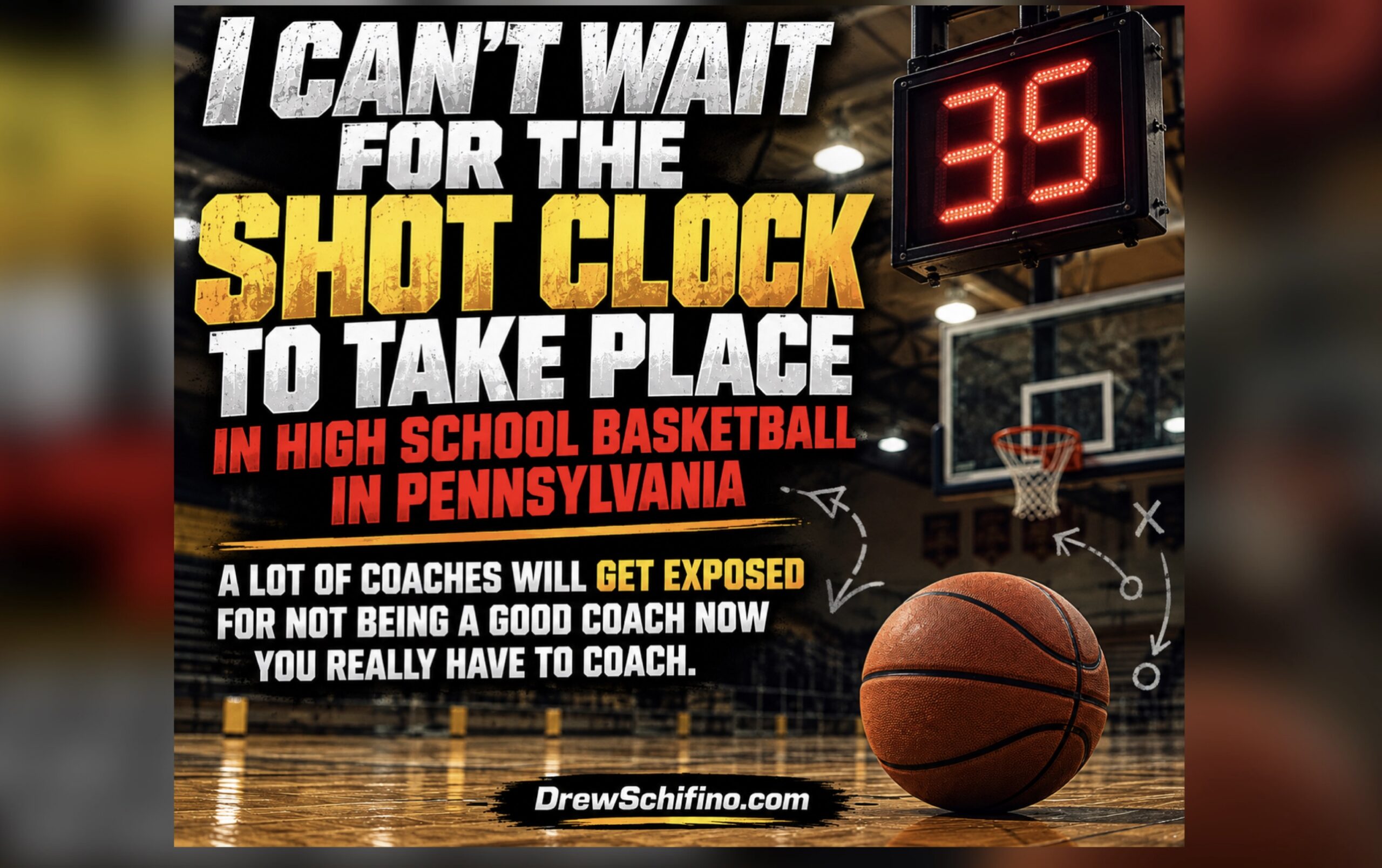
I can’t wait. Pennsylvania high school basketball is finally getting a shot clock.
Beginning with the 2028-29 season, PIAA boys’ and girls’ varsity and junior varsity basketball will use a 35-second shot clock.
And I’m going to say something that might make a few coaches uncomfortable.
Some coaches are about to get exposed. Because now you’re actually going to have to coach basketball.
You can’t just hold the ball. You can’t play keep-away for minutes at a time. You can’t get a lead and decide that nobody is playing basketball anymore.
Eventually, that clock is hitting zero. You’ve got to run something.
I Remember Stall Ball
Coming up during my high school days at Penn Hills, I saw it firsthand.
We played teams that knew they couldn’t match up with us, so instead of trying to beat us playing basketball, their strategy was basically to make sure as little basketball as possible was played.
Hold the ball. Pass it around. Stand near half court. Make us chase. Wait. Wait some more.
And if you got a lead?
Forget about it. Some teams were perfectly content turning the rest of the game into keep-away.
Was it legal? Absolutely. Was it sometimes smart strategy? Absolutely.
But don’t tell me it was good basketball.
There is a difference.
Now You’ve Got 35 Seconds. Show Me What You Can Coach.
That’s what I love about the shot clock. You’ve got 35 seconds.
What are we running? What’s your offense? Can your players execute? Can you create a good shot against pressure? Can you make an adjustment when somebody takes away your first option? Can you draw something up after a timeout? Can your guards make decisions? Can you teach your team how to play late in the clock?
Now we’re coaching. The shot clock doesn’t eliminate strategy. It creates MORE strategy.
A coach has to understand pace, possessions, clock management and late-clock situations.
And the players have to learn it too.
That’s basketball.
Good Coaches Aren’t Going Anywhere
I know what somebody is going to say.
“Drew, holding the ball was coaching too.”
Sure.
There were times when slowing down a superior opponent was absolutely the right strategy. If my team is overmatched athletically and shortening the game gives us our best opportunity to win, I’m not blaming a coach for trying it.
But there’s a difference between occasionally using that strategy and building your entire identity around the fact that high school basketball had no possession limit.
Great coaches will adjust to the shot clock. That’s what great coaches do.
In fact, I think the really good coaches are going to separate themselves even more.
The coaches I’m talking about are the ones who could hide behind the old rules. That’s going away.
Players Need This Too
There’s another reason I’m excited about it.
Development.
If you’re supposedly preparing kids to play college basketball, why wouldn’t you want them learning how to play with a possession clock?
College basketball has one. Professional basketball has one.Players need to understand that internal clock. They need to recognize when there’s 12 seconds left. Eight seconds. Five.
When do you get into your action? When do you attack? When do you stop running the regular offense and create a shot?
Those are basketball skills.
A Pennsylvania kid shouldn’t encounter those situations for the first time when he steps onto a college campus.
It Will Change Late-Game Basketball
This might be my favorite part.
Team goes up six with four minutes remaining. Under the old system, you could potentially spend huge chunks of that time protecting the basketball and forcing the opponent to chase and foul.
Not anymore.
You still have to play. You’re going to have to continue getting quality shots. And the team that’s behind knows it can get the basketball back without immediately turning the game into a free-throw contest.
That should make the final minutes more interesting.
Basketball Is Supposed to Be Played
I’m probably biased because I was a scorer.
I wanted possessions. I wanted to hoop. I didn’t come to the gym to watch somebody stand with the basketball while everybody else watched the clock. And I definitely didn’t want to chase somebody around for two minutes because their entire game plan was to avoid playing us straight up.
Give me basketball. Offense. Defense. Adjustments. Execution. Decision-making. Pressure.
That’s what I want to see.
Pennsylvania waited long enough.
The 35-second shot clock is coming. And when it gets here, we’re going to learn something about the players.
But we’re going to learn something about the coaches, too.
Because when that clock starts ticking, you can’t hide anymore. You’ve got 35 seconds.
Coach.