
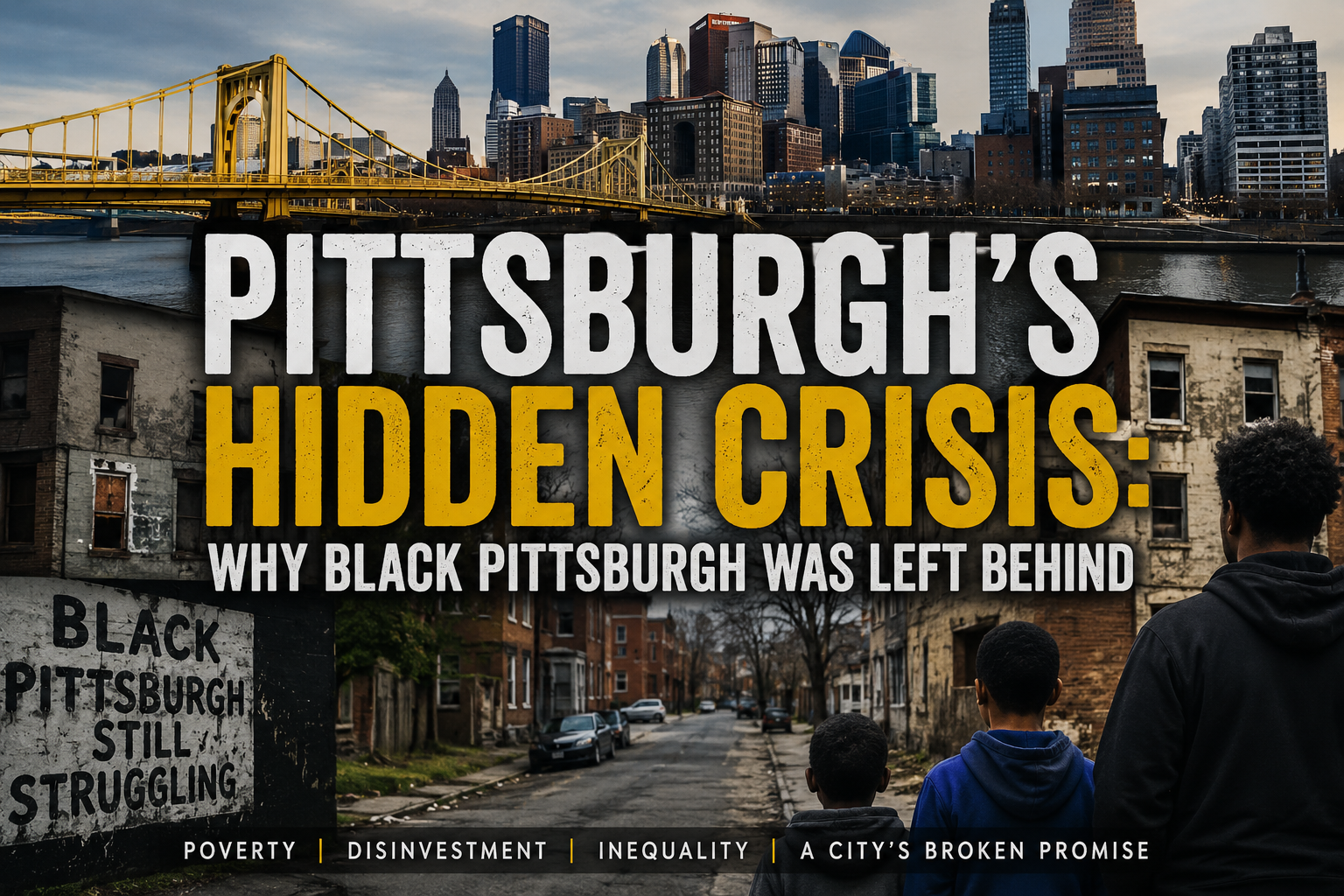
Pittsburgh loves to tell its comeback story.
The city talks about technology, hospitals, universities, sports teams, riverfront development, new restaurants, and billion-dollar institutions. From the outside, Pittsburgh looks like a city that reinvented itself after the collapse of steel.
But there is another Pittsburgh. A black Pittsburgh. And that Pittsburgh has not experienced the same comeback. For many black residents, Pittsburgh is not a national success story. It is a case study in how a city can modernize while leaving its black population behind.
This is not just about poverty. It is about power. It is about ownership. It is about neighborhoods that once had culture, business, identity, and influence being stripped down through decades of redlining, urban renewal, highway construction, disinvestment, school inequality, mass incarceration, job loss, and political neglect.
Pittsburgh does not have a Black Wall Street. It does not have a Harlem. It does not have an Atlanta-style Black professional class with major neighborhood influence. It does not have a Prince George’s County-type black middle-class engine. What Pittsburgh has instead are historically black communities that have been asked to survive without the same level of investment, protection, or opportunity given to other parts of the city.
Homewood. The Hill District. Larimer. Beltzhoover. Knoxville. Garfield. East Hills. Wilkinsburg. Parts of Penn Hills. Parts of the Mon Valley. These communities are not poor because black people lacked talent, ambition, intelligence, or work ethic. They are poor because systems were built around them, against them, and sometimes directly through them.
The Hill District was once one of the most important black cultural neighborhoods in America. Jazz legends performed there. Black businesses operated there. Families lived there. Churches, clubs, barbershops, newspapers, and community institutions gave the neighborhood identity. Then came urban renewal. The Civic Arena project displaced thousands of residents and destroyed a large part of the neighborhood’s economic foundation.
Homewood tells a similar story. Once a stable and mixed-income community, it became home to many black families displaced from other parts of the city. Over time, jobs disappeared, schools struggled, businesses left, housing declined, and violence increased. The people did not fail the neighborhood. The neighborhood was failed by policy, economics, and neglect. That is the part people often miss.
When people talk about poverty in black Pittsburgh, they usually talk about crime, broken families, drugs, or bad decisions. But they rarely talk about banks refusing loans. They rarely talk about black families being locked out of homeownership. They rarely talk about black neighborhoods being cut off from grocery stores, quality schools, transportation, healthcare, and business capital. They rarely talk about how wealth is created in America through property, ownership, inheritance, and access — and how black Pittsburgh was denied those tools for generations.
Poverty is not just about income. Poverty is about being disconnected from opportunity. That is why Pittsburgh’s racial inequality is so disturbing. This is a city with world-class hospitals, but black people still face major health disparities. This is a city with elite universities, but many black neighborhoods still lack direct pipelines to those institutions. This is a city with major foundations, banks, developers, and corporations, but black communities often remain the last to receive meaningful investment.
The question is not whether Pittsburgh has successful black people. It does. The question is whether Pittsburgh has black power at scale.
Does black residents own enough land?
Does black businesses receive enough contracts?
Does black neighborhoods control development?
Does black children have equal access to quality education?
Does black families have pathways into the city’s new economy?
Does black communities have political influence equal to their history and struggle?
The honest answer is no.
Pittsburgh’s problem is not simply that black people are poor. The deeper problem is that black poverty here has been normalized. People expect certain neighborhoods to struggle. They expect certain schools to underperform. They expect certain communities to have violence. They expect black families to keep adjusting to less. That expectation is part of the racism.
A city cannot call itself progressive while its black residents remain trapped at the bottom of nearly every major quality-of-life measure. A city cannot brag about livability if that livability does not include black people. A city cannot celebrate development if development only means pushing poor people out instead of building them up.
The future of Pittsburgh depends on whether the city is willing to tell the truth. Black Pittsburgh does not need more speeches. It needs ownership. It needs investment. It needs grocery stores, banks, quality schools, safe housing, mental health services, youth programs, job pipelines, business grants, land protection, and real political accountability.
Most importantly, black Pittsburgh needs power. Because poverty is not just the absence of money. It is the absence of control. And until black Pittsburgh has control over land, business, education, development, and political direction, the city’s comeback story will remain incomplete. Pittsburgh did not become one of the hardest places in America for black people by accident. And it will not become a better place for black people by accident either.