
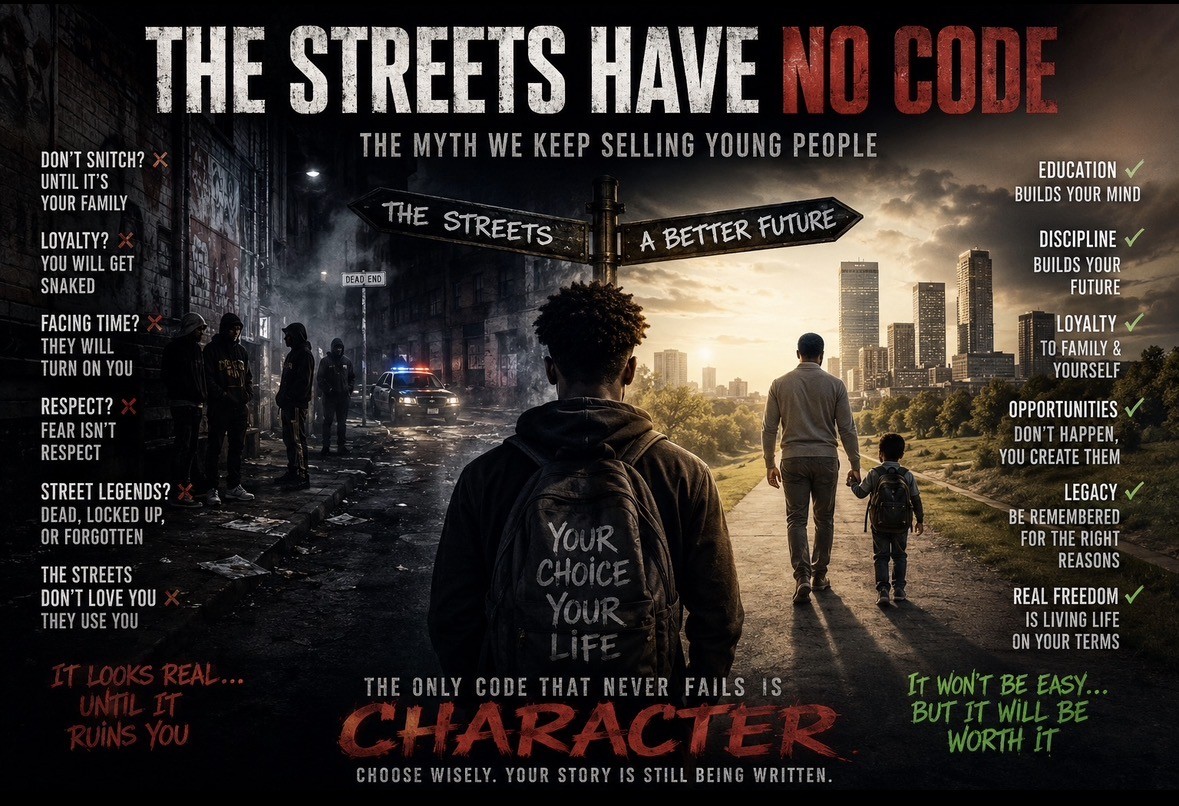
For generations, people have talked about “the streets” as if they operate under a sacred code of honor. Don’t snitch. Be loyal. Never fold. Stand on business. Protect your people.
It sounds noble. It sounds honorable. It sounds like a system built on respect.
The reality is often very different.
The streets are one of the greatest myths ever created. People say “don’t snitch” until the victim is their brother, sister, son, daughter, or best friend. Suddenly they want witnesses to come forward. Suddenly they want surveillance footage. Suddenly they want arrests. The code changes when the pain becomes personal.
People preach loyalty, yet betrayal is one of the most common currencies in street life.
Friends rob friends. Business partners steal from each other. People set up the very individuals they once called family. Jealousy often destroys relationships long before outsiders ever do. The same person you risk your freedom for today may disappear tomorrow when you need them most.
Then comes the courtroom.
One of the biggest illusions is believing everyone will “keep it solid.” Reality says otherwise. When decades in prison become real. When someone is facing life sentences. When prosecutors begin offering plea deals. When families start crying. Many people who once promised, “I’ll never tell,” suddenly begin cooperating. Not because they’re uniquely evil. Because survival is one of the strongest human instincts.
The street code often collapses the moment real consequences arrive. That’s because the streets were never built on principles.
They were built on circumstances.
People also glorify reputation. Respect in the streets is often temporary. Fear isn’t respect. Popularity isn’t loyalty. A name in the neighborhood doesn’t guarantee peace, wealth, happiness, or a future. Many of the people who were considered legends in the streets are either dead, incarcerated, addicted, or forgotten. Meanwhile, the people who quietly chose education, business, skilled trades, entrepreneurship, or family rarely receive the same attention, yet they’re the ones building lasting legacies.
Perhaps the biggest contradiction is this: The streets tell young people to never cooperate with law enforcement, yet demand justice whenever violence touches their own family. They condemn informing when it affects someone else. They celebrate accountability when it affects them.
Those two beliefs cannot exist together without contradiction.
None of this is meant to judge people who grew up in difficult environments. Many had limited opportunities and impossible choices. But we should stop romanticizing a lifestyle that has buried countless young men and women. The streets don’t love anyone. They don’t provide retirement plans. They don’t offer health insurance. They don’t visit you every weekend in prison. They don’t raise your children after you’re gone.
In the end, the so-called street code isn’t nearly as consistent as people claim.
The only code that truly survives is character. Because real integrity isn’t determined by what happens on the corner. It’s determined by who you are when no one is watching, when life gets hard, and when keeping your principles costs you something. That code doesn’t disappear when the pressure arrives.
That’s what makes it real.