
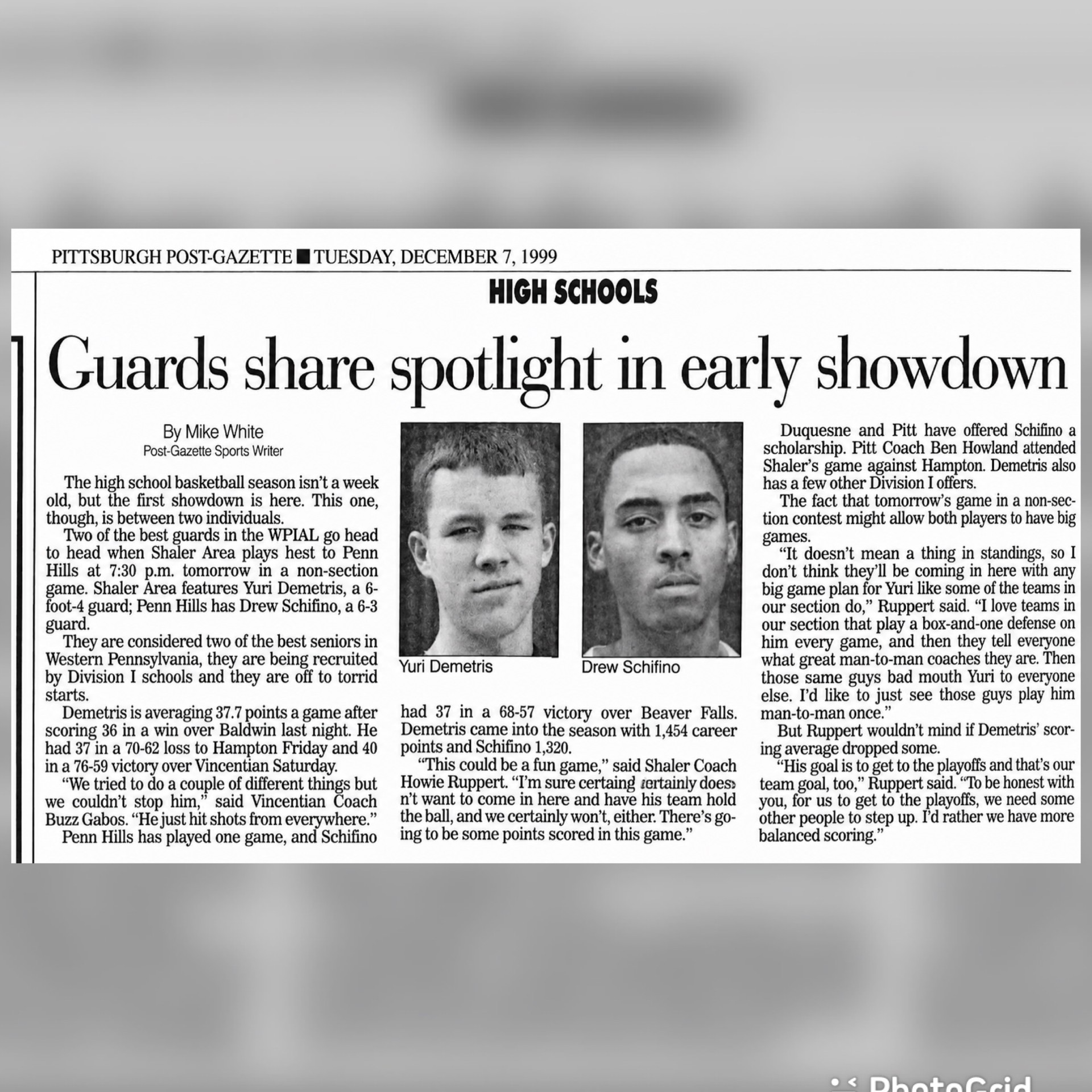
Long before social media, mixtapes, and national recruiting rankings became part of high school basketball, Western Pennsylvania already had its own must-see matchups..
One of the biggest came in December 1999. Penn Hills. Shaler. Drew Schifino. Yuri Demetris.
The Pittsburgh Post-Gazette called it an early-season showdown between two of the best guards in the WPIAL. Looking back more than 25 years later, it’s crazy to think about how much attention that game received before the season was even a week old.
Yuri was already putting up ridiculous scoring numbers at Shaler. I was leading Penn Hills and coming off a season that had already made me one of the most heavily recruited guards in the state.
The game wasn’t just about two schools. It was about two players trying to prove they were the best guard in Western Pennsylvania.
What I respected most about Yuri was that he could flat-out score. He had confidence, wasn’t afraid of the moment, and every defense knew he was getting the ball but still had trouble stopping him.
Iron sharpens iron. That’s what made that era special. There wasn’t any social media hype. You earned your reputation on the court. If people wanted to see who was better, they showed up to the gym.
Looking back now, it’s amazing how quickly time passes. We were just kids chasing our dreams. Now we’re old enough to reflect on those moments and appreciate what we were part of.
The WPIAL has had plenty of great guards, but for one night in December 1999, the spotlight belonged to two seniors who were trying to leave their mark on Pittsburgh basketball.
Twenty-five years later, I think it’s only right that we tell the story together.
Q&A with Drew Schifino & Yuri Demetris
Q: When you heard you would be facing each other in one of the biggest early-season games in the WPIAL, what was going through your mind?
Drew: I was excited more than anything. I knew how talented Yuri was because I had played with and against him growing up. At the time, we were ranked No. 1 and No. 2 in the WPIAL scoring race, so there was a lot of anticipation surrounding the matchup. As a competitor, you live for games like that. I wanted to perform at a high level, represent Penn Hills, and put on a show for the fans who came out to watch two of the area’s top scorers go head-to-head.
Yuri: It was an exciting matchup for everyone involved. Penn Hills had you and a great team that season, so it was an opportunity to play against a great team in front of an excited home crowd. Lots of people came to see that game! I was focused on making sure both myself and the team were ready to compete.
Q: Did you view the matchup as a personal challenge, or was it just another game?
Drew: I wouldn’t say it was a personal challenge because there was always a lot of respect between us. However, I knew I had to bring my best because Yuri was capable of having a huge night against anybody. Shaler also had a very good team around him, so it wasn’t just about stopping one player. It was one of those games where you knew the margin for error was small, and you had to be locked in from the opening tip.
Yuri: At that age, I think we viewed every game against the better players in the area as a personal challenge. We wanted to represent ourselves and our communities because transfer situations and super teams did not seem as prevalent back then. There was no social media; we just had friendships that were built from growing up and playing together. We had played together from our days with Karl Kohlman’s Pittsburgh Basketball Club as young kids to being roommates at ABCD Camp during our junior year, so I absolutely wanted to play well.
Q: What do you remember most about each other’s game?
Drew: Yuri was an elite scorer and one of the best shooters I faced during my high school career. When he got into a rhythm, it felt like he couldn’t miss. Because I had played with him growing up, I knew exactly how dangerous he was offensively and how quickly he could take over a game. As for my game, I was an aggressive scorer who constantly attacked the basket. I was a slasher who put pressure on defenses every possession. My mindset was always to stay in attack mode, get downhill, and force teams to adjust to what I was doing. I wanted to make defenders uncomfortable from the opening tip until the final buzzer.
Yuri: You were a smooth scorer of the basketball. You had an effortless approach to attacking and getting by defenders whenever you wanted to score. As you got older, you also developed the ability to shoot the basketball, which added another dimension that defenses had to deal with. I was more of a shooter, but we both did a great job of putting the ball in the basket during that era.
Q: Looking back, what made WPIAL basketball in the late ’90s so special?
Drew: The late ’90s were a special era because of the incredible talent and the intensity of the rivalries. There were Division I players all over Western Pennsylvania, and every night felt like a major event. What made it even more unique was that there was no social media, livestreams, or highlights available instantly. If you wanted to see the best players and biggest games, you had to show up in person. The gyms were packed, the atmosphere was electric, and the rivalries meant everything to the players and communities involved.
Yuri: I believe the four classifications created more competition and balance. In my opinion, sections were more balanced from top to bottom, with tough teams across the board. Then, come playoff time, you had to battle through brackets filled with quality opponents. AAU also didn’t have as many tournaments and games, and there weren’t nearly as many exposure camps or invitation-only events. This allowed summer leagues and camps throughout Pittsburgh to be highly attended and extremely competitive. This may sound nostalgic but not having social media and having to read the newspaper to see results, standings, player rankings, and other news made the experience different. You became more familiar with everyone who was competing and who was performing well. There was just something special about sitting down and reading the paper to see your results. Of course, it also helped that there were so many great players during that era.
Q: Who were some of the toughest players you faced during your high school career?
Drew: There were so many great players during that era that it’s hard to name everyone. Yuri Demetris was obviously one of the toughest because of his scoring ability. Dave Young, Rod Rutherford, Brandon Fuss-Cheatham, Tutu Ferguson, and Jim Horan were all outstanding players who could impact a game in different ways. The WPIAL was loaded with talent at the time, so it seemed like every week you were facing another player who had the ability to dominate a game.
Yuri: Drew Schifino, Dave Young, Brad Midgley, Brandon Fuss-Cheatham, Chaz McCrommon, and Carlo Dorazio. Also, all of the older Future Stars players from Ozanam. I’m sure I’m leaving out some great players, so a shoutout to them as well!
Q: How did that game impact your confidence for the rest of the season?
Drew: Honestly, it didn’t have much impact on my confidence because I already believed in myself. Whether we won or lost, my mindset wasn’t going to change. We ended up losing that game, but I still finished with around 42 points. I’ve always been confident in my abilities, and one game was never going to define how I felt about myself as a player. Even on nights when I didn’t play my best, I still believed I could bounce back and have a great performance the next time out.
Yuri: It gave both our team and me the belief and confidence that we could compete with the best. We played a tough schedule during my senior year, so it was always fun to test ourselves against some of the top teams in the area.
Q: What do you think today’s players could learn from your era of basketball?
Drew: Mental toughness. In our era, there weren’t social media followers, rankings updates every day, or constant outside opinions. You had to handle adversity, criticism, and pressure without looking for validation online. Players learned how to fight through tough games, tough practices, and difficult situations. Talent is important, but mental toughness is what separates good players from great players over the long run.
Yuri: You don’t have to travel across the country or spend a ton of money to develop your game and reach your goals. Putting in the daily work, staying committed, and having someone who believes in you and is willing to invest time in your development is incredibly important. That’s how you build the skill set necessary to play in college and beyond. Playing in competitive pickup games against older, better players and attending tough workouts with dedicated people who were willing to challenge you was how most of us developed back in the day.
Q: Is there a memory from that game or that season that still makes you smile today?
Drew: The biggest memory from that season is winning the WPIAL championship. That’s what every player dreams about when they start high school basketball. Another accomplishment I’m proud of is setting the WPIAL playoff scoring record with 147 points over four playoff games. Individual accomplishments are nice, but being able to combine personal success with a championship run makes those memories even more meaningful.
Yuri: So many memories! As I get older, both the good and the bad make me smile because high school basketball during that era was amazing and so much fun. I still love going to WPIAL games, especially playoff games, and rooting for Western Pennsylvania kids when they move on to play in college or beyond. But if I had to pick one memory, it would probably be coming out before a big home game and getting hyped before the layup lines. The atmosphere was electric.
Q: When you look back now, what are you most proud of from your high school career?
Drew: Without question, bringing a WPIAL championship to Penn Hills. Individual awards, scoring records, and recognition are great, but championships are what people remember. Being able to help lead my school to a title and give the Penn Hills community something to celebrate is what I’m most proud of. That’s a legacy that lasts much longer than any statistic.
Yuri: Play every game like it could be your last. Don’t get too high or too low, regardless of the results, and keep putting in the work. The ball stops bouncing sooner than you think—or want it to. Have fun, enjoy your success, and then get back to work.