
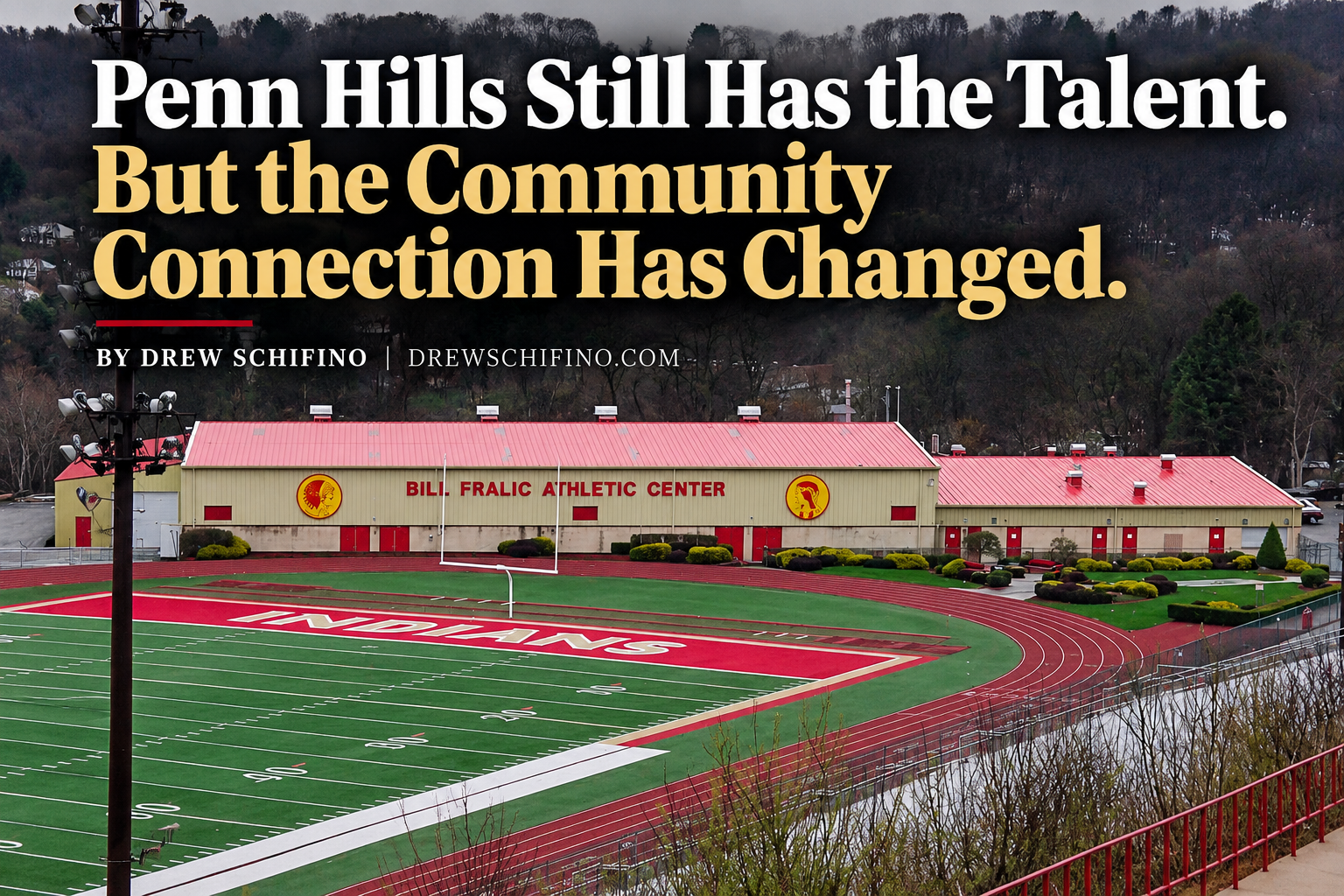
I think about Penn Hills sports a lot. Probably because I lived it.
When you grow up in Penn Hills, play there, understand the history and remember what those games used to feel like, you notice when something changes.
And something has definitely changed.
Penn Hills still has athletes. That has never been the problem.
There is still talent walking those hallways. There are still kids capable of playing college sports. There are still football and basketball teams capable of making noise.
But the connection between the community and the sports programs doesn’t feel the same anymore. And I think one of the biggest reasons is that Penn Hills has become such a transient community.
It Used to Feel Like Everybody Was Connected
The Penn Hills I grew up in felt different.
Families had roots. You knew somebody’s older brother because he played before you. Then the younger brother came through behind him.
Parents knew other parents. Former players came back to games. Kids grew up hearing about the great Penn Hills teams and players before them.
You didn’t just put on a Penn Hills uniform when you got to high school. You understood what came with it. There was history attached to that uniform.
When I played basketball at Penn Hills, I understood there were great players before me. Football players understood the tradition they were stepping into too.
That history created pride. And pride created expectations.
That’s Harder to Build When People Are Constantly Moving
Penn Hills today is a very transient community.
Families move in. Families move out. Kids can arrive in the district without having grown up around Penn Hills athletics or knowing much about the people who came before them.
That’s not the kids’ fault. It’s just a different community structure. And when you have that much movement, maintaining a sports culture from generation to generation becomes harder.
Look at some other Western Pennsylvania communities and you’ll see families with deep roots in the same school district.
Grandfather played there. Dad played there. Son plays there. Uncles and cousins are in the stands. Former players still live five minutes away. Everybody knows the history because the history is sitting in the bleachers. That creates something you can’t manufacture with uniforms, facilities or social media.
It creates identity.
Penn Hills Used to Have That
There was a time when Penn Hills athletics felt like an extension of the community itself.
Football games mattered. Basketball games mattered.
You knew the players. You knew their families. You knew the coaches. Young kids wanted to become the next great Penn Hills athlete because they actually saw those guys around the community.
That’s how tradition survives. It’s passed down.
The older generation tells the younger generation who came before them and what Penn Hills represented. But when communities change and people become less rooted in one place, some of that history gets lost.
A kid can be a great athlete at Penn Hills today and have no idea who some of the greatest Penn Hills athletes were.
Again, that’s not criticism of the kid. Who’s teaching him? Who’s keeping that history alive?
Sports Programs Need More Than Talent
This is something I think people miss when discussing high school sports.
Talent matters. Coaching matters. Facilities matter. Youth programs matter.
But community matters too. Maybe more than people realize.
The strongest high school programs usually have an identity that stretches beyond one particular team.
Kids grow up wanting to play for that school. Former players remain involved. Parents take pride in the program. Youth coaches understand what the varsity program expects. Everybody feels like they’re part of the same thing.
When those pieces become disconnected, you can still have good teams.
You can still have great players. You can still win championships. But it doesn’t necessarily feel like a program belongs to the entire community anymore.
That’s the difference.
Penn Hills Has Too Much History to Lose It
That’s really why I write so much about Penn Hills history.
I’m not living in the past. I’m trying to make sure the past isn’t forgotten.
Penn Hills has produced too many great athletes, coaches and teams for younger generations not to know about them.
That history should be an advantage.
A kid wearing Penn Hills across his chest should know he’s representing something bigger than that particular season.
He should know about the championships. He should know about the legends. He should know about the people who packed those stands long before he got there.
And former Penn Hills athletes have a responsibility in that too. We can’t complain that young people don’t know the history if nobody teaches it to them.
Maybe That’s How You Rebuild the Connection
Penn Hills isn’t going to become the Penn Hills of 1975, 1985, 1995 or 2000 again.
Communities change. Demographics change. Families move.
That’s reality.
But you can still intentionally build culture.
Bring former athletes back. Connect the youth programs with the high school. Celebrate the history. Honor great teams. Put former players in front of current players. Make young athletes understand that they’re joining a tradition rather than simply joining a team. Give families a reason to feel invested.
Because Penn Hills still has something a lot of places would love to have: A name that means something in Western Pennsylvania sports.
The talent hasn’t disappeared. The history definitely hasn’t disappeared.
What’s been lost, at least to me, is some of that connection between the community and the programs.
And maybe the next chapter of Penn Hills athletics isn’t about trying to recreate the past. Maybe it’s about figuring out how to connect the Penn Hills of today with the Penn Hills that came before it.
Because once you know the history, you understand why that PH on your chest means so much.