
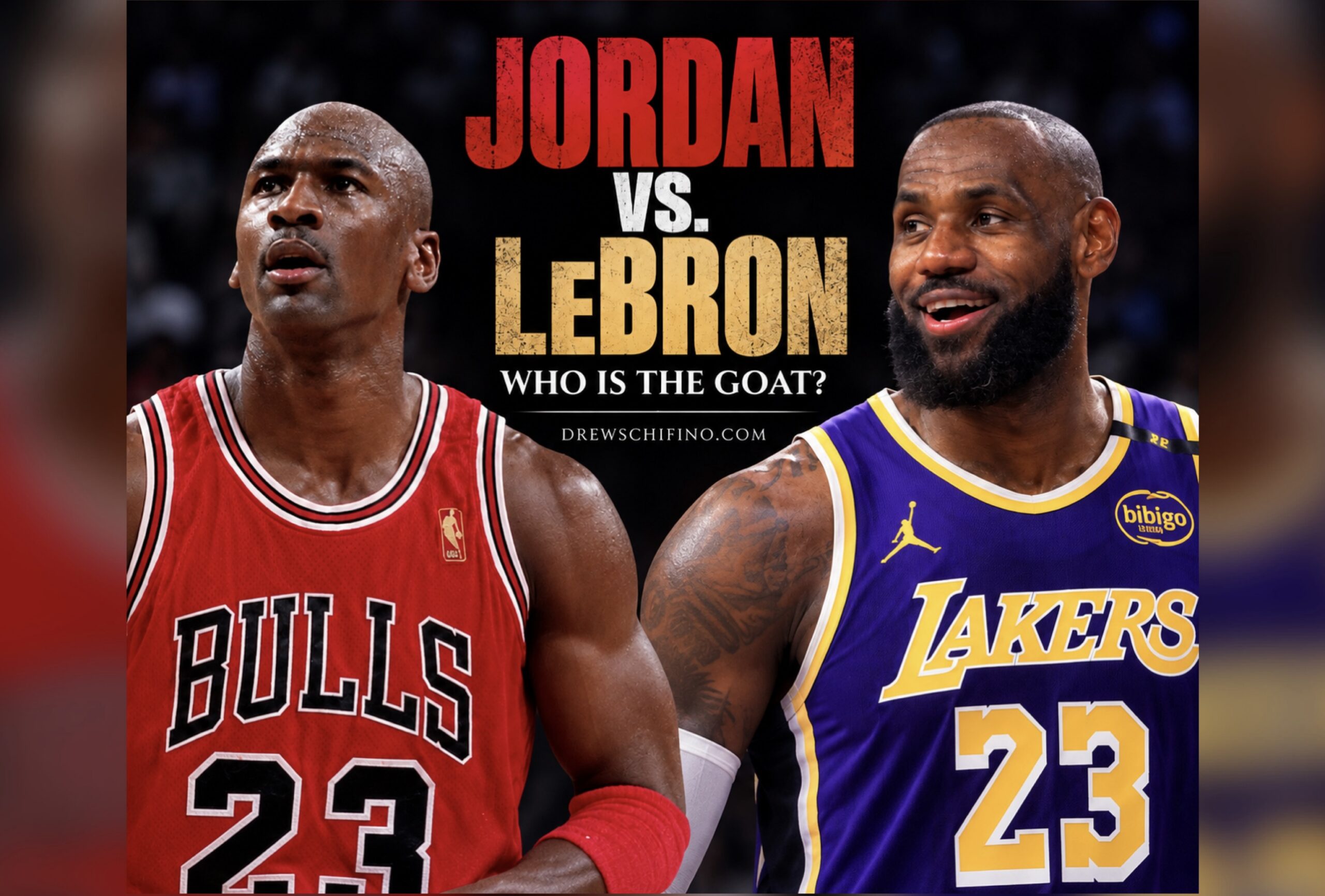
We’ve been having the same basketball argument for years.
Michael Jordan or LeBron James? Who is the GOAT?
Everybody has their answer.
Jordan fans will tell you six championships, six Finals MVPs, 6–0 in the NBA Finals, killer mentality, scoring titles and dominance.
LeBron fans will tell you all-time scoring record, longevity we’ve never seen before, Finals appearances with different franchises, one of the greatest all-around statistical résumés ever and dominance across multiple eras of basketball.
Here’s where I’ve gotten with the argument: I’m not sure there is a right answer.
Because at some point we have to admit that we’re comparing two players who played under different rules, in different styles, with different teammates, against different competition, with different sports science and in completely different versions of the NBA.
You can make a legitimate case for Michael Jordan. You can make a legitimate case for LeBron James. And you can poke holes in both cases.
That’s why I think the GOAT conversation is much more subjective than people want to admit.
THE CASE FOR MICHAEL JORDAN
Let’s start with the obvious.
Six NBA championships. Six trips to the Finals. Six championships. Six Finals MVPs.
That’s ridiculous.
When Jordan finally got to the biggest stage, he never left without the trophy. There is something powerful about that.
He didn’t just win championships either. He became the central figure of two separate three-peats.
Then after retiring, playing baseball and coming back: Think about how difficult it is to win three championships in a row.
Jordan did it twice.
Jordan Wasn’t Just a Scorer
Sometimes people reduce Jordan to being the greatest scorer ever.
He was much more than that. He won 10 scoring titles.
But he was also a nine-time All-Defensive First Team selection and the 1988 Defensive Player of the Year.
That matters in this conversation.
Jordan could dominate a game offensively and then turn around and guard one of the opponent’s best perimeter players.
At his peak, you weren’t talking about somebody who was great on one end of the floor.
You were talking about complete dominance.
His Peak Was Almost Untouchable
This is probably Jordan’s strongest GOAT argument to me.
Maybe LeBron has the longevity argument.
But Jordan’s peak? Good luck.
From the late 1980s through the 1990s, there were stretches where Jordan basically owned the league.
Everybody knew who the best player was. Everybody knew Chicago was coming. And once the Bulls became championship-ready, nobody knocked Jordan off the mountain in the Finals.
There’s something to be said for reaching a level where your era starts feeling like it belongs to you.
Jordan did that.
BUT LET’S TALK ABOUT THE KNOCKS ON JORDAN
This is where some Jordan fans get mad.
People talk about Michael Jordan’s career like it began in 1991. It didn’t.
Jordan entered the NBA in 1984. He didn’t win his first championship until 1991.
That doesn’t diminish what he eventually accomplished.
But if we’re going to use LeBron’s entire career against him, then we have to discuss Jordan’s entire career too.
What About the Years Before the Six Championships?
Jordan lost in the first round three straight years to begin his playoff career. His Bulls were swept twice by Larry Bird and the Boston Celtics.
Then Detroit became the wall.
The Pistons eliminated Chicago three consecutive postseasons from 1988 through 1990. Eventually Jordan and the Bulls broke through and swept Detroit in 1991.
But context matters on both sides.
People sometimes say Jordan “beat everybody.”
No.
He eventually beat Detroit. He never beat Bird’s Celtics in a playoff series.
And by the time Chicago finally got through Detroit, that Pistons championship group was reaching the end of its run.
That doesn’t mean Jordan’s championship is somehow fake.
That’s ridiculous.
But if we’re examining LeBron’s competition down to the smallest detail, Jordan’s competition deserves the same examination.
The Magic Johnson Argument Needs Context Too
Jordan beat Magic Johnson and the Lakers in the 1991 NBA Finals.
That absolutely counts.
But that wasn’t the Showtime Lakers at their absolute peak. Magic was still an elite player, but Kareem Abdul-Jabbar was gone and the Lakers dynasty of the 1980s was ending.
Again, this isn’t about taking the championship away.
It’s about context.
We Forget Washington Jordan
This is another thing people conveniently erase.
Michael Jordan played for the Washington Wizards. Those seasons count too.
He was still productive, especially considering his age, but he wasn’t the Chicago Michael Jordan. The Wizards didn’t make the playoffs in either of his seasons.
Nobody holds those years against Jordan the way people dissect every season of LeBron’s career.
And maybe they shouldn’t. Jordan was 38, 39 and 40 years old.
But that’s exactly my point.
Why do we understand age when discussing Washington Jordan but sometimes forget it when discussing older LeBron?
“JORDAN WAS 6–0. LEBRON IS 4–6.”
This is probably the most famous argument in the entire debate.
Jordan was 6–0 in the Finals. LeBron is 4–6.
If championships are your ultimate measurement, Jordan has a massive advantage.
I understand that argument.
But here’s my problem. Why is losing before the Finals somehow better than losing IN the Finals?
Think about that.
Jordan’s six championships deserve every bit of praise they receive. But his career wasn’t six seasons long. There were years his teams lost before reaching the Finals. Those losses don’t disappear simply because they aren’t part of a Finals record.
Meanwhile, LeBron reaching 10 NBA Finals gets turned into an argument against him because he lost six of them.
That has never completely made sense to me.
The Case For Lebron James
LeBron’s strongest argument might be something we’ve simply never seen before.
Longevity at an elite level.
There’s a difference between playing 20-plus NBA seasons and still being one of the most productive players in basketball after 20-plus NBA seasons.
Plenty of great players hung around toward the end.
They became role players. Their minutes dropped. Their production fell off a cliff.
LeBron hasn’t aged like that. That’s what people don’t appreciate enough.
We keep comparing old LeBron to young LeBron instead of comparing old LeBron to every other old player in NBA history.
People will say: “LeBron isn’t what he used to be.”
Of course he isn’t. But that’s the wrong comparison.
Why are we comparing a player in his 40s to the 27-year-old version of himself? Compare him to other players at that age. That’s when you understand how ridiculous his longevity really is.
Has LeBron Declined?
Of course. Every athlete eventually declines.
The question is how much? That’s where LeBron is different.
The fact that we can even debate whether a man in his 40s has dramatically declined tells you something.
His athleticism isn’t what it was in Miami. His defensive motor isn’t what it was at his absolute peak. He can’t dominate every possession physically the way he once could.
But he has adjusted his game.
He’s become a better shooter. He’s become smarter. He understands pace. He understands angles. He knows how to conserve energy.
That’s part of greatness too.
Lebron’s 10 Finals Appearances Matter
Ten NBA Finals appearances is absurd.
Eight consecutive from 2011 through 2018. And he reached the Finals with Cleveland, Miami and the Lakers.
Now let’s acknowledge the criticism.
The Eastern Conference wasn’t always great during those years. That’s fair.
There were seasons where the road through the East was easier than what teams faced in the West. But you still have to win.
Year after year.
Different teammates. Different coaches. Different circumstances. And once LeBron got to the Finals, several times he ran into teams that were simply better.
Look at Some of Those Finals
In 2007, a 22-year-old LeBron took Cleveland to the Finals against San Antonio.
The Spurs were better.
In 2015, Cleveland lost Kevin Love and Kyrie Irving was injured in Game 1 of the Finals against Golden State. In 2017, LeBron faced a Warriors team with Stephen Curry, Kevin Durant, Klay Thompson and Draymond Green. In 2018, he faced them again.
We’re really going to look at all six Finals losses exactly the same?
I can’t. Context has to matter.
But Lebron Has Knocks Too
If we’re being fair to Jordan, we have to be fair to LeBron. And LeBron has blemishes on his résumé.
The biggest one is obvious. 2011 Dallas.
There is no explaining that one away. Miami was talented enough to win the championship. LeBron was in his prime. And by his standards, he did not perform well enough in that Finals.
Dallas deserves credit. Dirk Nowitzki deserves credit.
But if you’re arguing LeBron as the greatest player ever, 2011 is absolutely something the Jordan side can bring up.
Jordan never had a Finals series like that. That’s a legitimate point.
LeBron Built Superteams Too
LeBron fans can’t pretend this part doesn’t exist.
He left Cleveland to join Dwyane Wade and Chris Bosh in Miami. Later, Cleveland put Kyrie Irving and Kevin Love around him. Then Los Angeles eventually paired him with Anthony Davis.
Jordan had great teammates too. Scottie Pippen is one of the greatest two-way players ever. Dennis Rodman is a Hall of Famer. Chicago had excellent role players and Phil Jackson.
But LeBron’s willingness to move teams and help construct championship situations is part of his legacy.
Whether you consider that a negative is subjective. But it’s part of the discussion.
Lebron Also Had A Head Start
This matters when discussing career totals.
LeBron entered the NBA at 18. Jordan entered at 21 after playing at North Carolina.
So when we compare cumulative numbers, LeBron had roughly three additional NBA seasons available at the beginning of his career.
That’s important context.
But here’s the other side: You still have to survive long enough to take advantage of it.
Coming into the NBA at 18 doesn’t guarantee you’re going to remain elite into your 40s.
The head start helps explain some of the enormous career totals. It doesn’t explain all of them.
The Eras Make This Almost Impossible To Compare
This is where the debate gets complicated.
People love saying Jordan’s era was more physical.
It was. Certain types of contact were tolerated then that aren’t tolerated now. The paint could be brutal.
But today’s NBA presents different challenges.
The floor is stretched. Players cover enormous amounts of space defensively. Big men have to defend guards 25 feet from the basket. Defenders are constantly navigating screens, switches and shooters.
Today’s game might involve less wrestling and body contact, but that doesn’t automatically mean it’s less demanding physically.
It’s demanding in a different way.
And Yes, Today’s Stats Are Inflated
We have to acknowledge this too.
Teams shoot far more threes. Offenses are designed for efficiency. Scoring has exploded. There are seasons where numbers that once looked extraordinary seem almost normal.
More possessions and more three-point attempts create more opportunities for points and assists. Spacing makes driving lanes different. So comparing raw statistics from 1992 to raw statistics from 2026 without context doesn’t make much sense. But we also have to be careful with the nostalgia.
Jordan played in some seasons where NBA pace was faster than people remember. Not every game in the 1980s and 1990s finished 88–84.
That’s another reason these conversations require more than repeating talking points from social media.
Sports Science Changed Everything
This is one of the most overlooked parts of comparing generations.
Training has changed. Recovery has changed. Nutrition has changed. Medical treatment has changed. Travel has improved. Players have personal trainers, chefs, advanced imaging, load-management data and recovery technology previous generations couldn’t access.
When a player reached his 10th NBA season decades ago, his body might have accumulated wear differently than a player reaching Year 10 today.
That’s why simply saying, “Player X was only 32,” doesn’t tell the whole story when comparing generations.
But that argument works both ways.
Jordan didn’t have today’s recovery technology. LeBron also has had to maintain his body through an unprecedented amount of NBA mileage.
Both deserve credit for surviving the circumstances of their eras.
Jordan’s Best Argument: Peak Greatness
If somebody tells me Jordan is the GOAT because his peak was greater, I understand it.
Six championships. Six Finals MVPs. Five regular-season MVPs. Ten scoring titles. Defensive Player of the Year. Nine All-Defensive First Team selections. Two three-peats.
He reached the mountaintop and basically owned it.
That’s a hell of an argument.
Lebron’s Best Argument: Total Greatness
If somebody tells me LeBron is the GOAT because nobody has combined this level of production, versatility and longevity for this long, I understand that too.
He has been an elite scorer. Elite passer. Elite rebounder for his position.
At his defensive peak, he could guard multiple positions. He has won championships with three franchises. And his career has lasted so long that we’ve watched different generations of stars come and go while he remained relevant.
That’s a hell of an argument too.
So Who Is The GOAT?
I think that’s where people get frustrated with me. Because I don’t know if there is one answer.
If your definition of greatness is highest peak and championship dominance, you’re probably picking Michael Jordan. If your definition is longevity, versatility and sustained elite production, you might pick LeBron James. If you value Finals perfection, Jordan wins. If you value repeatedly getting your team to the Finals, LeBron has an argument. If you value scoring dominance, Jordan has an argument. If you value all-around statistical accumulation, LeBron has an argument.
And neither side has to be stupid, young, old or biased for seeing it differently.
Greatness Isn’t A Math Equation
That’s ultimately why I think the GOAT debate will never end. We’re trying to turn something subjective into something objective.
There isn’t a formula where six championships equals 37 GOAT points and 10 Finals appearances equals 31.
What do you value?
Peak? Longevity? Championships? Statistics? Defense? Competition? Versatility? Cultural impact? Era?
Your answer to those questions probably determines your GOAT before you ever say Jordan or LeBron.
Michael Jordan has flaws in his résumé. LeBron James has flaws in his résumé.
Jordan fans shouldn’t erase everything before 1991 or Washington. LeBron fans shouldn’t pretend 2011 didn’t happen or act like every Finals loss was completely out of his control.
Tell the whole story. Then make your choice.
For me, that’s what makes this debate great.
Michael Jordan may be the greatest peak we’ve ever seen. LeBron James may be the greatest example of sustained excellence we’ve ever seen.
And depending on what you value more, either one can be your GOAT.
Maybe that’s the answer nobody wants to hear.
The GOAT isn’t a fact. It’s an argument.
And that’s why Jordan vs. LeBron will probably still be debated long after both of them are gone.