
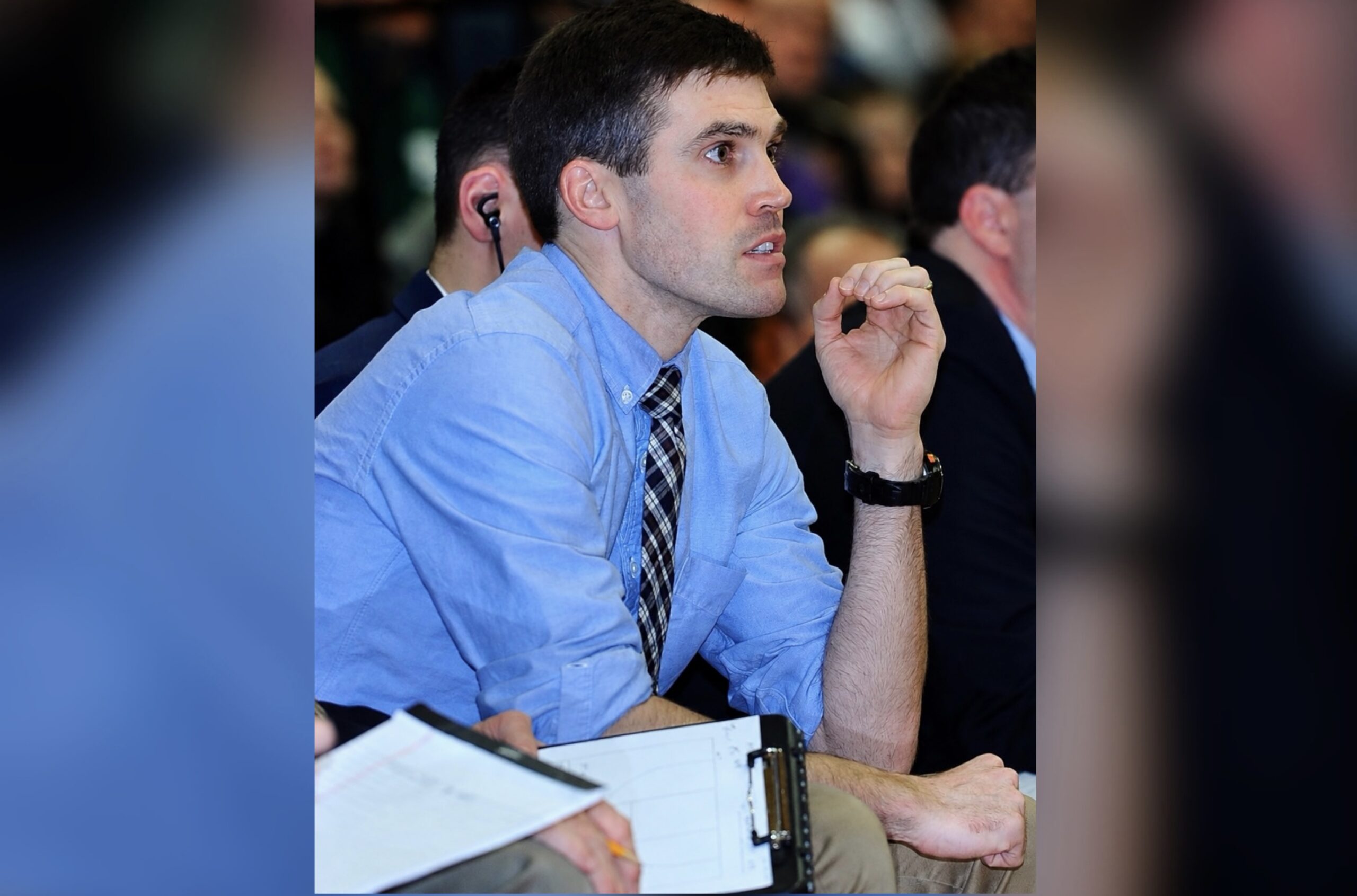
There’s something different about getting the opportunity to lead a program you once played for.
For Tyler Bluemling, Mt. Lebanon basketball isn’t just another coaching job. It’s home.
Bluemling played at Mt. Lebanon before going on to play Division I basketball at Duquesne University. Basketball later took him into coaching, including an opportunity to serve as a graduate assistant under John Beilein at Michigan.
But eventually, the journey brought him right back to where it started. Mt. Lebanon.
Now, after spending years as an assistant under longtime head coach Joe David, Bluemling is taking over one of Western Pennsylvania’s most respected basketball programs.
And he isn’t walking into the job trying to tear down what was there before him.
He wants to continue it.
Following a Legend
Taking over for Joe David isn’t like taking over an ordinary high school basketball program.
David spent 26 years establishing expectations at Mt. Lebanon. Winning became part of the culture, but so did discipline, toughness and playing the game the right way.
Bluemling had a front-row seat for it. In fact, he told me he would have been perfectly happy remaining David’s assistant forever.
But when David decided it was time to step away, Bluemling looked at the opportunity differently. It almost felt like a responsibility.
That says a lot.
Sometimes a new coach comes into a program wanting everybody to immediately know that things are going to be different.
Bluemling doesn’t seem interested in doing that. Why change an identity that works?
The expectations remain the expectations: compete for section championships, compete for WPIAL championships and eventually capture the one prize that has remained elusive, a state championship.
Mt. Lebanon Is Part of Who He Is
There’s also something unique about Bluemling’s connection to the school.
He has spent most of his life in the Mt. Lebanon School District in one capacity or another, as a student, player, teacher and coach.
He understands the community. He understands the kids. Most importantly, he understands what is expected when you put on a Mt. Lebanon basketball uniform.
That gives him something an outside hire couldn’t immediately have. History.
Bluemling says there have only been four head coaches in Mt. Lebanon basketball history before him.
Now he joins that small fraternity.
His Playing Career Shaped His Coaching Philosophy
One thing I found interesting talking with Tyler was how much his own playing career influenced the coach he became.
We actually go back to our AAU days.
When we played AAU together, Tyler was sharing the floor with guys who had different roles and different levels of talent. At Mt. Lebanon, he was expected to score. On the AAU circuit, he had to figure out other ways to impact winning.
Then he went to Duquesne and experienced something else.
He wasn’t always the star. He had seasons when he didn’t play much. He had to learn how to be a role player, a bench player and a good teammate before earning more playing time later in his career.
A lot of former players only know the game through the eyes of the star. Tyler has seen it from just about every seat on the bench.
That matters when you’re coaching high school kids.
The 12th man wants to feel important, too. The kid who isn’t starting needs to understand his role. And the star needs to understand that winning requires more than his points.
Bluemling lived all of it.
The Game Has Changed
We also talked about something I’ve written about often on DrewSchifino.com: how different high school basketball is today compared with our era.
Social media has changed it. AAU has changed it. Transfers have changed it.
Recruiting has changed dramatically. Today, almost every kid has highlights. There are photographers, videographers, mixtapes and social-media pages documenting their careers.
There are positives to that exposure. But Bluemling also sees the downside.
When young players constantly see highlights of themselves, it can create a distorted picture of where they actually are as players. Everybody plays AAU, and sometimes simply being on an AAU team can convince a kid that he should automatically be starting for his high school team.
At the same time, today’s players have resources we could only dream about. A kid can record his jump shot on his phone and study it seconds later. He can find drills from coaches around the world without leaving his bedroom.
When we wanted new drills, we went to basketball camp or watched VHS tapes. Different world.
Some Things Shouldn’t Change
Basketball will continue evolving.
Mt. Lebanon will have different personnel every season. Some years you might have a future Division I player. Other years you might not have anyone taller than 6-foot-4.
That’s high school basketball. You coach the hand you’re dealt.
But Bluemling believes certain things are controllable regardless of talent. Effort. Energy. Enthusiasm. Focus. Fundamentals. Playing together. Playing hard for 32 minutes.
Those things don’t require a scholarship offer.
And when I asked Tyler what he hopes people say about his program five or ten years from now, his answer was simple.
He wants people to say his teams played hard and played disciplined basketball. If that happens, Bluemling believes the winning will take care of itself.
For someone who grew up in the program, played in the program, teaches in the district and spent years helping coach the program, this isn’t really the beginning of Tyler Bluemling’s Mt. Lebanon story.
It’s the next chapter. And now he’s the one responsible for writing it.
Here’s my Q&A with new Mt. Lebanon boys basketball head coach Tyler Bluemling.
Q: You played at Mt. Lebanon, went on to play Division I basketball at Duquesne, and now you’re coming back to lead your alma mater. What does becoming the head coach at Mt. Lebanon mean to you personally?
Tyler Bluemling: Honestly, I was perfectly fine being Joe David’s assistant coach forever. When he decided that he was done, it almost felt like a responsibility to take over and continue what he had created over the last 26 years. I have been in the district for pretty much my entire life as a student, teacher and coach, so I have tremendous pride in Mt. Lebanon in general, but especially the basketball program. There have only been four coaches in Mt. Lebanon basketball history, so it’s an honor to now be part of that small fraternity.
Q: You’re taking over for a legendary coach who built a tremendous tradition at Mt. Lebanon. When you follow somebody like that, do you feel pressure to continue what was built, or are you more focused on maintaining the foundation while putting your own stamp on the program?
Tyler Bluemling: Joe had a ton of success at Mt. Lebanon. The championships and wins aside, he created a culture of success and playing hard. I am taking over a program where the expectations have already been set. Now we just have to continue to work on meeting those expectations. So while there is some weight to following Joe and his success, we will remain focused on the process just like we did when Joe was the coach.
Q: Because you played at Mt. Lebanon, you understand the expectations and culture better than most people walking into a new head-coaching job. How much of an advantage is that?
Tyler Bluemling: It’s a huge advantage. The foundation and expectations are well known. We have expected and demanded a lot out of the kids at Mt. Lebanon, and that will continue. I also know most of the kids before they even get to the high school level because I had a lot of them in class, which is a big advantage when talking about building relationships.
Q: What parts of the Mt. Lebanon basketball tradition do you want to make sure never change under your leadership?
Tyler Bluemling: These have been the expectations that Joe set for Mt. Lebanon for 26 years, and we will continue them: section championships, WPIAL championships and — the white whale — a state championship. We have had some great players and athletes come through Mt. Lebanon, and most of them were multi-sport athletes — Paul Lang, Luke Hagy, Greg “Big City” Gavlik, Andrew Devlin and Eddie Jenkins, to name a few. I hope that tradition of kids playing multiple sports and being successful across the high school sports spectrum continues.
Q: At the same time, every coach has his own personality. When people watch a Tyler Bluemling-coached team, what do you want them to immediately recognize about the way your teams play?
Tyler Bluemling: I hope that people see a group of kids who play hard, play hard together, are fundamentally sound and compete for 32-plus minutes. I come from a teaching background, so I hope that we play like a well-taught team.
Q: You played Division I basketball at Duquesne. How much did your experience as a college player shape the way you see and teach the game today?
Tyler Bluemling: I think college is a great learning experience for so many reasons. I learned a lot at Duquesne. We never had great seasons, but that doesn’t mean that I didn’t learn a ton. Sometimes you learn just as much from the bad seasons as you do from the good seasons. I learned a lot about being a role player, a bench player and being a good teammate. I learned how to make success about more than just playing time. Those experiences of not playing much and then playing a good bit my senior year help me see the game from a lot of different positions within the team. I have seen every role, so I feel like now I am able to make everyone feel important because I have been in each of their positions at some point in my career.
Q: You and I go all the way back to our AAU days. 😂 When we were running around playing AAU basketball, did you ever imagine that one day you’d be the head coach at Mt. Lebanon?
Tyler Bluemling: Both of my parents were teachers and coaches, and all of my siblings coached at various levels from high school to Division I, so I knew at some point I’d get into coaching. My junior year at Duquesne, I thought college coaching might be the route I would go, so I went around to a ton of schools across the country working summer camps. It was probably the best experience I ever had — seeing Stanford, Arizona State, West Virginia, the Naval Academy and some other schools, seeing how their players worked in the offseason and getting a chance to play with them. I did that thinking it was a great way to build relationships, and it ultimately led me to being a graduate assistant with Coach Beilein at Michigan.
Q: What did playing AAU basketball during our era teach you that you still carry with you as a coach today?
Tyler Bluemling: Looking back at high school and AAU, I learned how to be a chameleon. At Mt. Lebanon I was expected to score, but then I’d go play AAU with guys like you, Brandon Fuss-Cheatham, Jack Higgins and guys way more talented than me, so I learned other roles I could fill to get on the court or be impactful for the team. So when I got into coaching, I made a great effort to make sure kids understand the importance of every role on the team.
Q: Mt. Lebanon has always had a reputation for disciplined, intelligent basketball. How do you maintain that identity while adjusting to the way high school basketball is played today?
Tyler Bluemling: I am hoping to keep that identity because those are things that we can control. I can’t control if we have a 6-foot-7 kid coming through Mt. Lebanon or a Division I prospect who can just light it up, but I can control how we play. I am looking to play a style that controls what we can control, makes good reads and shares the ball.
Q: High school basketball has changed dramatically with AAU, transfers, social media and recruiting. What do you think is the biggest challenge for a high school coach in 2026 that coaches 20 years ago didn’t have to deal with?
Tyler Bluemling: I think it is great that the kids get the social-media exposure, the Instagram photos and the video creators who follow their teams around to capture their high school careers, but I also think it creates an illusion for a lot of them. I don’t know if kids can really be honest with themselves when all they see are the highlights and content creation. Every kid plays AAU now, so they all think that because they play AAU, they should be playing or starting for their high school team. That being said, the amount of film and the ability to film themselves with their phone is such a huge advantage that this generation has. Kids can get immediate feedback on their shot form and find any drill under the sun online by using their phone. Unfortunately, a lot of kids aren’t using these resources for that purpose. We used to have to go to camp to find new drills or watch VHS tapes.
Q: When you inherit a program with a winning tradition, there can be a temptation to compare everything you do to the previous era. How important is it for you and your players to establish your own identity?
Tyler Bluemling: I don’t know that we are trying to establish a new identity. Mt. Lebanon isn’t getting many Division I basketball players walking through the doors, so our identity is success with what we have. I learned a lot from Joe David, so I hope to continue to have the same success by holding the kids to the same level of accountability and work ethic.
Q: What type of player fits a Tyler Bluemling basketball team? What qualities do you value beyond just talent?
Tyler Bluemling: The tough part about high school basketball is that you play with the hand you are dealt. Most schools aren’t out recruiting, so those qualities may change from year to year. With that being said, from year to year we have to take care of the things that we can control regardless of the talent level: effort, energy, enthusiasm, focus and fundamentals.
Q: Having played college basketball yourself, what advice would you give a high school player who believes he can play at the next level but may not be getting the recruiting attention he thinks he deserves?
Tyler Bluemling: I don’t envy kids playing high school basketball today who are trying to get recruited. You hear more and more about programs that don’t even recruit high school players. So my advice is to be open to everything. Not everything has to be a high major. There are great lower Division I, Division II and Division III programs. It might not have the “label,” but it’s great basketball. Then, go where you can be you and be successful and happy.
Q: Western Pennsylvania basketball doesn’t always get the national respect that Philadelphia and some other areas receive. Having played here and then at the Division I level, how would you describe the basketball talent in the WPIAL?
Tyler Bluemling: There are great players who come out of Pittsburgh each year. It’s a little bit different now than in the late ’90s and early 2000s because there are more private schools that kids transfer to now than there were then. So there are some really talented players, but maybe the talent is spread out more across different schools than it was back in our days because there are more options for kids on where they play.
Q: What former coach had the biggest influence on you — not just with X’s and O’s, but in shaping the type of coach you wanted to become?
Tyler Bluemling: That’s an easy answer — my dad. My dad was the high school girls soccer coach at Mt. Lebanon for almost 20 years. He won WPIAL championships and a state championship and was ranked No. 1 in the country in 1992. I watched everything that he did and was attached to his hip. He was a teacher, too, so I saw how he was able to teach the game and how he treated his players. If I am able to coach like him, I will be just fine. But there are a ton of coaches who do an amazing job teaching the game. John Mahoney at 212 Academy in Florida, Coach Beilein and some WPIAL coaches that I enjoy watching. I always liked Dan Elzer when he was at KO, too.
Q: Five or ten years from now, when people talk about the Tyler Bluemling era of Mt. Lebanon basketball, what do you hope they’re saying about your program?
Tyler Bluemling: I hope people talk about how hard the kids play and how disciplined they play. If we are known for those two things, the success will follow.