
When people discuss the greatest football programs in WPIAL history, certain names always come up.
Aliquippa. Thomas Jefferson. Central Catholic. Clairton. North Allegheny. Programs built on championships, physical football, outstanding athletes, and decades of tradition.
But there’s another program I believe deserves more recognition, not simply for the championships it won, but for the way it challenged traditional thinking about Western Pennsylvania football.
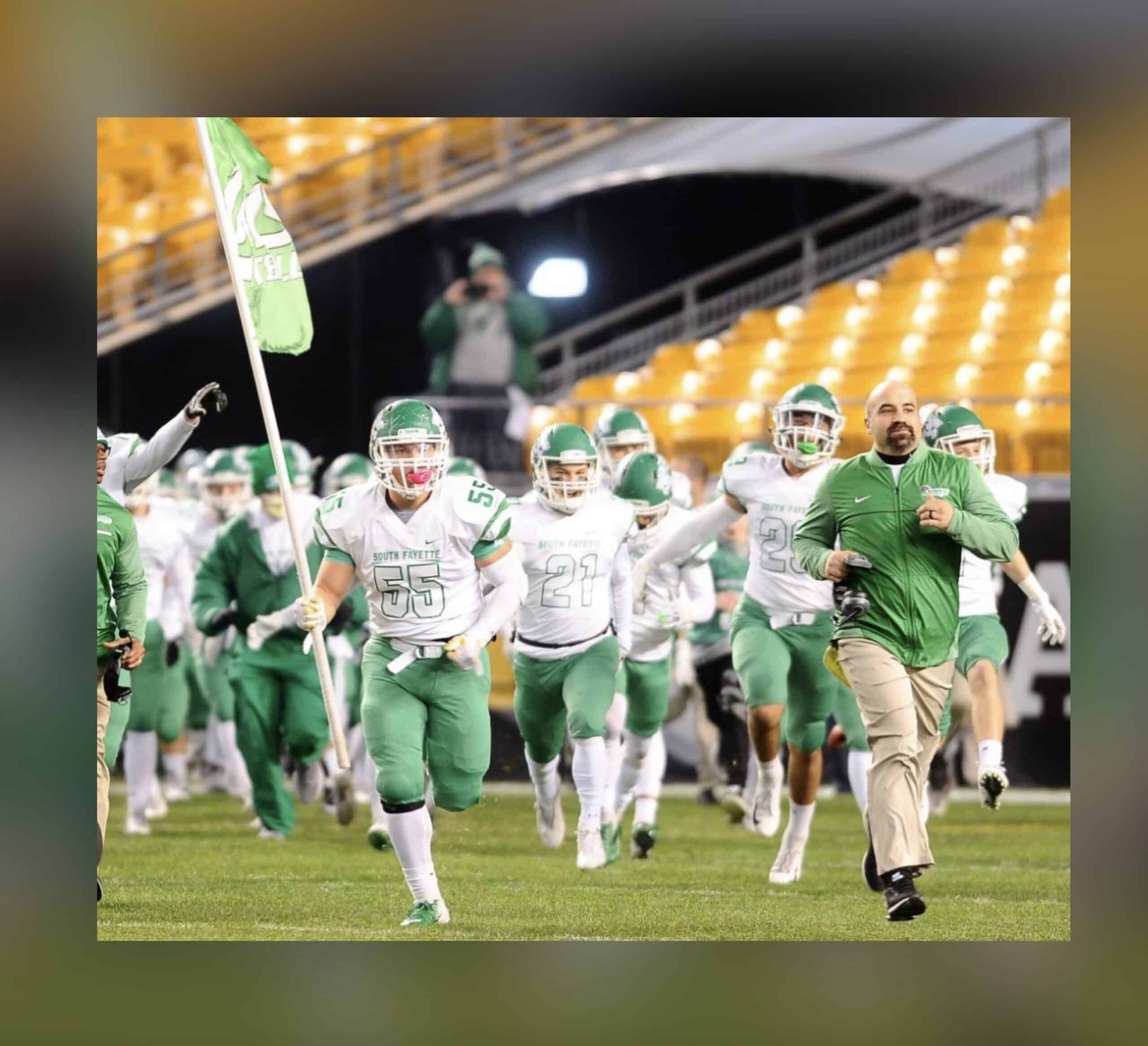
South Fayette under head coach Joe Rossi.
For generations, WPIAL football was associated with physicality. Powerful offensive lines, outstanding running backs, tough defenses, and controlling the line of scrimmage. And that philosophy produced some of the greatest teams in Pennsylvania history.
But Rossi built something different at South Fayette.
His Lions could spread you out, throw the football all over the field, and methodically move downfield without relying on a dominant rushing attack.
Five yards here. Seven yards there. A quick slant. A screen pass. A completion to the sideline. Before you knew it, South Fayette had marched 70 yards down the field, and your defense had barely gotten close to the quarterback.
What made that offense so frustrating was its simplicity.
You knew what was coming. But knowing what was coming and actually stopping it were two completely different things.
And some of Western Pennsylvania’s most respected football programs discovered that firsthand.
When Physical Football Met a Different Style
To appreciate what Rossi accomplished, you have to understand the football culture he was coaching in.
Western Pennsylvania has always taken pride in producing physical football teams.
Run the football. Control the clock. Win the battle in the trenches. Make your opponent prove it can match your toughness.
That philosophy wasn’t outdated. It was successful, and plenty of championship programs continued winning that way.
But South Fayette presented defenses with a different challenge.
Instead of allowing opponents to crowd the line of scrimmage and concentrate on stopping the run, Rossi made them defend the entire width of the field.
Defensive backs had to cover receivers in space. Linebackers had to recognize formations and react to quick passes. Defensive linemen had to generate pressure before the quarterback released the football. And everybody had to tackle. One missed assignment could turn a routine completion into a big gain.
What I appreciated about South Fayette was that Rossi wasn’t trying to prove traditional football was wrong. He was showing that there was another way to win. And his system was particularly effective against teams accustomed to controlling games with their athleticism and physicality.
Which brings me to Aliquippa.
Aliquippa Was the Perfect Example
Let me make something clear. Aliquippa is one of the greatest high school football programs in Pennsylvania history.
The Quips have produced exceptional athletes for generations. Their tradition, toughness, speed, and championship success speak for themselves.
But South Fayette created an interesting matchup because the two programs represented different offensive philosophies.
Aliquippa was known for its physicality and explosive athletes. South Fayette wanted to spread the field, establish rhythm through the passing game, and force defenders into uncomfortable situations.
And when these programs met with WPIAL championships on the line, Rossi’s approach produced some remarkable results.
South Fayette defeated Aliquippa in three WPIAL Class AA championship games in five seasons.
- 2010: South Fayette 19, Aliquippa 6
- 2013: South Fayette 34, Aliquippa 28
- 2014: South Fayette 31, Aliquippa 22
Think about that for a moment.
Three championship victories against a program that has been synonymous with winning for decades. That’s an accomplishment worth examining.
And what makes those games particularly interesting is how effectively South Fayette threw the football.
In the 2013 championship game, quarterback Brett Brumbaugh passed for 315 yards and two touchdowns. The following season, he threw for 352 yards against Aliquippa. That’s 667 passing yards in two WPIAL championship victories against one of Western Pennsylvania’s most respected programs.
Now, I don’t believe those victories were simply a matter of South Fayette having a superior offensive scheme. The Lions had excellent players, outstanding coaching, and the ability to execute under pressure.
But their passing attack created problems that even talented defenses struggled to solve.
They weren’t trying to match Aliquippa’s traditional style of football. They were making Aliquippa adjust to theirs.
And to me, that’s one of the most fascinating aspects of those championship matchups.
The Art of Dinking and Dunking
One thing I’ve always appreciated about great offensive coaching is the ability to make something relatively simple incredibly difficult to defend.
That’s what I remember about South Fayette. They could dink and dunk you to death.
A quarterback takes the snap, makes his read, and delivers a quick pass. The receiver catches it for six yards. Next play, another completion. Then a short pass across the middle. Another first down. And suddenly the defense has been on the field for an extended drive without giving up one spectacular play.
From a defensive standpoint, that can be exhausting.
You’re constantly chasing receivers, communicating coverage assignments, and trying to make tackles in open space.
Meanwhile, the quarterback is getting comfortable. His confidence grows. The receivers establish a rhythm. And the defense starts getting frustrated.
But here’s what made the offense especially dangerous.
Once defenders began anticipating the short throws, South Fayette could attack deeper downfield.
A defensive back starts creeping forward. A linebacker becomes aggressive underneath. A safety hesitates for a split second. And suddenly a receiver is running behind the coverage.
That’s what made Rossi’s approach so effective.
It wasn’t simply about throwing the football 40 times. It was about understanding how one play could create an opportunity for another.
The passing game became a method of controlling the defense. And when executed properly, it was beautiful football to watch.
The Brumbaugh Brothers Were Central to the Success
You can’t tell the story of South Fayette’s passing attack without discussing Christian and Brett Brumbaugh. Both quarterbacks played important roles in establishing the Lions as a championship program.
Christian helped lead South Fayette to the 2010 WPIAL Class AA championship and an appearance in the PIAA state championship game.
Then Brett came along and took the passing attack to another level. Brett was an outstanding high school quarterback, but what impressed me about his success wasn’t simply his ability to throw the football.
It was the efficiency of the offense.
He understood where to distribute the ball. He trusted his receivers. He was comfortable operating in a system that demanded quick decisions and precise timing.
And when South Fayette needed him to produce big numbers, he delivered. In a 2013 playoff victory over Seton-LaSalle, Brumbaugh threw for a then-WPIAL-record 463 yards.
That’s a remarkable performance at any level of high school football.
But here’s what stands out to me. South Fayette’s offensive identity didn’t disappear when Christian graduated. It continued with Brett.
That tells me Rossi and his coaching staff had established something bigger than one talented quarterback. They had developed a philosophy that could be taught, practiced, and executed by different players.
Of course, having exceptional quarterbacks made the system more dangerous.
But developing those quarterbacks and putting them in positions to succeed was also part of Rossi’s coaching ability.
Great coaches don’t simply recognize talent. They understand how to maximize it.
Great Coaching Isn’t Always About Playing the Traditional Way
There’s something else about South Fayette that I believe deserves recognition.
Too often, people associate toughness in football exclusively with running the ball and physically overpowering opponents.
But toughness comes in different forms.
An offensive lineman protecting his quarterback against an aggressive pass rush is demonstrating toughness. A receiver making a catch across the middle while knowing he’s about to take a hit is demonstrating toughness. A quarterback standing in the pocket and delivering a pass with defenders closing in is demonstrating toughness. And an entire offense executing with precision under championship pressure requires discipline and mental toughness.
South Fayette wasn’t a finesse team simply because it threw the football.
The Lions could run, block, tackle, and play defense. Their passing game was simply the part of their identity that made them different.
And that’s an important distinction.
Rossi wasn’t building an offense around what people traditionally expected a Western Pennsylvania football team to look like. He was building one around what gave his players the best opportunity to succeed.
To me, that’s outstanding coaching.
Championships Proved It Was More Than a Gimmick
Some people look at pass-heavy high school offenses and question whether that style can consistently win championships.
Rossi’s South Fayette teams provided a pretty convincing answer.
During his tenure, the Lions captured four WPIAL championships. 2010. 2013. 2014. 2018.
They also won consecutive PIAA Class AA state championships in 2013 and 2014. The 2013 team finished with a perfect 16-0 record and defeated Imhotep Charter 41-0 in the state championship game.
That wasn’t simply a successful regular season. That was complete domination on the biggest stage in Pennsylvania high school football.
And it demonstrated that South Fayette’s approach could succeed beyond the WPIAL.
The Lions weren’t winning championships because opponents were unfamiliar with their offense for one season. They were winning because they had talented players, excellent preparation, and a coaching staff that understood how to consistently execute its philosophy.
By the time Rossi’s 17-year tenure at South Fayette ended, he had compiled a 157-43 record.
Four WPIAL championships. Two PIAA state championships. And a program that had established itself among the most successful in Western Pennsylvania during that period.
Those accomplishments deserve recognition regardless of what offensive system a coach chooses to run.
But the way Rossi achieved that success makes his story especially interesting.
Did South Fayette Change the Way People Viewed WPIAL Football?
I believe Rossi’s success helped challenge some traditional assumptions about what a championship football team in Western Pennsylvania needed to look like.
Now, I’m not suggesting South Fayette invented the spread offense or introduced passing football to the WPIAL. That wouldn’t be accurate.
Western Pennsylvania had outstanding passing teams and talented quarterbacks long before Rossi’s championship run.
But what South Fayette demonstrated was that a program could make the passing game a central part of its identity and still win championships against some of the most respected teams in the state.
And not just once. Year after year. That’s what separates an interesting offensive approach from an established championship philosophy.
Rossi didn’t need to abandon physical football to succeed. He simply expanded the ways his team could attack an opponent.
I also believe there’s an important lesson here about coaching.
Sometimes the best strategy isn’t trying to beat an opponent at what it does best. Sometimes it’s forcing that opponent to deal with what you do best.
South Fayette understood that.
And its championship results speak for themselves.
Joe Rossi Deserves His Flowers
As someone who competed in Western Pennsylvania sports, I’ve always respected coaches who can establish an identity and get their players to believe in it.
It’s one thing to have talented athletes. It’s another thing to develop a system that allows those athletes to consistently perform at a championship level.
Joe Rossi accomplished both at South Fayette.
He took a program and built an offensive identity that became one of the most recognizable in WPIAL football.
His quarterbacks produced outstanding numbers. His teams defeated traditional powerhouses. And his championship résumé established him as one of the successful coaches of his era.
But what I appreciate most is that he demonstrated the value of coaching to your personnel rather than forcing your personnel into a particular philosophy.
That’s a lesson that extends beyond football.
Great coaching is about recognizing what you have, understanding what your players do well, and creating an environment where those strengths can flourish.
Rossi did that. And the results were difficult to argue with.
When people discuss the great WPIAL football programs and coaches of the 2000s and 2010s, South Fayette and Joe Rossi deserve to be part of that conversation.
Not because they invented a new way to play football.
But because they took a different approach, executed it at an exceptionally high level, and built a championship program around it.
Four WPIAL championships. Two PIAA state championships. And three championship-game victories over Aliquippa.
That’s a legacy worth remembering.
Coach Joe Rossi, DrewSchifino.com gives you your flowers.
Because sometimes greatness isn’t about playing football the way it’s always been played. It’s about having the vision and confidence to succeed playing it your own way.