
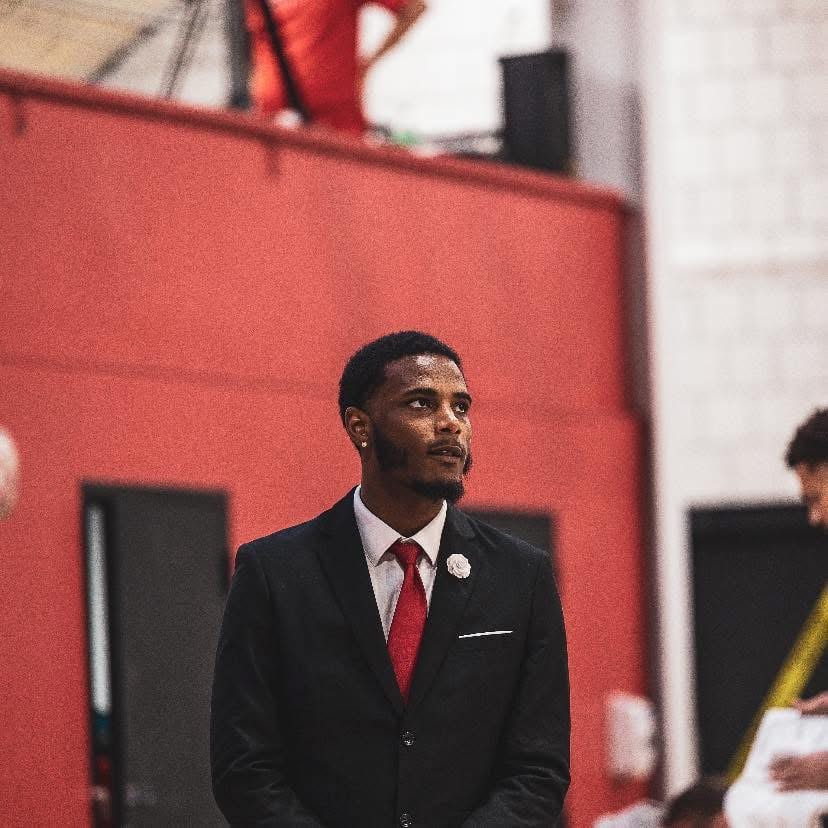
When we talk about basketball in Pittsburgh, we often focus on the players, the championships, and the programs that have established themselves over the years.
But sometimes, the most interesting stories belong to the coaches themselves.
And the more I learned about Kyle Carrington, the new boys basketball head coach at Obama Academy, the more I realized his journey deserves some recognition.
Carrington isn’t originally from Pittsburgh. He grew up on the east side of Detroit, Michigan, in the Sojourner Truth Homes, where basketball became much more than a game.
It became an opportunity. An opportunity to stay away from some of the negative influences surrounding him, pursue an education, and eventually build a future for himself.
But his road wasn’t easy.
Injuries repeatedly interrupted his high school basketball career, limiting his opportunities to showcase his ability and making the recruiting process even more difficult. For a young athlete with college basketball aspirations, those setbacks could have easily ended his journey.
Carrington refused to let that happen.
After experiencing more adversity at the college level, he eventually found his way to Westmoreland County Community College, where he averaged 16 points, 10 rebounds, and five assists.
That performance earned him a full scholarship to Point Park University. He would go on to become a four-year starter, earn his master’s degree, and transition into coaching as a graduate assistant.
Now, years after growing up in Detroit, Carrington finds himself leading one of Pittsburgh’s established City League basketball programs.
And he’s stepping into a situation where expectations are already high.
Obama Academy is coming off an appearance in the 2026 PIAA Class 4A state championship game under former head coach Naron Jackson.
Taking over a program after that kind of success isn’t easy, especially for a first-year head coach.
But what caught my attention about Carrington wasn’t simply his basketball background. It was his perspective on the game.
He comes from a Detroit basketball culture where talented players traditionally represented their neighborhood public schools. That’s something he would like to see more of in Pittsburgh.
And I think that’s an interesting conversation because I’ve talked numerous times about how transfers, prep schools, and the changing landscape of high school athletics have affected traditional public-school basketball.
Carrington also recognizes something I’ve noticed over the years. The Pittsburgh City League doesn’t receive nearly the same attention as the WPIAL.
There was a time when City League basketball was a major part of the conversation in Western Pennsylvania. Schenley, Peabody, Perry, Allderdice, and other programs produced outstanding players, memorable rivalries, and teams capable of competing with anybody.
Carrington wants to help bring more attention back to that tradition. But he also understands that winning basketball games is only part of his responsibility.
As a husband, father, and former college athlete who experienced plenty of adversity himself, he wants to prepare young men for life beyond basketball.
That’s something I respect.
I’ve always believed the best coaches are the ones who can teach you lessons that stay with you long after your playing career ends.
With the 2026–27 basketball season approaching, Carrington has an opportunity to establish his own identity while continuing the success Obama Academy has enjoyed.
I wanted to learn more about the man taking over the program, his Detroit upbringing, his coaching philosophy, and what he envisions for the future of Obama Academy basketball.
Here’s Q&A with new Obama Academy head coach Kyle Carrington.
Q: Coach, you’re originally from Detroit and played college basketball at Point Park University. Tell us about your basketball journey and how it eventually led you into coaching in Pittsburgh.
Kyle Carrington: I started playing basketball when I was 4 years old back in my hometown of Detroit. Growing up in the projects, this game was the one thing that kept me from doing a lot of the things my peers were doing. I’m a first-generation college graduate from the Sojourner Truth Homes on the east side of Detroit. Basketball afforded me that opportunity, but the journey didn’t come without a lot of adversity. I only had one full season as a varsity basketball player because of injuries. My freshman year of high school, I played junior varsity. My sophomore year, I broke my hand just two games into the season. My junior year, I fractured my tibia in a car accident six games into the season. Both years, I was off to good starts as a varsity starter. My senior year, I finally started every game and played a full regular season. Unfortunately, I suffered a high ankle sprain in the first playoff game, and we eventually lost in the district championship. All that adversity hurt my recruitment and limited my ability to show what I could do as a varsity basketball player. I went on to Adrian College, where I fractured my tibial plateau. After that injury, I decided to step away from college for a year and a half. Eventually, people around me encouraged me to chase my dreams on the basketball court again. I enrolled at Westmoreland County Community College, where I averaged 16 points, 10 rebounds, and five assists. After one season, I earned a full scholarship to Point Park University. My resilience throughout that journey showed me that I had a story to tell and qualities that could help me lead young men long after my playing days were over. I became a four-year starter at Point Park, receiving an additional year of eligibility because of COVID. After my playing career, I became a graduate assistant coach and earned my master’s degree from Point Park University. Throughout my career, my coaches always made me a captain and praised my basketball instincts and IQ, so transitioning into coaching came pretty naturally. I eventually decided to make Pittsburgh my home after meeting my wife and starting a family here.
Q: Growing up in Detroit, a city with a rich basketball tradition, how did that environment shape you as a player and influence your coaching philosophy today?
Kyle Carrington: Growing up in Detroit builds an innate sense of toughness. The style of play is also a lot faster than what you typically see in Western Pennsylvania basketball. I preach toughness and setting a pace that’s difficult for most teams to sustain. I’m also big on teaching principles and concepts rather than relying heavily on set plays.
Q: You’re taking over for Naron Jackson following a successful run at Obama Academy. What attracted you to this opportunity, and how do you balance continuing that success with establishing your own identity?
Kyle Carrington: Looking at the history of the City League in recent years, I’ve noticed that it’s been dominated by Allderdice, outside of the two championships Obama won in 2020 and 2026. But when you look further back, you had those powerhouse Schenley teams and more balance throughout the league. I saw this as an opportunity and a challenge to keep inner-city kids playing at their neighborhood schools while bringing more notoriety and recognition to the City League. I think the WPIAL overshadows City League basketball when it comes to media coverage nowadays. I love what Naron built here, but I also think it’s important that I stay true to myself rather than feeling like I need to fill his shoes or become him. I’ve actually gotten to know Naron pretty well throughout this transition. One thing he always tells me is, “Put your own stamp on the program.” He’s made this transition a lot easier for me.
Q: Having played college basketball yourself, what lessons from your playing days do you emphasize most when developing young athletes?
Kyle Carrington: The biggest lesson I emphasize is resilience. My whole life has been about facing adversity and how I responded to it. Another important lesson I teach these young men is that, in life, there are REASONS and RESULTS. There can be an excuse or a reason for everything in life, but greatness is built on pushing through adversity and executing with discipline and accountability. Regardless of your circumstances or the odds against you, you have to remain committed to reaching your goals.
Q: Looking ahead to the 2026–27 season, what are your expectations for Obama Academy, and what will be the biggest keys to having a successful first year?
Kyle Carrington: The expectation every year is to maximize the talent we have through discipline, hard work, and execution. We’re senior-heavy this year, but a lot of those guys don’t have much varsity experience. I’m looking to lean on their maturity as we work to defend our City League championship and make another push in the PIAA Class 4A playoffs.
Q: Every coach has a philosophy. When people watch a Kyle Carrington-coached basketball team, what do you want them to recognize immediately about how your players compete?
Kyle Carrington: I want people to notice a group of kids willing to value every possession by laying it all on the line, play after play. We’re going to play hard. We’re going to have a first-team-to-the-floor mentality.We’re also going to set the pace. Expect a lot of pressing, advancing the ball early, and creating advantages early in possessions. I want our style of play to make opponents uncomfortable.
Q: Coming from Detroit and eventually becoming involved in Pittsburgh basketball, what differences have you noticed between the basketball cultures in the two cities?
Kyle Carrington: The biggest difference I’ve noticed between Detroit and Pittsburgh basketball is that, growing up in Detroit, the big-name players attended their neighborhood public schools. We saw Division I and Division II talent playing against each other on a nightly basis. In Pittsburgh, you see a lot more transferring and players leaving for other opportunities, which creates a talent gap. Another difference is that Western Pennsylvania is very football-heavy. Detroit has more of a balance between basketball and football. Basketball becomes important at a very young age in Detroit, while in Western Pennsylvania, it seems like kids grow up eating, sleeping, and breathing football much earlier.
Q: High school basketball has changed tremendously with AAU, social media, transfers, and individual exposure. What’s your biggest challenge when it comes to getting today’s players to buy into a team-first mentality?
Kyle Carrington: Humility is one of the greatest advantages you can have in life. I put a major emphasis on humility and teaching our players that we can’t reach our goals without understanding that no individual or personal goal is greater than the team’s goal. I teach the importance of playing for one another. I believe whatever you emphasize the most eventually becomes your standard. And that’s going to be our standard here at Obama.
Q: Taking over an established program comes with expectations. What’s the biggest challenge you anticipate as a first-year head coach at Obama, and how do you plan to earn the trust of your players?
Kyle Carrington: These guys played until the very last day you can play high school basketball last season, reaching the PIAA Class 4A state championship game. That alone sets extremely high expectations. For me, the biggest challenge is introducing a new philosophy and new standards to players who have already experienced success under different principles and leadership. I plan to earn their trust by being authentically myself. I’m going to lead with love and always make player-first decisions that show these young men I have their best interests at heart.
Q: Finally, when your coaching career is over, what do you want your former players to remember most about playing for Kyle Carrington, beyond wins and championships?
Kyle Carrington: I want to be remembered as a coach who instilled life skills that lasted far beyond success on the basketball court. I want to be the coach who helped develop the discipline, confidence, resilience, and commitment these young men need to become anything they want to be. Whether that’s in their careers or their family lives, I want them to be successful. I’m a dad and a husband first. And I want these guys to develop the qualities they need to succeed as family men first and in their careers second. That’s bigger than basketball to me.