
When we talk about the greatest football coaches in WPIAL history, the conversation usually starts with the names most of us watched.
Bill Cherpak. Bob Palko. Jim Render. Jack McCurry George Novak. Art Walker. Don Yannessa. Joe Hamilton. Mike Zmijanac.
Their programs became machines. Year after year, you knew what was coming. They were going to be disciplined. They were going to be prepared. They were going to have an identity. And most importantly, they were going to win.
But before many of Western Pennsylvania’s great football dynasties were ever built, there was a coach showing everyone what the blueprint looked like.
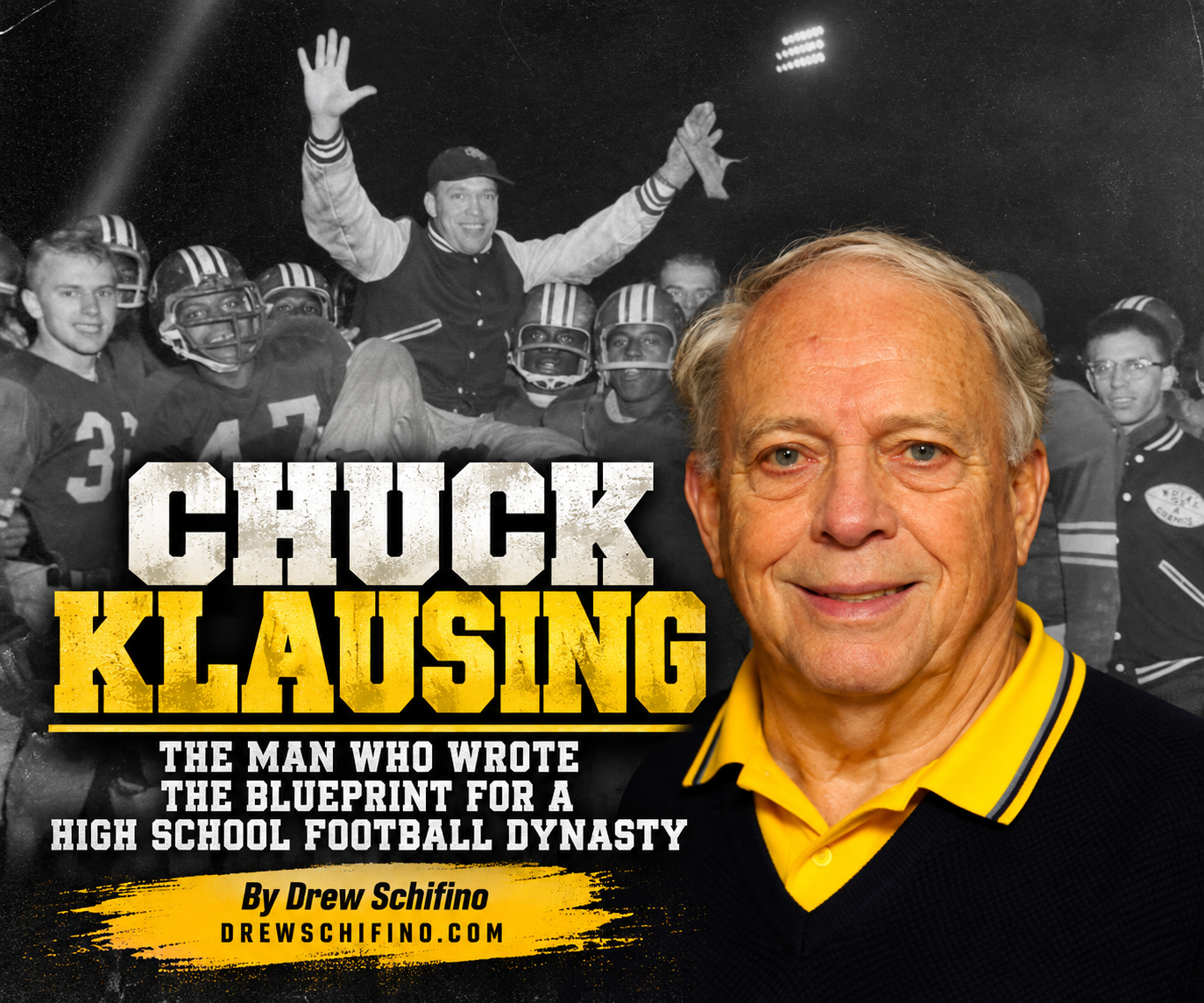
His name was Chuck Klausing. And what Klausing accomplished at Braddock High School during the 1950s almost sounds fictional today.
Six Years. Six WPIAL Championships.
Klausing took over at Braddock in 1954. He left after the 1959 season.
Braddock won the WPIAL championship every single year he was there.
Think about that.
Not two championships in six years. Not three. Not even four. Six consecutive WPIAL championships in six seasons.
Braddock also went through those six seasons without losing a football game, putting together one of the longest unbeaten streaks in Pennsylvania high school football history.
Eventually, Sports Illustrated came to Western Pennsylvania to tell the country about what was happening at Braddock. That alone tells you how extraordinary this was.
This wasn’t happening in the social-media era, where a dominant high school team can become nationally known overnight.
This was 1950s Western Pennsylvania football. And Braddock became a national story.
This Was Western Pennsylvania Football at Its Toughest
You also have to understand where Klausing was doing it.
Braddock wasn’t some football factory drawing players from all over the region. This was a hard-working steel town.
Western Pennsylvania was loaded with communities just like it. Aliquippa. Clairton. McKeesport. Duquesne. Rankin. Homestead. Braddock. Football was woven into these towns.
The mills were running. Families lived close together. Kids grew up playing with one another. Friday nights mattered.
And Klausing figured out how to take that environment and build something almost unbeatable.
That’s what makes his Braddock run so important to me.
He wasn’t simply winning games. He was showing Western Pennsylvania what a football program could become.
The Blueprint
When I study the great dynasties in WPIAL history, they usually have several things in common.
They have an identity. They develop players. They are fundamentally sound. The younger kids understand the expectations before they ever become starters. The coaching staff establishes a standard that doesn’t change depending on who graduates.
And eventually, winning becomes part of the culture.
Players don’t walk into the program hoping to win. They walk into the program expecting to win because the players before them did it.
That’s a dynasty.
And Klausing was doing it more than 70 years ago.
Talent changes. Players graduate. Assistant coaches come and go. But the standard stays.
That’s the difference between having a great team and building a great program.
Chuck Klausing built a program.
And Then He Proved It Wasn’t Just Braddock
This is where Klausing’s career becomes even more impressive.
Sometimes a coach finds the perfect collection of players, the perfect community and the perfect moment. People can always ask whether he could have done it somewhere else.
Klausing answered that question.
Long before Braddock, he had started his head-coaching career at Pitcairn High School in 1948. After leaving Braddock, he moved into college football.
Rutgers. Army. Indiana University of Pennsylvania. West Virginia. Carnegie Mellon. Pitt.
Then, late in his career, he returned to the high school level at Kiski Prep. Every stop added another chapter.
At IUP, Klausing went 47-10 in six seasons and took the program to the 1968 Boardwalk Bowl, its first postseason appearance.
Then came another remarkable head-coaching run.
From 1976 through 1985, Klausing went 77-15-2 at Carnegie Mellon. Six conference championships. Four NCAA Division III playoff appearances. And in 1979, Carnegie Mellon won the Lambert Trophy as the top small-college football team in the East.
Different players. Different level. Different school.
Same result. Winning.
Bobby Bowden Trusted Him
There is another part of Klausing’s résumé that shouldn’t get overlooked. He spent six seasons at West Virginia working with Bobby Bowden.
Klausing wasn’t just another assistant on the staff. He became Bowden’s assistant head coach and eventually defensive coordinator. WVU has described Klausing as Bowden’s right-hand man during Bowden’s entire tenure in Morgantown.
Think about the football knowledge in that room.
Bowden would eventually become one of the greatest college football coaches who ever lived.
And beside him at West Virginia was a guy who had already built one of the greatest high school football dynasties Western Pennsylvania had ever seen.
Klausing’s reputation was built on preparation and attention to detail.
That matters to me because it gets to the heart of coaching.
Schemes change. Formations change. Football changes.
Preparation doesn’t.
Coaching Was Teaching
Maybe the most revealing part of Klausing’s career came toward the end.
After coaching at Pitt in 1986, he could have remained around college football. Instead, he returned to high school football at Kiski Prep.
Why?
Because Klausing believed coaches could have an enormous impact on players while they were still young.
That tells you what coaching meant to him.
It wasn’t simply collecting victories. It was teaching. Developing. Building habits. Giving young players something they could carry beyond football.
Klausing even started summer learning camps for kids in 1964. Those camps eventually drew roughly 1,000 youngsters each summer.
The man loved football.
But more importantly, he understood what football could teach.
His Coaching Tree Wasn’t Just Coaches
When people talk about coaching trees, they usually look for assistants who eventually became head coaches.
I look at it a little differently.
Sometimes a coach’s tree is an idea. A standard. A way of running a program.
And when I look at the great WPIAL programs that followed Braddock, I see pieces of the same formula Klausing mastered decades earlier.
Build from within. Establish an identity. Make preparation non-negotiable. Develop your younger players. Demand fundamentals. Create expectations. And don’t rebuild every few years. Reload.
That formula didn’t begin with today’s powerhouse programs.
Klausing was showing Western Pennsylvania how to do it in the 1950s.
The Numbers Speak for Themselves
His college head-coaching record finished at 124-25-2. That’s an .828 winning percentage.
He won championships at multiple levels. He coached with Bobby Bowden. He coached at Army, West Virginia and Pitt. He built powerhouse programs at IUP and Carnegie Mellon. He coached high school football for 19 years.
And in 1998, Chuck Klausing was inducted into the College Football Hall of Fame.
But somehow, I still think the Braddock chapter says the most about him. Six seasons. Six WPIAL championships. Not one loss.
You can debate where Chuck Klausing belongs on a list of the greatest WPIAL coaches ever.
Longevity matters, and several legendary coaches stayed in the WPIAL much longer and accumulated incredible careers.
But if we’re talking about building a dynasty, Klausing belongs in a different conversation.
Because while everybody else was eventually trying to perfect the formula, Chuck Klausing had already written the blueprint.
Braddock wasn’t just winning football games. It became a standard.
And more than 60 years later, every time we see a Western Pennsylvania program dominate for a decade, develop player after player and make championships feel almost routine, we’re watching a version of something Chuck Klausing showed this region a long time ago: Great teams win championships. Great programs create expectations. Dynasties make those expectations and survive generations.
Chuck Klausing built a dynasty before Western Pennsylvania even knew what the blueprint was supposed to look like.