
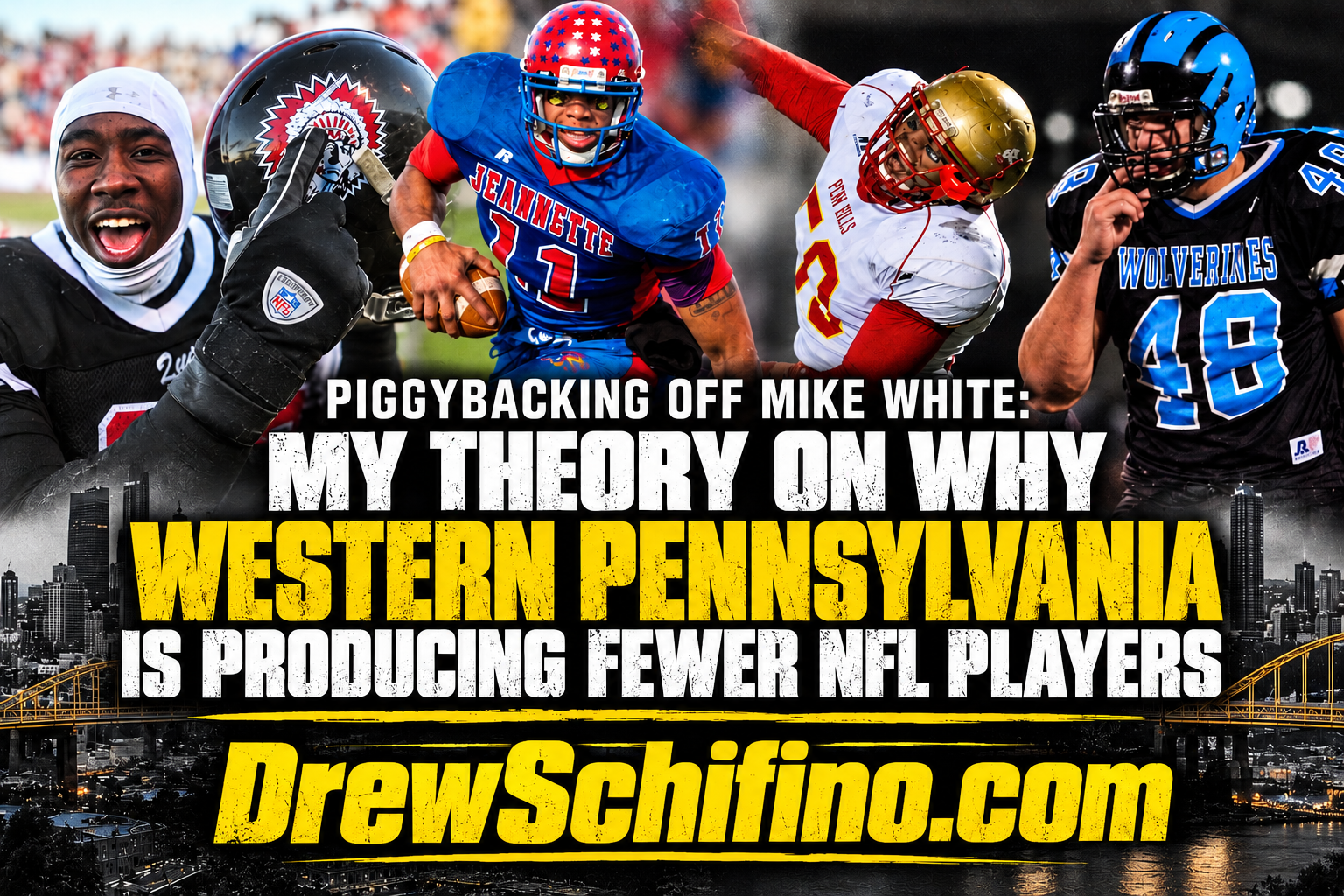
I recently read the Pittsburgh Post-Gazette article about the significant decline in NFL players coming out of the WPIAL and City League. Mike White also gave his thoughts on the subject, saying he believes it goes back to the area producing far fewer FBS players than it once did.
The numbers definitely caught my attention.
In 2012, Western Pennsylvania had 31 players in the NFL. At the start of the 2026 season, the WPIAL had just 11 players on active NFL rosters, and the City League had none.
That’s a major decline.
So I’m going to piggyback off that conversation and give my own theory. And I’ll take it a step further.
I don’t think this is just a Western Pennsylvania problem. I think Pennsylvania football as a whole has fallen off from where it once stood nationally.
Why?
I think one of the biggest reasons is pretty simple.
Football changed. And the type of athlete the game values changed with it.
Western Pennsylvania Football Had an Identity
If you grew up around Western Pennsylvania football, you know exactly what this area was known for.
Toughness. Physicality. Running the football. Defense. Big linemen. Hard-hitting linebackers. Cold Friday nights where everybody in the stadium knew somebody was getting the football 25 times, and you still had to stop him.
Western Pennsylvania didn’t build its reputation playing football on grass. We built it by physically beating people.
That mentality helped produce generations of unbelievable football players.
Joe Montana. Dan Marino. Joe Namath. Johnny Unitas. Mike Ditka. Tony Dorsett. Darrelle Revis. Aaron Donald.
And that’s only scratching the surface.
For decades, Pennsylvania and Western Pennsylvania in particular, was one of America’s great football factories.
But here’s my question: What if the game evolved away from the style of football that made this area so dominant?
Today’s Game Is About Speed and Space
Turn on an NFL or major college football game today and look at the field.
Football is played differently.
Spread offenses. RPOs. Mobile quarterbacks. Receivers everywhere. Defenses forced to cover the entire field.
A linebacker can’t just be 250 pounds and knock the hell out of a running back anymore. Can he run? Can he cover a tight end? Can he cover a running back out of the backfield? Can he survive when an offense spreads him out?
The same thing applies to defensive linemen.
It’s not enough to be big and strong. Teams want explosiveness, quickness and the ability to move.
Safeties have to cover. Quarterbacks have to create. Even offensive linemen are being asked to move differently. The modern game puts a premium on speed, space, versatility and athleticism.
And when I look at where so much of today’s elite football talent is coming from, I don’t think that’s a coincidence.
Look at the South
Texas. Florida. Georgia. Alabama. Louisiana. The Carolinas.
Those places didn’t suddenly discover football. They’ve always produced great players. But today’s game fits the athletes those areas produce extremely well.
Look at the numbers.
In the 2026 NFL Draft, Texas high schools produced 33 draft picks. Florida produced 26 and Georgia produced 22.
Pennsylvania? Five.
Over the last nine NFL drafts, Florida and Texas high schools have each produced more than 260 draft picks.
That isn’t one great recruiting class. That’s a pattern.
Watch high-level high school football in Georgia, Florida or Texas and one thing immediately jumps out at you.
Speed.
You’ll see defensive ends who move like linebackers. Linebackers who look like safeties. Safeties who could play receiver. Quarterbacks who can beat you with their arm or their legs.
Everybody can run.
And football has evolved into a game that rewards exactly that.
I Think This Is Bigger Than the WPIAL
This is where I differ a little bit from making the conversation strictly about Western Pennsylvania. I think we have to look at the entire state.
Pennsylvania still produces NFL talent. In fact, the state had 44 players on NFL Week 1 rosters in 2026.
So when I say Pennsylvania has “fallen off,” I’m not saying Pennsylvania doesn’t have good football anymore. That’s ridiculous.
I’m talking about Pennsylvania’s place in the national hierarchy compared with what it once represented.
There was a time when Pennsylvania was synonymous with football talent. Now look at where the center of gravity has moved.
In the 2026 draft, Texas had 33 selections, Florida 26 and Georgia 22. Pennsylvania’s five put it well behind those states. The year before, Pennsylvania also produced five draft picks while Texas had 37, Florida 26 and Georgia 22.
That’s why I don’t believe we’re just looking at a random WPIAL drought.
Something bigger has changed.
It’s Not Because Kids Stopped Playing Football
One thing I found especially interesting in the Post-Gazette article was the participation numbers.
You might assume fewer Pennsylvania kids are playing football. The numbers don’t really support that.
According to the participation figures cited by the Post-Gazette, Pennsylvania had 26,370 high school football players in 2012. Last year, it had 28,119.
So simply saying, “Kids don’t play football anymore,” doesn’t completely explain this.
There are obviously other factors.
Population shifts matter. Year-round specialization in other sports matters. Development matters. Exposure matters. Where kids choose to attend high school matters. Private-school programs assembling talent changes the landscape.
And I agree with the coaches and former players in the Post-Gazette story who raised some of those points.
But I keep coming back to the evolution of the game itself.
Think About the Players Western PA Used to Produce
This is what really makes me think.
Western Pennsylvania became famous for producing quarterbacks, linemen, linebackers and tough, physical football players.
Those positions still matter. Toughness still matters. Strength still matters.
But the prototypes have changed.
Take linebacker.
Thirty years ago, if you were a big, physical linebacker who could come downhill, destroy a fullback and dominate the running game, you had tremendous value.
Today? You better be able to run.
Because an offensive coordinator is going to find you. He’s going to put you in space. He’s going to make you cover. And if you can’t do it, he’s going to attack you all night.
That’s modern football.
We’re Competing Against the Entire Country Now
There’s another part of this that I think people overlook.
Years ago, a great WPIAL player was competing for recognition with other great players in Pennsylvania, Ohio and maybe a handful of other traditional football areas.
Today, recruiting is truly national.
A college coach can sit in his office and watch a kid from Atlanta, Miami, Houston, Los Angeles and Pittsburgh in the same afternoon.
Social media changed recruiting. Hudl changed recruiting. Camps changed recruiting. 7-on-7 changed recruiting.
The internet eliminated geography.
A WPIAL kid isn’t just competing against the kid at the school across town anymore. He’s competing against America.
Former Gateway star Justin King made a similar point in the Post-Gazette story: players need to understand that the competition isn’t merely against other WPIAL athletes — it’s against kids nationwide.
That’s a completely different world.
This Doesn’t Mean Western PA Football Is Dead
I want to make that clear.
There are still great football players here. There are still great coaches here. There are still kids coming through the WPIAL who will play major college football and eventually play on Sundays.
And football can be cyclical.
The Post-Gazette article pointed out that the area has several highly regarded prospects coming through the pipeline right now.
So maybe those NFL numbers start climbing again.
But I don’t think we’re ever going back to the days when Western Pennsylvania could simply rely on its old formula and expect to dominate nationally.
The rest of the country caught up. And in some areas, it passed us.
Keep the Toughness. Add the Speed.
I don’t think Western Pennsylvania needs to abandon its football identity.
Actually, I think the opposite.
Keep the toughness. Keep the physicality. Keep the discipline. Keep that mentality that made playing football around here different.
But combine it with modern player development.
Speed. Movement. Position versatility. Skill development. Playing in space.
Because the game isn’t going backward.
And that’s ultimately my theory.
Maybe Western Pennsylvania didn’t suddenly stop producing football players. Maybe football changed faster than the type of football this region historically produced. And maybe Pennsylvania as a whole is experiencing the same thing.
The talent didn’t disappear.
The standard changed. The prototype changed. The geography of elite football changed. And the game changed.
Pennsylvania helped build the old football world.
Now the question is whether we can adapt to the new one.