
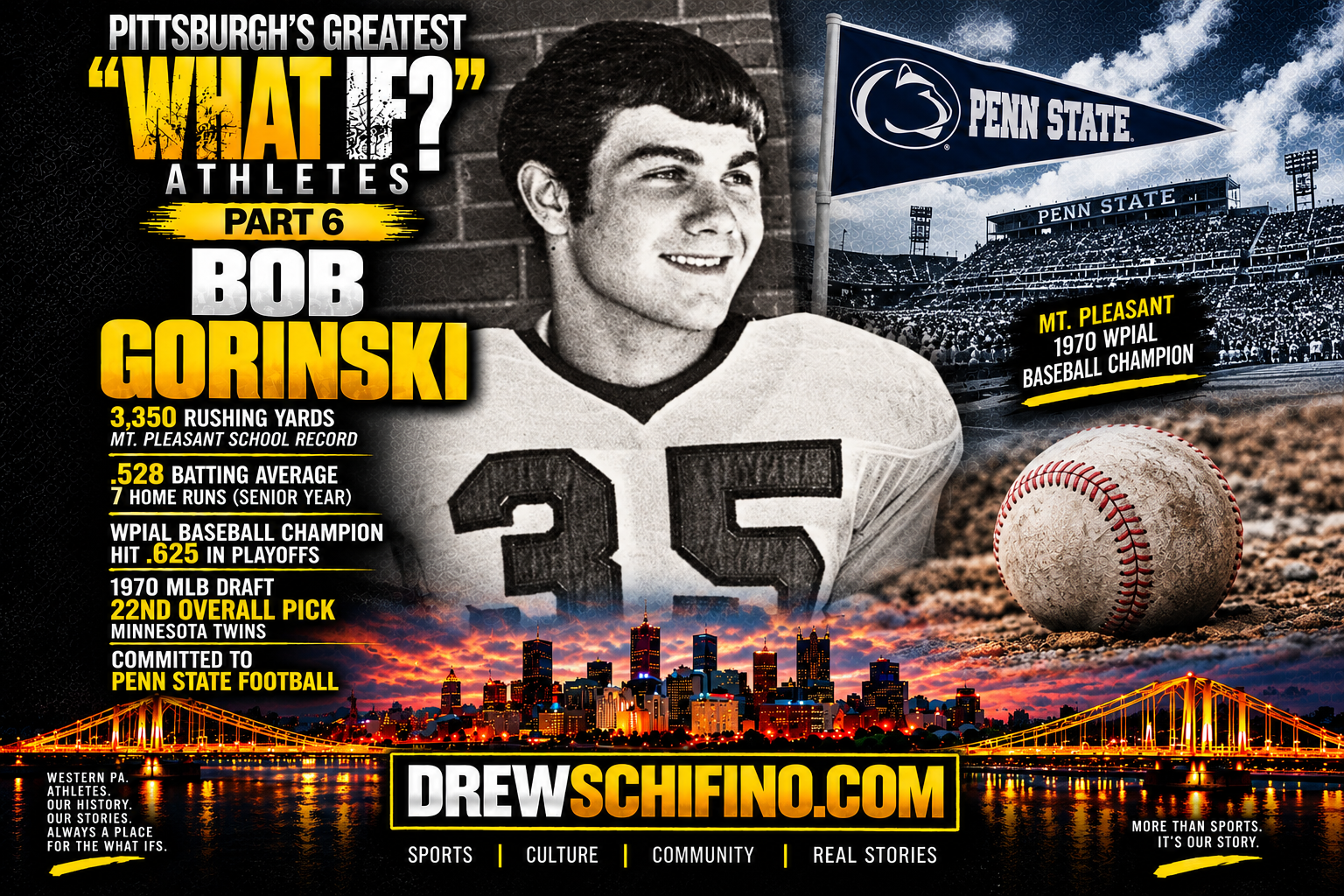
What if one of Western Pennsylvania’s best baseball players had never played professional baseball?
What if instead he showed up at Penn State, put on a football helmet and joined the same recruiting class as a future Heisman Trophy winner?
That’s the Bob Gorinski story. And it might be one of the most fascinating “what ifs” in this entire series.
Because football wasn’t Gorinski’s backup plan. Football was the plan.
He had already committed to Penn State.
Then Major League Baseball changed everything.
Mt. Pleasant Had a Monster
Bob Gorinski graduated from Mt. Pleasant in 1970.
At 6-foot-3 and around 215 pounds, he had tremendous size for a high school running back in that era.
But this wasn’t just a big kid who looked the part. Gorinski produced.
He finished his high school career with 3,350 rushing yards, setting a Mt. Pleasant record that stood for more than 40 years.
He earned all-state honors and became one of the most heavily recruited football players in Western Pennsylvania.
Penn State wanted him. So did Ohio State, Notre Dame, Michigan, Pitt, Maryland, Miami and North Carolina State.
Gorinski later recalled having more than 100 college offers to sort through.
Think about that in 1970.
No Hudl. No social media. No recruiting websites. No star rankings.
If that many programs knew about a kid from Mt. Pleasant, Pennsylvania, he had to be special.
Penn State Won the Recruiting Battle
Gorinski eventually chose Penn State.
There was a family connection. His father had played there and was part of the Nittany Lions’ undefeated 1948 Cotton Bowl team, and Bob grew up attending Penn State games.
Ohio State wanted him badly, too.
Gorinski later remembered having to call legendary Buckeyes coach Woody Hayes to tell him he had chosen Penn State. Hayes told him he was making a mistake.
Imagine being a high school kid with Woody Hayes and Joe Paterno battling to get you.
Penn State won. At least temporarily.
Because Gorinski still had one more high school sport to play. And he might have been even better at that one.
Then Baseball Changed Everything
Mt. Pleasant won the 1970 WPIAL baseball championship with Gorinski’s father, Clarence, serving as head coach.
Bob was the star.
As a senior, he hit .528 with seven home runs. During the playoffs, he went 10-for-16 — a .625 batting average when the games mattered most.
In the WPIAL championship game at Forbes Field, Mt. Pleasant beat Bethel Park 4-2. Gorinski went 3-for-4 and ripped a double off the left-field scoreboard.
By then, however, his future had become a lot more complicated.
The Minnesota Twins selected Gorinski with the 22nd overall pick in the first round of the 1970 Major League Baseball Draft.
He became the first WPIAL baseball player ever selected in the first round.
Now an 18-year-old kid had a decision to make. Penn State football or professional baseball?
Pick No. 22 Was Hard to Turn Down
Gorinski later said that if he had been drafted in the 10th or 15th round, he probably would have gone to Penn State.
But the first round changed things.
The Twins reportedly offered him a signing bonus of more than $60,000 — serious money in 1970.
Gorinski chose baseball. And I can’t blame him. A Major League organization had just made him one of the first 22 players selected in the entire country.
So Gorinski called Joe Paterno and told him he wasn’t coming to Penn State.
That decision created the “what if” we’re still talking about more than 50 years later.
Because another running back was part of that Penn State recruiting class. His name was John Cappelletti.
What If Gorinski Shows Up at Penn State?
Three years later, Cappelletti won the 1973 Heisman Trophy.
Penn State went 12-0.
Now imagine Gorinski never signs with Minnesota. He walks onto Penn State’s campus as a 6-foot-3, 215-pound all-state running back who had rushed for 3,350 yards in high school.
What happens?
Maybe Cappelletti still becomes the star. Maybe Gorinski pushes him for carries. Maybe Joe Paterno finds a way to get both of them on the field. Maybe Gorinski becomes a fullback or changes positions. Maybe he eventually becomes an NFL prospect.
Nobody knows. And that’s the point.
I’m not going to rewrite history and say Gorinski would have won a Heisman or become an NFL star. Sports don’t work like that.
But when Penn State, Ohio State, Notre Dame, Michigan and Pitt are all recruiting you, there’s a pretty good indication you belonged at that level.
That’s what makes the question legitimate.
Baseball Wasn’t the Wrong Decision
This part of the story matters.
Gorinski didn’t choose baseball and disappear. He spent years working his way through the Minnesota Twins organization and played 10 seasons of professional baseball.
He hit at least 20 home runs in six of his first eight professional seasons.
Then, in 1977, he reached the major leagues.
Gorinski appeared in 54 games for Minnesota, finishing with 23 hits, three home runs and 22 RBIs. It ended up being his only Major League season, but his professional career lasted more than 1,000 games.
So this isn’t a story about failure.
Bob Gorinski became a Major League Baseball player. That alone puts him in rare company.
And years later, Gorinski said he didn’t regret choosing baseball.
But he still wondered about football. There’s a difference.
Imagine This Decision Today
Now take Gorinski’s story and drop it into 2026.
A 6-foot-3, 215-pound Western Pennsylvania running back rushes for more than 3,000 career yards and earns all-state honors.
Penn State, Ohio State, Notre Dame, Michigan and Pitt are recruiting him.
Then baseball season starts. He hits .528, leads his school to a WPIAL championship and gets selected in the first round of the MLB Draft.
The sports world would go crazy.
Every recruiting site would follow the decision. Football analysts would debate his future. Baseball scouts would discuss his ceiling.
And NIL would completely change the equation.
Could he attend Penn State, play football and baseball, make NIL money and delay professional baseball?
Those options didn’t exist for Gorinski.
In 1970, professional baseball was offering an 18-year-old real money immediately. He made the choice that made sense for him and his family.
But choosing one path meant closing the other. And behind that other door was Penn State football.
Give Bob Gorinski His Flowers
Before Bo Jackson became the symbol of two-sport greatness, Western Pennsylvania had a 6-foot-3, 215-pound athlete dominating football and baseball at Mt. Pleasant.
Bob Gorinski rushed for 3,350 career yards.
He earned all-state honors. He was recruited by some of the biggest football programs in America. He committed to Penn State.
Then he hit .528 as a senior, helped Mt. Pleasant win a WPIAL baseball championship and became the first WPIAL player ever selected in the first round of the Major League Baseball Draft.
And eventually, he made it to the majors. That’s an incredible athletic story by itself.
But somewhere in an alternate version of Western Pennsylvania sports history, Bob Gorinski tells the Minnesota Twins no.
He shows up at Penn State. He joins the same recruiting class as John Cappelletti.
And then? We’ll never know.
That’s exactly why Bob Gorinski belongs in Pittsburgh’s Greatest “What If?” Athletes.
This is Part 6 of DrewSchifino.com’s series, “Pittsburgh’s Greatest ‘What If?’ Athletes,” preserving the stories of Western Pennsylvania athletes whose talent deserves to be remembered.