
There is something strange when you look through the history of WPIAL football champions.
Year after year, there is a school next to the championship.Then you get to the largest classification in 1979.
Vacant.
No Penn Hills. No Gateway. Nobody.
If you didn’t know the history, you might assume there wasn’t a championship game that season. There was.
Penn Hills played in it. Penn Hills won it. The players celebrated it.
And then, more than a year later, the championship disappeared from the official record books.
To me, that makes the 1979 Penn Hills Indians one of the most fascinating teams in WPIAL history.
This wasn’t a championship decided years later because of something involving star players, recruiting or some huge competitive advantage.
It involved a backup offensive lineman who barely played. And it eventually cost an entire team its championship.
Penn Hills Was in the Middle of a Dynasty
To understand why 1979 matters so much, you have to understand what Penn Hills football was at the time.
This wasn’t a program that suddenly got hot for one season. Coach Andy Urbanic had built a machine.
From 1976 through 1978, Penn Hills went 37-1-1 and won three consecutive WPIAL championships, including a co-championship after tying Butler 7-7 in the 1977 title game. The 1978 team even shut out Dan Marino and Central Catholic during the playoffs.
By 1979, Penn Hills was trying to do something unprecedented in the WPIAL’s largest classification: Win four consecutive championships.
And the roster was loaded.
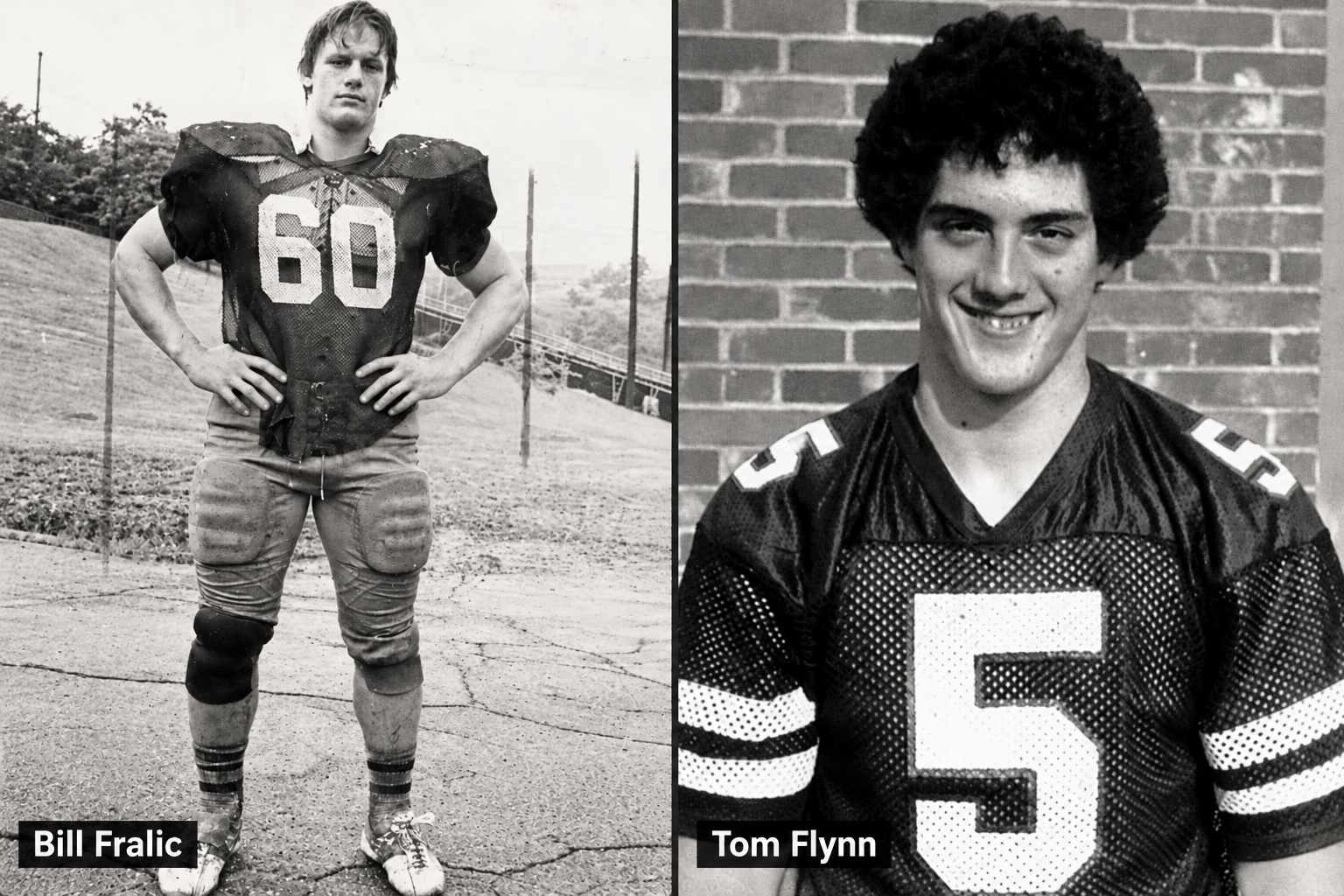
Future Pitt and NFL great Bill Fralic was only a junior. Quarterback and defensive back Tom Flynn would eventually play at Pitt and win a Super Bowl with the New York Giants. Tom Johnson went to Pitt. Bob Lawson went to Pitt. Leon Rhodes went to Virginia Tech.
Even the coaching staff had another important piece of Penn Hills history. Neil Gordon, who would later become the Indians’ head coach and win the 1995 WPIAL championship, was an assistant.
This was a legitimate powerhouse.
But the biggest opponent Penn Hills faced that season wasn’t another football team. It was an eligibility ruling.
One Backup Player Changed Everything
During the season, Penn Hills discovered that a junior backup offensive guard had participated in three games despite being academically ineligible.
This wasn’t one of Penn Hills’ stars.
He wasn’t Fralic. He wasn’t Flynn. He wasn’t somebody carrying the offense or dominating defensively. His participation was limited primarily to special teams.
Penn Hills also didn’t try to hide what happened. The school reported the situation after discovering what was described as an administrative or clerical mistake.
The WPIAL’s response was severe. Penn Hills was ordered to forfeit three victories. Those forfeits would knock Penn Hills out of the playoffs and put Kiski Area into the postseason as the Foothills Conference representative.
Think about that.
One academically ineligible reserve player appearing sparingly in three games was about to end the season for one of the best teams in Pennsylvania.
That’s when this stopped being simply a football story. It became a legal battle.
Penn Hills Took the WPIAL to Court
Parents and supporters fought the ruling in court.
The stakes were enormous because the playoffs were approaching, and there wasn’t much time to settle anything.
On November 3, 1979, Allegheny County Common Pleas Court Judge Nicholas Papadakos ruled in Penn Hills’ favor, preventing the forfeitures from keeping the Indians out of the postseason.
But the WPIAL and PIAA appealed.
The uncertainty became so significant that the Class 3A playoffs were delayed by a week while the legal battle continued.
Then, one day before Penn Hills was scheduled to begin its postseason, Commonwealth Court upheld the ruling that allowed the Indians to play.
So after lawyers, hearings, appeals and a delayed postseason, Penn Hills finally got back to doing what the players had wanted to do all along.
Play football.
And once they got onto the field, they proved they belonged there.
Penn Hills Took Care of Business
The Indians opened the playoffs by beating Southmoreland 31-0.
Then came a matchup that tells you just how good Western Pennsylvania football was at the time. Penn Hills faced North Hills in the semifinals.
Jack McCurry was beginning to build his own powerhouse at North Hills, and his defense had been unbelievable. North Hills had surrendered only one touchdown all season entering the game.
Penn Hills scored 10 points. That was enough.
The Indians won 10-7 and advanced to the championship.
Waiting for them was a familiar rival. Gateway.
A Snowy Night and Three Points
The 1979 WPIAL Class 3A championship was played November 30 at Mt. Lebanon Stadium.
The conditions were pure Western Pennsylvania football.
Cold. Snow. Defense. Neither offense could get much going.
Penn Hills kicker Mike Holodonik had already missed two field goals when the Indians gave him another opportunity late in the fourth quarter.
This time he connected from 28 yards.
There were 3:31 remaining. Penn Hills won 3-0.
On the field, there wasn’t any confusion. Penn Hills had just won its fourth consecutive WPIAL championship.
The Indians finished 12-1, with their only loss coming in the season opener against national powerhouse Cincinnati Moeller.
That wasn’t some ordinary opponent, either. Moeller was one of America’s premier high school programs under Gerry Faust, who would soon become Notre Dame’s head coach.
Penn Hills’ numbers over those four championship seasons were almost ridiculous.
From 1976 through 1979, the Indians went 49-2-1.
They recorded 26 shutouts. Opponents averaged fewer than five points per game against them.
That’s not simply winning. That’s a dynasty.
Then the Championship Disappeared
Penn Hills had won its court battles. Penn Hills had won its playoff games. Penn Hills had won the championship.
But the legal fight wasn’t finished.
The WPIAL and PIAA continued pursuing the case, and in March 1981—roughly 15 months after Penn Hills beat Gateway—a Commonwealth Court panel ruled that Penn Hills should not have been permitted to participate in the 1979 postseason.
The WPIAL subsequently vacated the championship. Penn Hills had to return the trophy. And officially, 1979 became: VACANT.
That’s what makes this story so unusual. Nobody else was declared champion. Gateway didn’t inherit the championship. The WPIAL simply erased Penn Hills from the official championship line.
But you can erase something from a record book much easier than you can erase what happened on a football field.
Was Vacating the Championship Really Justice?
This is where I struggle with the decision. Rules matter. Eligibility standards matter.
I understand why governing bodies have to enforce them. Once you start deciding that certain violations don’t count, you can create a slippery slope.
But punishment should also have some relationship to the violation.
Did this player provide Penn Hills with a meaningful competitive advantage? Was Penn Hills intentionally trying to cheat? Was an ineligible superstar responsible for winning games?
That’s why the punishment has always felt extreme to me.
You’re talking about taking a championship away from an entire roster because a seldom-used reserve participated in three games when he shouldn’t have been eligible.
The other players didn’t become less deserving.
Bill Fralic didn’t suddenly become less dominant. Tom Flynn didn’t stop being the quarterback. Penn Hills didn’t suddenly lose those playoff games on the field.
And nobody can pretend that Gateway actually won that snowy championship game.
The scoreboard said Penn Hills 3, Gateway 0.
Penn Hills Has Never Treated 1979 as Vacant
Maybe that’s the most interesting part. The official WPIAL record can say vacant.
Penn Hills doesn’t have to agree. The school has continued to recognize 1979 as one of its championships.
And I understand why.
Those kids practiced. They played the season. They survived a bizarre legal fight. They beat Southmoreland. They beat an outstanding North Hills team. They beat Gateway for the championship. Nobody handed them anything.
They earned it between the lines.
There were no PIAA football playoffs in 1979, so beating Gateway was the end of the road. There wasn’t another championship waiting afterward.
That was the championship.
It’s Also Why Andy Urbanic Can’t Be Forgotten
Writing my list of the greatest WPIAL coaches ever made me go deeper into some of these older eras, and Andy Urbanic’s résumé deserves much more attention than it gets today.
What he built at Penn Hills was extraordinary.
The 1979 controversy sometimes overshadows the actual football accomplishment.
Four seasons. 49-2-1. Twenty-six shutouts. Four championship games won or tied. And if you’re judging what happened on the football field, four consecutive WPIAL championships.
That is one of the greatest runs any program has ever had in Western Pennsylvania.
The WPIAL record book recognizes only three of those championships. History is a little more complicated.
Forty-Seven Years Later, I Know What I Call Them
It’s 2026 now.
Almost half a century has passed. The court decisions aren’t changing. The official record probably isn’t changing either.
But when I look back at the 1979 season, I’m not going to pretend there wasn’t a champion.
There was.
Penn Hills beat Gateway 3-0 on November 30, 1979. They celebrated a championship because they had won a championship.
You can put an asterisk beside it. You can explain the eligibility violation. You can explain the court cases. You can explain why the WPIAL eventually vacated it.
All of that belongs in the history. But so does what actually happened on the field.
The WPIAL record book says 1979 is vacant. Penn Hills history says otherwise.
And if you ask me?
The 1979 Penn Hills Indians were WPIAL champions.