
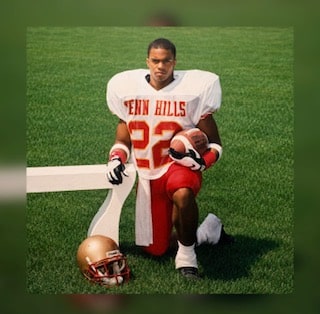
When people talk about the greatest running backs in Penn Hills football history, one name should always be part of the conversation: DeWayne Thompson.
During the mid-1990s, Thompson helped lead one of the greatest teams in Penn Hills history. The 1995 Indians finished undefeated, captured WPIAL and PIAA championships, and relied on a dominant rushing attack. Thompson rushed for more than 1,600 yards that season, sharing the backfield with Victor Strader as Penn Hills became one of the most physical teams in the state.
His outstanding high school career earned him a spot on the prestigious Pittsburgh Post-Gazette Fabulous 22 team before continuing his football career at Rutgers, where he became a member of the Scarlet Knights program.
Today, we’re catching up with one of Penn Hills’ all-time greats to talk about football, memories, and life after the game.
Q: What was it like growing up in Penn Hills, and when did you realize football could take you to the next level?
Thompson: Growing up in Penn Hills was special because it had a real community feel. It was a great sports community where everybody knew everybody, and it was just a fun place to grow up. Football was a big part of our culture, and it taught me hard work, discipline, and resilience. I realized I had a chance to play at the next level during my sophomore year of high school when I started receiving recruiting letters from colleges. That’s when it became real to me that football could open doors and create opportunities for my future.
Q: The 1995 Penn Hills team is considered one of the greatest in school history. What made that team so special?
Thompson: What made that team so special was that it was truly the perfect storm. We had incredible talent, but even more importantly, we had chemistry. Yes, we had our big names, but the unsung heroes on that team would have been stars on just about any other team. We were also a very disciplined team. Everyone accepted their role, trusted one another, and bought into the same goal. We had great coaching, a strong work ethic, and a competitive mindset. We truly played for each other, and that’s what made us one of the greatest teams in Penn Hills history.
Q: You and Victor Strader formed one of the best running back duos Western Pennsylvania has ever seen. What made your chemistry work so well?
Thompson: Victor and I weren’t just teammates—we were brothers. We grew up together and played midget league football together. On the Bantams, we shared the same roles, splitting time at running back, so when we got to high school, it was a natural continuation. We already knew how to complement each other, and there was never any ego involved. When one of us needed a breather, it was simply next man up. I actually enjoyed being on the sideline watching Vic run the football. He was like a magician with the ball in his hands, and it was exciting to watch. The reality was, either one of us could score at any moment. That created a healthy competition because if Vic was in the game for three, four, or five plays, there was a good chance he was going to find the end zone. So when it was my turn, I knew I had to make the most of every opportunity. We pushed each other to be our best, but at the end of the day, we were always rooting for each other’s success.
Q: Coach Gordon built a championship culture at Penn Hills. What made him such a great coach?
Thompson: Coach Gordon prepared me for college football before I ever stepped on a college campus. Our “Hell Week” consisted of three-a-day practices, long days in the weight room, and working in the heat with no shortcuts and no excuses. When I got to college, training camp was also three practices a day—but it lasted for two weeks. Because of everything Coach Gordon had already put us through, I was ready for it. He pushed us every single day. He made us work when we were tired, uncomfortable, and ready to quit. He demanded discipline in everything we did. Even on Fridays, game day, he had us wear blazers and ties. As teenagers, none of us really wanted to dress up like that, but he insisted because he was teaching us discipline, pride, and professionalism. It made us feel like a team, and it got us comfortable doing things that weren’t always comfortable. Looking back, I realize it wasn’t just about football. Coach Gordon was preparing us for life. He built our mental toughness, our physical toughness, and our character. He taught us to embrace hard work, stay disciplined, and never give up, and those lessons have stayed with me long after my playing days.
Q: What is your favorite memory from winning the WPIAL and PIAA championships?
Thompson: My favorite WPIAL memory was walking into Three Rivers Stadium. As a kid, playing in the same stadium as the Pittsburgh Steelers was something you only dreamed about, so that moment is one I’ll never forget. Then, when we ran out of the locker room before the game and saw the entire Penn Hills community in the stands—our families, friends, and fans cheering us on—it was an unbelievable feeling. You could feel the energy, and it made you realize you were part of something much bigger than yourself. The game itself was a battle, but we found a way to win. B.J. DiNatale made one of the biggest plays of the game with an interception return that gave us the lead. It seemed like it took him about 35 seconds to run 50 yards, but he got there, and that’s all that mattered. It’s a memory I’ll always cherish because we accomplished it together as a team. My favorite memory from winning the PIAA championship was scoring four touchdowns in the state championship game, three on offense and one on an interception return. That’s something I’ll always be proud of. What I remember most, though, is how dominant we were as a team. We faced some of the best offenses in the state, but our defense stepped up every time it mattered. Everyone made plays, and that’s what championship teams do. The other memory that always sticks with me is how cold it was. When the clock hit zero and we realized we were state champions, I was excited, but freezing. While my teammates were celebrating on the field and people were looking to interview me, I ran straight to the locker room to warm up. My family still laughs about that to this day.
Q: What was the recruiting process like, and why did you choose Rutgers?
Thompson: The recruiting process was exciting, but it was also one of the most challenging times of my life. I was fortunate to have several Division I schools recruiting me, but I hadn’t reached the SAT score I needed by signing day. Because of that, a lot of schools had to move on and offer those scholarships to other players. Rutgers, however, stayed by my side while I continued taking the SAT, and that loyalty meant a lot to me. Rutgers also had one of the top recruiting classes in the Big East. They had signed outstanding players from Western Pennsylvania like Delrico Fletcher and Mike McMahon. When I took my official visit, I loved everything about it—the location, the diversity of the campus, the energy around the program, and the opportunity to compete for playing time right away. Knowing I had a chance to start as a freshman made Rutgers feel like the perfect fit, and looking back, it was one of the best decisions I ever made.
Q: How did playing at Rutgers help you grow as both a player and a person?
Thompson: Rutgers helped me grow in every way. As a player, I learned what it took to compete at the Division I level. The game was faster, more physical, and more demanding, so I had to elevate my preparation, work ethic, and attention to detail. It also taught me how to deal with adversity. I was blessed to start for several years, but I was also hit by the injury bug. I dealt with a number of unfortunate injuries throughout my college career. Those experiences tested me mentally and taught me resilience. I learned how to fight through difficult situations, stay focused, and never give up. As a person, Rutgers taught me independence, responsibility, and how to connect with people from different backgrounds. The diversity of the campus broadened my perspective, and starting as a freshman gave me the confidence to believe that if you’re prepared and willing to work, opportunities will come. Those lessons have stayed with me long after football.
Q: Looking back, what accomplishment are you most proud of from your football career?
Thompson: I’m proud of being part of the Penn Hills team that was ranked number one in the country by USA Today. To be recognized as the best high school football team in the nation is something no one can ever take away from us. Personally, I’m proud to have been ranked among the top 50 athletes in the country, to have rushed for over 1,600 yards and 26 touchdowns during our state championship season, and to have been selected to the Fab 22 team as a sophomore, junior, and senior. Those honors meant a lot because they reflected the hard work of my teammates, coaches, and everyone who helped me along the way. At Rutgers, I lettered all four years and started for three seasons. I competed against many players who went on to play in the NFL, and I proved I could compete at that level. More than anything, I’m proud that I was always a competitor. Whether I was facing adversity, battling injuries, or lining up against elite talent, I never stopped competing.
Q: Who were some of the toughest opponents you faced during your Penn Hills days?
Thompson: There were a lot of great players and teams during that era. Guys like LaVar Arrington, Melvin Cobb, Jermaine Cromartie, Mark Ponko, Marc Bulger, Brandon Short, and Justin Kerpakis stand out. Woodland Hills was always a tough opponent, too. There was so much talent in Western Pennsylvania at the time that you knew when you stepped on the field against those teams and players, you had to be ready to compete.
Q: If you could tell today’s Penn Hills football players one thing about wearing that jersey, what would it be?
Thompson: Respect the jersey, respect your teammates, and respect the work it takes to wear it. Give everything you have because one day the games will end, but the friendships, the lessons, and the pride of being a Penn Hills Indian will stay with you forever. Leave the jersey better than you found it.
Q: Does that Plum playoff loss still sting today?
Thompson: No, it really doesn’t. Looking back, I can honestly say we weren’t the same team we were the year before. In my opinion, we weren’t as talented, and we weren’t as focused or mentally tough as our championship team. On that day, Plum was the better team, and they deserved to win. The only thing I wish is that we had the opportunity to play Woodland Hills the following week under the lights on turf. I think that would have been a great matchup and a fun game for everyone to see. But that’s football. As they say, when you slip up, you get caught—and that’s exactly what happened. Plum took advantage of the opportunity, and they earned the win.
Q: Finally, when people look back at DeWayne Thompson’s career years from now, what do you hope they remember most about you?
Thompson: I hope people remember me as someone who competed with everything I had every time I stepped on the field. I want them to remember that I was a great teammate, that I played the game the right way, and that I represented Penn Hills and Rutgers with pride. I also hope they remember that I wasn’t just an athlete—I was someone who worked hard, stayed humble, and never quit, even through adversity. Championships, awards, and statistics are special, but those things eventually fade. What lasts is the impact you have on your teammates, your community, and the people who watched you play. If people remember me as someone who gave everything he had and helped make those around him better, that’s a legacy I’ll always be proud of.