
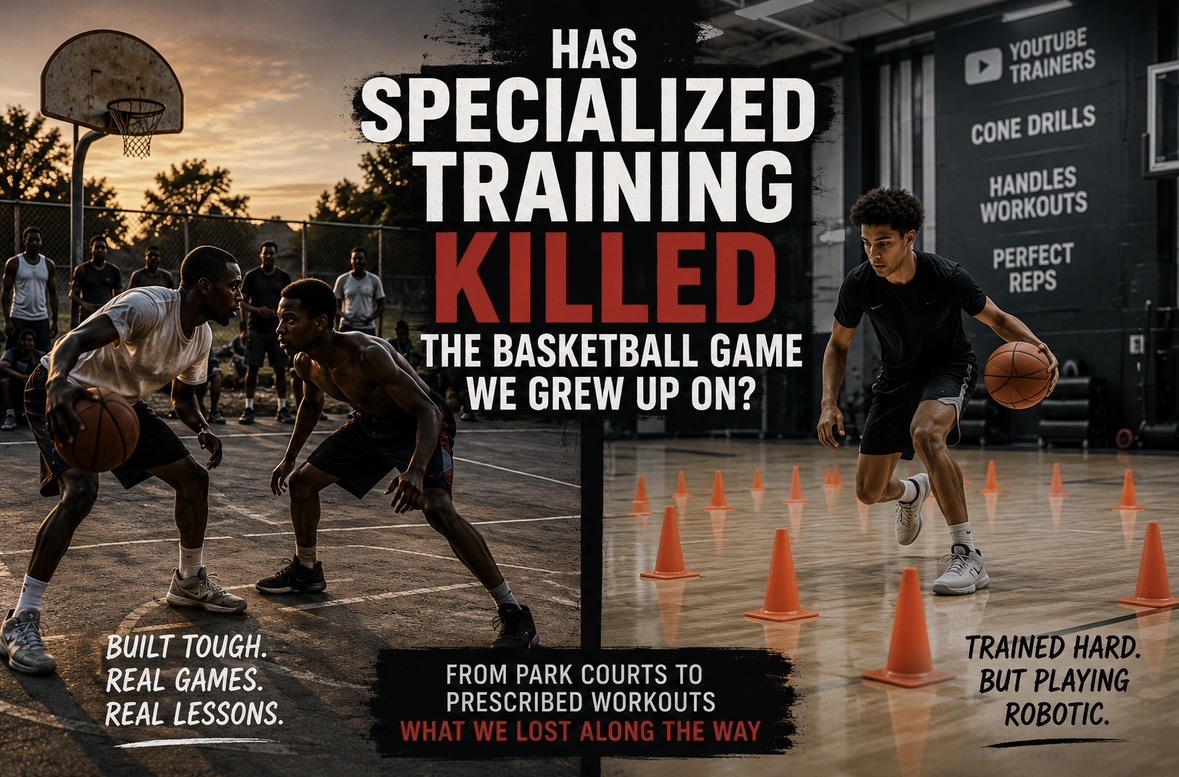
I know this opinion won’t be popular with everyone, especially in an era where basketball training has become a billion-dollar industry. But as someone who grew up playing basketball before social media, before YouTube trainers, and before every kid had a personal skills coach, I believe specialized training has hurt the game in many ways.
Don’t get me wrong. Training has its place. Learning proper footwork, shooting mechanics, and ball-handling fundamentals matters. The problem is that many young players are spending more time rehearsing basketball than actually playing basketball.
When I was growing up, development happened at the park.
You learned by playing older players who were stronger than you. You played pickup games where nobody cared about your ranking, your followers, or your highlight tape. You played one-on-one until it got dark. You learned how to compete, how to adjust, how to deal with trash talk, and how to figure things out on your own.
The court was the classroom.
Today’s players often spend hours weaving through cones, doing scripted drills, and memorizing moves for Instagram clips. They can execute a workout perfectly, but many struggle when the game becomes unpredictable.
Basketball is not played against cones. Cones don’t reach. Cones don’t talk. Cones don’t double-team. Cones don’t hit you with a hard foul when you’re driving to the basket.
Real basketball requires decision-making. It requires creativity. It requires reacting to defenders who are trying to stop you.
Somewhere along the way, many players became workout stars instead of basketball players. The result is a generation of athletes who often look polished but sometimes lack the instincts that come from endless hours of pickup basketball. Too many players are robotic. They know the drill but don’t always know the game.
The best players I’ve ever been around learned through competition. They learned through failure. They learned by getting embarrassed at the park and coming back the next day determined to be better.
You couldn’t fake toughness. You couldn’t edit a highlight tape. You couldn’t hide behind social media. You either got buckets or you didn’t. That’s why so many older players miss that era. The game felt raw. It felt authentic. It taught lessons that went far beyond basketball.
I’m not saying training should disappear. I’m saying it should complement competition, not replace it. Because at the end of the day, basketball is still a game.
And sometimes the best way to get better at basketball is the simplest way: Go find a court and play.