
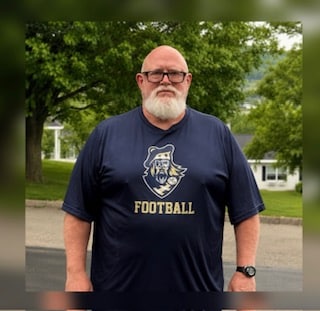
Sometimes you don’t fully understand the impact someone had on your life until years later. For me, one of those people is Russ Moore.
Long before DrewSchifino.com, before the books, before I started looking at my journey differently, Coach Moore did something for me that I’ll never forget: He took a chance on me when other people wouldn’t. He gave me my first opportunity to become a head basketball coach.
And more than a decade later, I finally got the opportunity to tell him what that meant to me.
I Thought My Playing Career Would Open the Door
When I decided I wanted to coach, I was serious about it.
Basketball had been my life. I was one of the most decorated players to come out of the WPIAL, played at West Virginia University, played professionally and had experienced the game at levels most aspiring high school coaches hadn’t. I figured somebody would give me an opportunity.
I was wrong. I went on interview after interview and kept getting passed over.
It was frustrating watching people with résumés I didn’t believe compared to mine get opportunities while I couldn’t get my foot in the door. Eventually, I started understanding something about high school coaching that I hadn’t realized from the outside.
Your résumé isn’t always enough. Relationships matter. Connections matter. Sometimes having somebody on the inside who believes in you matters as much as anything you’ve accomplished. But I kept applying.
At the time, I was living in Monroeville, Pennsylvania. Eventually, I saw that the boys basketball head coaching position at Waynesburg Central High School had opened. So I applied.
Why Waynesburg?
I knew a little about Waynesburg before I ever interviewed.
Most importantly, I knew about Russ Moore. Coach Moore had built a tremendous reputation as a football coach, including leading Waynesburg to the school’s only WPIAL football championship. I also knew he was a West Virginia University guy.
I remember thinking, Maybe I finally have a shot.
Waynesburg basketball wasn’t exactly a powerhouse at the time. The program hadn’t won a section game in years. They needed somebody willing to come in, work and try to build something. I needed somebody willing to give me an opportunity. Maybe we needed each other.
When Coach Moore contacted me, he initially couldn’t believe it was really me applying for the Waynesburg job. He remembered Drew Schifino from WVU basketball and basically wondered why that guy would be applying to coach at Waynesburg.
But my answer was simple. I wanted to coach. That was my passion.
He Went to Bat for Me
I interviewed, and Coach Moore believed I was the right person for the job. But there was still another obstacle. My dismissal from WVU came up.
That chapter of my life had followed me for years, and I understood why a school would ask questions. But I also explained that I hadn’t committed a crime. I hadn’t done anything illegal. It was a situation between a player and a basketball program that had become part of my public story.
Coach Moore listened. More importantly, he believed in me. He put my name in front of the school board and went to bat for me.
I’ll be transparent about something else that was going through my mind at the time.
Waynesburg is in Greene County. It was a rural community that was completely different from where I grew up. As a Black head-coaching candidate coming from Penn Hills and the Pittsburgh area, I wondered whether I would truly be accepted there.
That was my perception going in. I couldn’t have been more wrong. They approved me.
Russ Moore had helped give me my first head coaching job.
An Hour Each Way
That season wasn’t easy.
We weren’t walking into a ready-made championship program. We had a long way to go. But we started winning section games again. More importantly, we were building. Every day during the winter, I made that roughly hour-long drive from Monroeville to Waynesburg because I was determined to become a great WPIAL basketball coach. At that point in my life, I thought coaching would be what I did forever. I pictured myself eventually retiring as a coach.
Then the season ended, and everything changed.
The Decision I Still Regret
I received a phone call asking whether I wanted the Steel Valley head coaching job. It was tempting.
Steel Valley was only about 15 or 20 minutes from where I lived instead of an hour away. The program had the kind of talent that could compete for a WPIAL championship. I decided I wanted the job.
But there’s one part of that decision that has bothered me for years. I didn’t tell Coach Moore what I was planning to do before accepting it.
Looking back, I felt shady.
Here was a man who had stood up for me when he didn’t have to. He believed in me when other schools wouldn’t give me an opportunity. Waynesburg had welcomed me and treated me with respect. And instead of sitting down with Coach Moore and telling him what I was thinking, I left.
That stayed with me.
The Place I Worried About Accepted Me
What happened afterward taught me one of the biggest lessons of my life.
I had initially wondered whether I would fit in at Waynesburg because it was so different from where I came from. They treated me like family.
Then I went somewhere much closer to the environment I knew.
I thought Steel Valley would naturally be a better fit. Instead, my experience there became the complete opposite of what I expected. I felt disrespected and eventually learned that familiarity doesn’t always mean comfort, loyalty or acceptance.
That experience changed the way I looked at people. Never judge a book by its cover. Perception isn’t always reality. The community I initially worried might not accept me became one of the places where I felt most accepted. And the situation I assumed would feel more comfortable didn’t.
Life has a funny way of teaching you lessons like that.
More Than a Decade of Silence
The craziest part of the story is that after I left Waynesburg, Coach Moore and I didn’t talk for more than a decade.
And it bothered me.
Whenever I drove past Waynesburg on my way to a WVU game, his face would sometimes pop into my head. I’d wonder how he was doing. I’d think about what he had done for me. I’d think about how I left.
That’s why when I wrote Buckets & Battles, I made sure Coach Moore was part of my story. He deserved to be. Then, after all those years, we finally reconnected. And I finally got to tell him what I should’ve told him a long time ago.
Thank you.
“It Was a Pleasure Working With You”
When we reconnected, Coach Moore didn’t respond with bitterness. He responded exactly like the man I remembered. He told me it had been a pleasure working with me and joked that being able to say he hired a WVU great was “definitely a feather in my cap.”
Then he started talking to me like a coach again.
He reminded me how difficult coaching can be when you’re young and still learning how to reach players who don’t possess the same ability you had. Then he told me something that put my own early coaching struggles into perspective.
His first year as a head coach, his team went 0-10 and scored one touchdown the entire season. Success didn’t immediately follow. He said things didn’t really turn around until about his sixth year.
Decades later, after coaching at both the high school and college levels, he told me he was still learning.
That stuck with me.
How Coach Moore Measures Success
But something else he told me meant even more.
Coach Moore said too many of us spend our lives trying to become the person other people expect us to be instead of figuring out who we really are. He encouraged me to keep growing, keep mentoring and keep helping young people.
Then he explained how he measures his own career. It isn’t wins and losses. It’s looking at the young men he coached 10 years later and seeing what kind of people they became.
Think about that.
A man who coached for more than four decades, won a WPIAL championship and spent years coaching college football doesn’t lead with trophies when discussing his legacy. He talks about people.
That tells you everything you need to know about Russ Moore.
Maybe Everything Really Does Happen for a Reason
My life today looks completely different than I thought it would when I was making those winter drives to Waynesburg. I thought coaching was going to define the rest of my life.
It didn’t.
My journey went in directions I never could’ve predicted.
I’ve had to grow. I’ve had to look at mistakes I’ve made. I’ve had to change parts of myself that needed changing. And I’ve learned that sometimes growth isn’t just about where you’re going. Sometimes it’s about finally understanding the people who helped you get there.
I believe there’s a reason Coach Moore and I reconnected when we did. Maybe the younger version of me didn’t have the maturity to fully appreciate what he had done.
The man I am today does.
One of the greatest gifts of changing your life is getting the opportunity to say things you should’ve said years ago while the person is still here to hear them.
So Coach Moore, I want to say it publicly now. Thank you. Thank you for believing in me. Thank you for looking beyond a difficult chapter in my past. Thank you for putting your name behind mine. Thank you for going to bat for me. Thank you for giving me my first head coaching opportunity when so many others wouldn’t. And thank you for treating me like family in a place where, because of my own preconceived ideas, I wasn’t sure I would be accepted.
I wish I would’ve handled leaving Waynesburg differently. I can’t change that. But I can make sure Russ Moore knows today how much his belief in me meant.
Everything happens for a reason.
And regardless of where the rest of my journey takes me, Coach Russ Moore will always be one of the greatest people to ever come into my life, and one of the most important people in my story.