
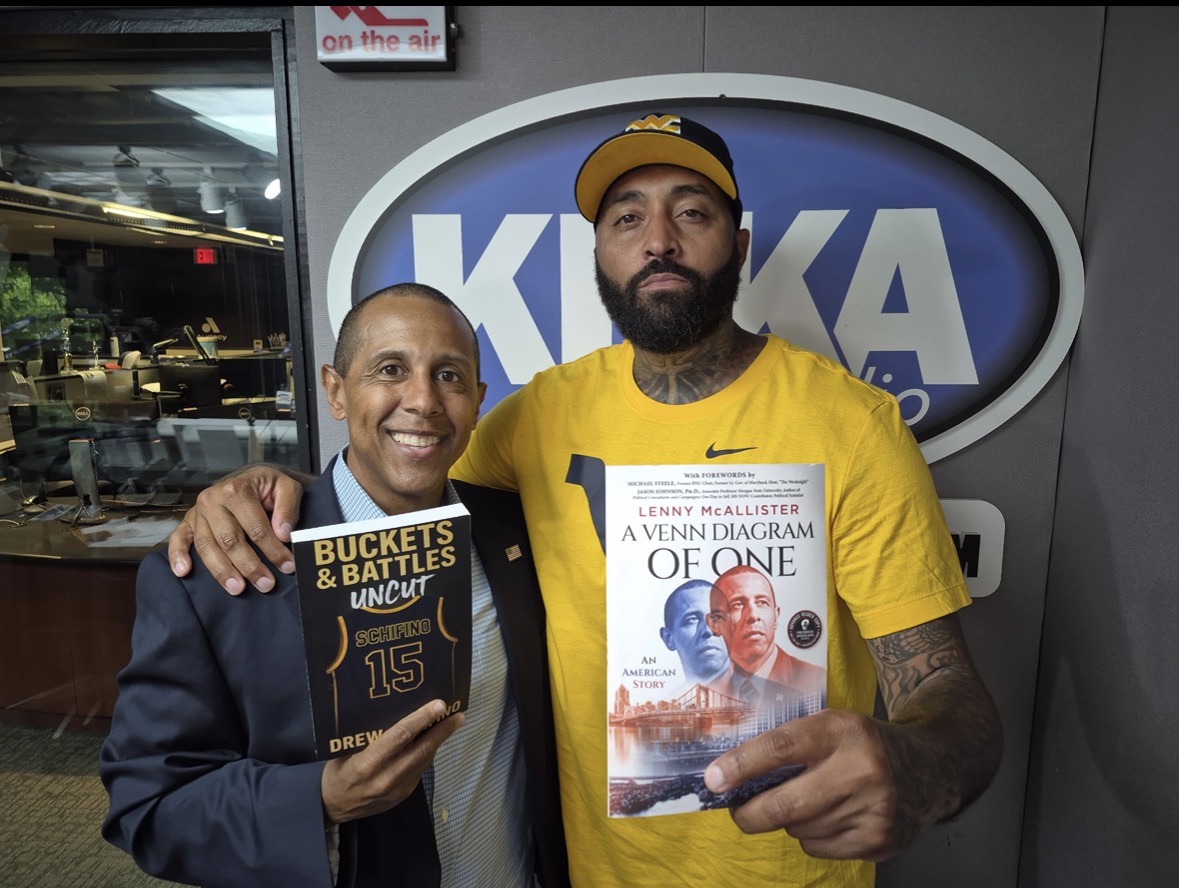
I’ve always believed that you can learn a lot about somebody by watching how they treat people who don’t necessarily agree with them.
It’s easy to talk about unity when everybody in the room thinks alike. It’s easy to preach respect when nobody challenges your beliefs. But what happens when you’re surrounded by people who see the world differently?
That’s when character really gets tested. And that’s one of the reasons I wanted to sit down with Lenny McAllister.
For those unfamiliar with Lenny, he’s spent years working in politics, broadcasting, public service, and community leadership. He’s been involved in conversations that extend far beyond Western Pennsylvania, but his roots remain right here in Penn Hills.
That’s something we have in common.
We both came out of Penn Hills, and although our professional journeys took us in completely different directions, we understand how much your upbringing can influence the person you eventually become.
Lenny has navigated political and cultural environments where people often expect you to fit neatly into a particular category.
But what happens when your beliefs, experiences, and convictions don’t fit into one box?
That’s a major theme behind his book, A Venn Diagram of One: An American Story.
And I think it’s a conversation worth having.
More Than Just Another Political Conversation
One thing I’ve noticed over the years is how quickly Americans have become comfortable labeling one another.
Republican. Democrat. Conservative. Liberal.
Sometimes people hear one of those labels and immediately decide everything they need to know about somebody.
They don’t ask questions. They don’t listen. They don’t even attempt to understand the experiences that shaped that person’s beliefs.
And I think that’s unfortunate.
I’ve always believed you can disagree with somebody politically and still respect them as a human being. You can have different opinions about government, religion, race, and social issues without turning every disagreement into a personal battle.
Somewhere along the way, I think we’ve lost sight of that.
That’s why I found the premise of Lenny’s book interesting. It’s not simply about political positions or public accomplishments. It’s about identity, personal responsibility, faith, leadership, and the experiences that shape our understanding of the American Dream. It’s also about the importance of standing on your principles, even when doing so costs you something.
And according to Lenny, those costs have sometimes included financial opportunities and professional support.
That’s something I wanted to explore.
Because it’s one thing to talk about having principles when everything is going your way. It’s another thing to maintain those principles when they become inconvenient.
The Penn Hills Connection
Another part of this conversation that stood out to me was Lenny’s appreciation for the people who helped raise and influence him.
When you grow up in a community like Penn Hills, you don’t always realize how much that environment is shaping you.
Your parents. Your teachers. Your coaches. Your neighbors. The older people who take an interest in you and want to see you succeed.
Sometimes you don’t fully appreciate those influences until years later.
Lenny talks about his parents, his education, and the people who invested in him long before he became a recognizable voice in politics and broadcasting.
I can relate to that.
I’ve traveled, played basketball at the highest levels of college competition, competed professionally overseas, and met people from all different backgrounds.
But no matter where life has taken me, Penn Hills will always be part of my foundation. And I think Lenny would tell you something similar about his own journey.
Different careers. Different experiences.
But an understanding that the people who helped shape us deserve recognition.
A Book Born From Personal Loss
What I didn’t know before this interview was how much personal loss influenced Lenny’s decision to write the book.
Within six months, he lost two mentors who had played important roles in his life.
Rev. Dean Nelson passed away in December 2023, and Dr. Metzler died in March 2024. Both were Black men who died in their 50s.
Those losses forced Lenny to think about his own purpose, the importance of time, and what it truly means to leave something meaningful behind.
He describes both men as servant leaders. And rather than simply reflecting on their deaths, he decided to put his own experiences into words.
I found that particularly interesting because sometimes the biggest turning points in our lives don’t come from success.
They come from loss. They come from disappointment. They come from realizing that tomorrow isn’t guaranteed.
And they force us to ask ourselves whether we’re really doing what we were put here to do.
Leadership, Accountability, and the Next Generation
One of the biggest things I wanted to discuss with Lenny was leadership.
Not just political leadership. Leadership in our communities, our homes, and our everyday lives.
We live in a society where somebody can build a massive following by being controversial. They can generate millions of views by making people angry.
But does that automatically make them a leader?
I don’t believe it does.
There’s a difference between having influence and using that influence responsibly. There’s a difference between getting attention and actually making a difference.,And there’s certainly a difference between being popular and being respected.
Lenny has some interesting thoughts on that distinction.
We also discussed the younger generation, the importance of opportunity in struggling communities, and whether Americans are really as divided as social media sometimes makes us believe.
One of his strongest arguments is that empowerment is the missing ingredient in too many communities.
People need more than promises. They need education, economic opportunities, career advancement, and a legitimate chance to improve their circumstances.
That’s a conversation that goes well beyond politics. It’s about the future of our communities.
My Takeaway Before the Conversation
I don’t believe you have to agree with everything somebody says to learn something from them. And I don’t believe every conversation needs to end with one person proving the other wrong.
Sometimes the most valuable thing we can do is listen.
That’s what I wanted this interview to accomplish.
Lenny McAllister has lived a life that has taken him through different political, professional, and cultural environments. Along the way, he’s experienced success, criticism, setbacks, and reinvention.
But what I found most interesting wasn’t simply where he’s been.
It was how those experiences shaped the person he is today and the message he wants to leave behind.
His story also raises a question I think all of us should consider: Are we more interested in being right, or are we genuinely interested in making things better?
With that being said, I appreciate Lenny taking the time to answer these 15 questions for DrewSchifino.com.
Let’s get into it.
Q: Lenny, you’ve spent years in politics, broadcasting, and public service. What happened in your life that made you decide this was the right time to write A Venn Diagram of One: An American Story? Was there a particular moment when you knew this story needed to be told?
Lenny McAllister: After the passing of my second beloved mentor in six months, I felt the need to step out in faith and put down my thoughts in book form. The late Rev. Dean Nelson passed away after an aggressive illness in December 2023. I had just spoken to him in November 2023 to thank him for his role in my life, and yet I had no idea that he would be gone just 45 days later. Dr. Metzler, a leader in civil rights, labor law, and public policy, was scheduled to attend my son’s Sacrament of Catholic Confirmation in May 2024. He was gone by the end of March. Both left us far too soon, Black men dying in their 50s. It was shocking, and yet what I took out of the shock was the need to up my intentions to live each moment to its fullest. They were servant leaders, and that has always been my goal: to live my life as a humble servant leader. And sometimes the best way to lead is to show the highs and lows on one’s journey, allowing others to see that the scars of failure often lead to the muscle memory of success. Thus, I needed to put down my thoughts. Others likely felt like me, even if the life experiences differ.
Q: The title A Venn Diagram of One immediately caught my attention. Most people associate a Venn diagram with things overlapping or coming together. What does that title mean to you personally, and how does it reflect the journey you’ve taken?
Lenny McAllister: I mentioned this during my interview with Major Garrett on his podcast, The Takeout with Major Garrett. The title of the book, A Venn Diagram of One: An American Story, not only highlights the unique path that God has allowed me to be on, but it also describes the uniqueness of our nation. There is not another nation in the world with the level of diversity, integration, complexities, connectivity, challenges, and overall successes that the United States of America has had over 250 years, often in spite of itself. It reflects a journey that I have taken personally and we have taken collectively, a walk that has taught us to lean into our spiritual faith and secular belief in ways that allow us to foster the American Dream and create new opportunities for ourselves and our children.
Q: One thing I’ve noticed about today’s society is that people almost demand that you choose a side. Whether it’s politics, race, religion, or social issues, independent thinking sometimes comes with a price. How much of your book is about the personal consequences of refusing to fit into somebody else’s box?
Lenny McAllister: The book discusses the times when I’ve had to stand on my own and make decisions. Not all of them, mind you, but certain instances where I felt that it was more important for me to stand on principle, for my family and community, for posterity and for what’s right, than it was to stand with the popular movement. And, to be fair, I’ve watched it cost me money and opportunities. Renowned activist Leon Ford mentioned it during one of the quotes for the book: “He is a man of faith and a principled thought leader who selflessly invests in the full spectrum of communities he serves … His commitment to leading with integrity has earned him praise and, at times, cost him support. Yet he remains steadfast, consistently challenging the status quo and doing what is right not for public relations, but for purpose.” I’d rather have that as my reputation and connection to people than going viral or being popular, if I have to choose. Principles matter.
Q: You’ve spent time around some powerful people and major political institutions. When you look back at your career, was there ever a moment when standing on your principles cost you an opportunity, a relationship, or something financially? How did that experience shape the message of your book?
Lenny McAllister: There have been times, but the lessons that I learned from those experiences are ones that I’ve tried to teach the young people that I have mentored and guided in my life. Do the right thing, trusting that listening to that “soft, still voice” that moves you with ethics and morals through life will allow you to overcome and position you to lead for the sake of helping others.
Q: One of the things I find fascinating is how divided America has become. People can disagree politically and suddenly become enemies. Do you believe Americans are genuinely that far apart in their beliefs, or have politicians, social media, and the media convinced us that we’re more divided than we actually are?
Lenny McAllister: We have more in common than we often are led to believe. That’s why I wrote A Venn Diagram of One. America remains the melting pot, and as a melting pot, we each contribute something that creates the richness that our society and its traditions have offered the world. Yet, the perception of our differences as detractions versus viewing them as complements to the American collective effort is where we lose out. We have to get back to seeing our differences as diversity that works for the greater cause. We don’t have any Americans to waste or lose. Each human in our nation must be a human resource, of talent, of thought, of energy, and of civic love. Division stifles that. Reconnection uplifts it.
Q: Your book discusses leadership, something I think our country desperately needs. In your opinion, have we reached a point where being popular, controversial, and having a large following is more valuable than actually being a good leader?
Lenny McAllister: No. People want good leadership. People crave good leadership. That’s why I wrote A Venn Diagram of One, to show that leadership looks different based on demographics, geography, and place in history. Civic love and leadership are constant needs but don’t have the same look and feel. Because we have often bought into the notion that leaders must look a certain way, vote a certain way, and act based on the rules within our silos and echo chambers, we mistake certain rhetoric or positions as true leadership, when sometimes it’s nothing more than performative antics that mislead us and divide us. True leadership is loving the people you serve more than they can ever love you back. True leadership is serving people in a capacity that will never fulfill you in quite the same way. The service is its own reward, its own payback. And people throughout history have always looked for that and needed that. The need for that type of leadership, in Pittsburgh and throughout the nation, is greater now than it’s been in a long time.
Q: As a Black man who has navigated different political and cultural spaces, have you ever felt pressure to think or speak a certain way simply because of your race? How much did those experiences influence what you wrote?
Lenny McAllister: Not anymore. I’ve been able to show over time that consistency of character will display the pathways to connection. And once I’ve been able to bridge connections with others, the pressure is not on trying to fit in, but the pressure comes with the obligation to work within each room with ongoing intentionality to make a positive, permanent difference for the greater good. The pressure to “be” is not a thing for me; the pressure to “be effective” is the only pressure I feel. And I use that pressure to push me forward to act, lead, collaborate, and work for that greater good.
Q: You emphasize security, empowerment, and opportunity. When you look at communities throughout Pittsburgh and across America, which of those three do you believe we’re failing people on the most, and why?
Lenny McAllister: Empowerment. Granted, we need people within our communities to be safe walking down the street. We need them to feel secure in their status as American citizens, capable of voting without fear and walking down the street in full enjoyment of their constitutional rights. Yet, without empowerment, the ability to get a proper education, to find pathways for career advancement and self-sustainment, and to reinvent themselves as needed through investment and opportunity, the American Dream for the non-wealthy American is mostly a misnomer. More Americans in the exhausted middle, the people who don’t follow politics 365 days a year and the folks who spend most of their time and money trying to survive, need regular chances to improve their lives. Getting a shot at life or a second chance to get it right shouldn’t be akin to playing the lottery. Empowerment allows people to make the most of each day. All three, security, empowerment, and opportunity, are braided together. Yet, without empowerment, people can be secure without the ability to advance, and opportunity is voided without the chance to move from hopes to action.
Q: Something I always talk about is how your upbringing shapes the person you eventually become. What experiences from your childhood or early adulthood had the biggest influence on the values and convictions that readers will discover in this book?
Lenny McAllister: My parents, honestly. My parents were superheroes, and folks of their generation, notably African Americans who had to grow up during the turbulence of the 1950s and 1960s and become adults and parents during the malaise of the 1970s, were capable of taking the baton from their parents and pushing their Gen X children into heights that were not available to many of their family members before them. That is the American Dream, because there are people from all walks of life and all different ethnic backgrounds who have had to do the same thing over the past 100 years in particular. And, aside from my parents, I’ve had a lot of influences: “St. Bart’s University” (my grade school in Penn Hills), CCHS, SSA, and of course the Mark Drive Family, that made sure that I could optimize my potential. They molded me so that whenever I am on stages from coast to coast, television, radio, or otherwise, I feel them with me. Eloquence is nothing without experience and relevance. Their love and investment in me fostered any eloquence I have through the gifts of experience and relevance they taught me.
Q: I find it interesting that so many people talk about wanting unity, but the moment somebody disagrees with them, that unity goes out the window. Do you believe people genuinely want to find common ground, or do they really just want everybody else to agree with them?
Lenny McAllister: People want folks to respect them more than they ever want them to agree with them 100% of the time. The goal is not to find common ground out of any argument. The goal is to find common ground out of ongoing relationship, and relationship cannot occur without respect. Most times, the two sides of politics can’t disagree without being disagreeable. Most times, opposing sides can’t debate without being disrespectful. Americans want to be heard, respected, and honored with civic love. Those things do not demand constant agreement. Yet, in our democracy, those things cannot be optional if our government and its policies are to work for as many of us as possible.
Q: You discuss the importance of reflection and the turning points that shape our lives. Looking back, what was the most difficult chapter of your personal journey to put into words, and why?
Lenny McAllister: Actually, I would say that the next chapter is the most difficult chapter. Why? Because it’s always about the work, serving others, building structures that others will climb and utilize. Reflection means nothing if the reflection at each inflection point does not point us in a better direction, and there is no need for knowing the new direction if we are not going to focus forward and do the work ahead of us. Chuck Noll said it best when he was coaching those Super ‘70s Steelers: focus on being tomorrow people, not yesterday’s champions. That is my focus, and that’s my goal: looking at the next chapter in my life as the most difficult. For it’s the one with people in need, problems to resolve, policies to amend or abolish, and opportunities to make the most of.
Q: You and I both understand the influence of having a platform. I often say that getting attention is one thing, but using that attention to make a difference is something entirely different. What responsibility do you believe people in media have when it comes to shaping public opinion rather than simply generating reactions?
Lenny McAllister: I have an obligation to reflect leadership. I have an obligation to reflect the past of my history, of my family, of my people, of America, of my faith as a child of God. That’s how I see the responsibility. Now, not everyone feels the same. Media is a free market entity. Some people only use media to make money or profit instead of using it to make a positive difference. That’s their choice. My choice is to make a lasting mark that elevates the common good.
Q: One thing that concerns me is the younger generation. They’re growing up in a world where political hostility, social media arguments, and division are almost normal. If a 20-year-old picks up your book, what is the most important lesson you hope they walk away with?
Lenny McAllister: Faith, in self, in God, and in America. Believe that you can be the change you want to see and feel in this world. Believe that the next American leader can come from any corner of the nation, including theirs. Hope and change is not just a campaign slogan from 20 years ago; it’s a mantra that has allowed former slaves and the children of immigrants to win World War II. Their families helped us build up the American Era from the late 1880s through today. It’s within them, despite today’s woes.
Q: You’ve experienced success, setbacks, criticism, and reinvention throughout your career. What did writing this book teach you about yourself that you may not have fully understood before you started?
Lenny McAllister: What I learned from writing A Venn Diagram of One is that the power of leadership often comes from the example of living an honest, flawed, and persistent life. A journey where second acts are not necessarily rewarded with wild success but with trail magic for opportunities and experiences that I could not have expected as a kid growing up in Penn Hills. From there, I learned that the power of my words, works, and presence matter. If I believe, they can be the shoulders upon which others can stand, just as I did with those who came before me.
Q: Finally, Lenny, when somebody finishes the last page of A Venn Diagram of One, what do you hope stays with them? And if there’s one misconception people have about you that this book finally gives you an opportunity to address, what would it be?
Lenny McAllister: That our communities are full of second acts, with people who are willing to lead despite our differences. One misconception about me? It’s one that is likely dissipating, but it’s the inaccurate notion that my political affiliation, neighborhood of origin, or academic background prevents me from loving on communities, serving communities as a humble servant leader, and being a difference to broker new levels of peace and success for others. I am about the work of making our world better.
Final Thoughts
After reading through Lenny’s answers, one thing stood out to me.
He kept coming back to service.
Not political parties. Not popularity. Not how many followers somebody has.
Service.
And I think that’s an important distinction in today’s society.
We spend so much time arguing about who’s right and who’s wrong that sometimes we forget the people who are actually affected by the decisions being made.
The families trying to survive. The young people looking for direction. The communities that need investment. The people who simply want an opportunity to improve their lives.
I also appreciated what Lenny said about respect.
Because I think too many people confuse unity with agreement.
You don’t have to agree with somebody on every issue to recognize their humanity. And you certainly don’t have to share somebody’s political beliefs to acknowledge the good they’ve done.
For me, that’s one of the most important conversations we can have right now.
Lenny and I come from the same community, but we’ve traveled different roads. And that’s what makes conversations like this valuable.
You get an opportunity to see the world through somebody else’s experiences.
I want to thank Lenny McAllister for taking the time to participate in this exclusive Q&A with DrewSchifino.com and for sharing the personal experiences behind A Venn Diagram of One: An American Story.
Whether you agree with his political views or not, I think there’s something worth considering in his message.
At the end of the day, your legacy shouldn’t simply be about what you accomplished for yourself. It should also be about what you helped make possible for somebody else.
And that’s a message that goes far beyond politics.