
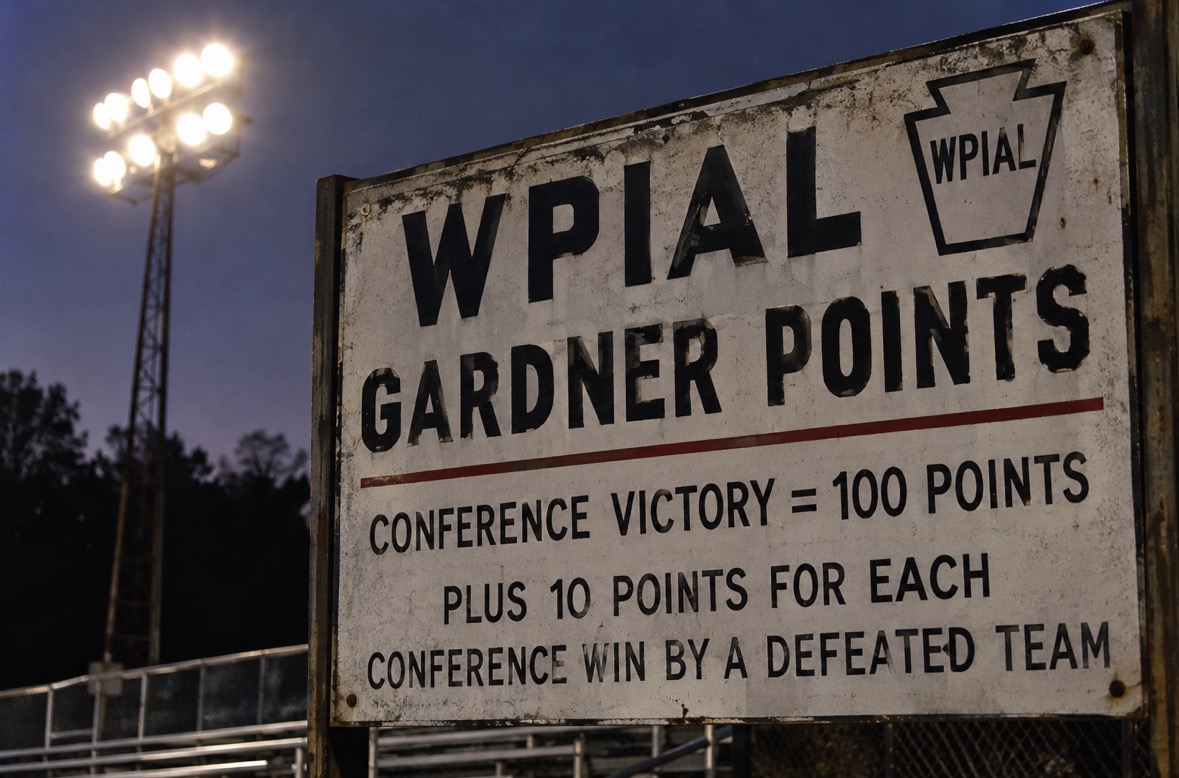
If you followed WPIAL football back in the day, there are two words you definitely remember: Gardner Points.
Man.
Just hearing the name probably brings back memories for some coaches, players and fans who spent the final weeks of a football season trying to figure out who needed to beat who just so their team could get into the playoffs.
Today, we complain about playoff seedings.
We complain about classifications. We complain about wild cards. We complain about too many teams making the playoffs.
But anybody who remembers the Gardner Point days knows there was a time when figuring out the WPIAL playoff picture could feel like doing somebody’s taxes.
And depending on the era, you could have a really good football team and still watch your season end because of something you couldn’t control.
That was the part that drove people crazy.
What the Hell Were Gardner Points?
For younger readers, let me explain this as simply as possible.
Gardner Points were essentially a way of putting a value on your victories based partly on the success of the teams you defeated.
In the system used for many years, only conference games counted. A conference victory was worth 100 points, and you received an additional 10 points for each conference victory earned by a team you defeated.
So let’s say Penn Hills beats Team A.
Team A eventually finishes with four conference victories. Penn Hills gets the points for winning the game, plus another 40 Gardner Points based on Team A’s four wins.
Now imagine Penn Hills beats Team B and Team B doesn’t beat anybody.
Same victory on Penn Hills’ record. Not the same value in Gardner Points.
That was the system.
And this is where things got interesting. You could beat somebody in September and find yourself rooting like hell for them in October.
Not because you suddenly became a fan. Because you needed them to win so your victory over them became more valuable.
That’s old-school WPIAL football for you.
Your Playoff Fate Could Be Sitting in Another Stadium
That’s the part younger fans need to understand.
Imagine Penn Hills takes care of business on a Friday night. Game over. Everybody should be celebrating, right?
Not necessarily.
Somebody in the stands might be listening for another score.
“What did North Hills do?” “Did Gateway win?” “What’s the score of the Woodland Hills game?”
Not because those teams were necessarily playing Penn Hills.
Their results could affect the math. Your game could be finished and your playoff situation still wasn’t settled.
Think about how crazy that sounds today.
A bunch of 16- and 17-year-old kids could do everything they were supposed to do, walk off the field with a victory, and then wait to find out what happened somewhere else.
Before Head-to-Head Became King
The system became more reasonable over time because head-to-head results were eventually given priority in many tiebreaking situations.
But that wasn’t always the case. And one of the greatest examples happened in 1983.
Bethel Park defeated Mt. Lebanon, 7-6, in the regular-season finale.
You’d think that’s simple.
Same playoff race? Bethel Park beat Mt. Lebanon? Bethel Park goes ahead of Mt. Lebanon.
Not back then.
Mt. Lebanon had more Gardner Points, helped by a victory over North Hills, and Mt. Lebanon got the fourth and final playoff spot.
Imagine being Bethel Park.
You literally beat the team you’re fighting for a playoff spot. Then that team gets into the playoffs instead of you.
And here’s the craziest part.
Mt. Lebanon didn’t just get in. They won the WPIAL championship. That’s one of those stories that perfectly captures that era.
One team’s heartbreak became another team’s championship run.
Gardner Points Were Bigger Than Just a Tiebreaker
Go further back in WPIAL history and Gardner Points carried even more importance.
There was a time before the modern playoff tournament when WPIAL football champions could be determined through the point system itself.
That’s how different high school football was.
Today, we expect championships to be settled on the field through a bracket.
Quarterfinals. Semifinals. Championship.
Back then, mathematics could play a much larger role in deciding who got an opportunity — and historically, even who was recognized as champion.
That’s hard to imagine now.
The System Wasn’t Completely Stupid
I’ll be fair. There was logic behind Gardner Points.
The idea was basically strength of victory.
Beating a really good football team should mean more than beating a team that couldn’t win a game. I understand that.
We still use versions of that philosophy throughout sports today.
Strength of schedule matters. Quality wins matter. College football has spent decades arguing about resumes. NCAA basketball teams get compared by who they beat. So the idea behind Gardner Points wasn’t ridiculous.
The problem was what happened when that philosophy collided with high school football.
Because you don’t control what another team does after you beat them.
That’s What Made It So Brutal
Let’s say you beat a team in Week 3.
Maybe they’re talented. Maybe everybody thinks they’re going to have a great season.
Then their quarterback gets hurt. They lose four games.
Your victory becomes less valuable through absolutely no fault of your own. Meanwhile, another team in your conference beats somebody who gets hot late in the year and starts stacking victories.
Their Gardner Point total keeps getting better.
What exactly were you supposed to do about that? Nothing.
That’s what made the system frustrating.
Football already gives you enough things to worry about. Blocking. Tackling. Turnovers. Penalties. Injuries. Weather. Coaching.
Now I have to worry about whether some team I beat a month ago can win Friday night too?
Friday Nights Became Math Class
The last couple weeks of the regular season could get hilarious.
People had scenarios everywhere.
“If we win, they lose, this team wins and that team finishes with four conference victories…”
Hold on. What?
Newspapers would break down the playoff possibilities.
Coaches knew the numbers. Fans were trying to calculate everything. And sometimes you needed more than Gardner Points.
If teams remained tied, the WPIAL could move to its point-differential tiebreaker, which awarded or deducted points based on conference-game scoring margins, with a maximum of 10 in either direction.
And if everything was still tied? There were eras when you could eventually reach a coin flip.
Imagine practicing since August and having your season potentially come down to that.
High school football used to be wild.
Good Teams Were Going Home
That’s what I remember most about those days.
The playoffs felt harder to reach. There weren’t as many classifications. There weren’t playoff spots everywhere. You could be a legitimate football team and still be finished after the regular season.
That’s why making the WPIAL playoffs meant something different back then.
Sometimes one loss could destroy you. Sometimes a three-way tie could destroy you. Sometimes Gardner Points could destroy you.
And sometimes another team’s result could destroy you.
There wasn’t always a second chance.
And Gardner Points Aren’t Completely Dead
Here’s something some people might not realize.
Gardner Points never completely disappeared from WPIAL football.
The WPIAL changed how playoff qualification works over the years, and head-to-head competition became the first tiebreaker in situations where it can settle things.
The league has also changed its approach to wild cards, with the football committee now selecting some wild-card qualifiers rather than relying entirely on the old mathematical process.
But Gardner Points can still come into play when three or more teams are tied and head-to-head results don’t resolve the situation.
So Gardner Points aren’t exactly ancient history.
They just don’t have quite the same power over an entire season that many older WPIAL fans remember.
Was It Fair?
That’s where I’ll let everybody argue.
Because I already know some old-school football people are going to defend it. And they’ll make a legitimate argument.
Beat better teams. Play a tougher schedule. Your victories should mean more.
I understand it.
But I’ve always believed football games should matter more than formulas. Especially head-to-head.
If two teams are fighting for one playoff spot and one beat the other on the field, that’s about as good a tiebreaker as you can have.
No calculator needed.
You lined up. You played.
One team won.
But I’ll Give Gardner Points This…
They made the end of the season interesting as hell.
You didn’t just watch your game. You watched the scoreboard. You listened for scores from other stadiums. You grabbed the newspaper the next morning. You tried to understand every possible scenario.
And everybody suddenly became a WPIAL mathematician for two weeks. 😂
It was confusing. It was frustrating.
Sometimes it probably wasn’t fair.
But it was definitely part of the experience of following Western Pennsylvania high school football.
If You Know, You Know
That’s why I love going back and talking about stuff like this.
The younger generation sees WPIAL football the way it exists today.
Six classifications. Online brackets. Instant scores. Social media updates. You can pull out your phone and know what’s happening around Western Pennsylvania in seconds.
We didn’t have all of that.
There was a time when you waited for scores. You waited for the newspaper. You listened to the radio.
And sometimes you waited to find out whether the math was going to send your football team to the playoffs or send everybody home.
So if you’re old enough to remember sitting there trying to calculate Gardner Points late in a WPIAL football season, this article is probably bringing back some memories.
Maybe good ones. Maybe bad ones.
And somewhere in Western Pennsylvania, I’m sure there’s still a former player or coach who can tell you exactly which team didn’t win the game they needed 30 years ago.
Because when Gardner Points broke your heart?
You didn’t forget it.