There are generations of basketball fans who believe they witnessed the greatest era of high school basketball. If you ask many people in Pittsburgh, they’ll give you the same answer.
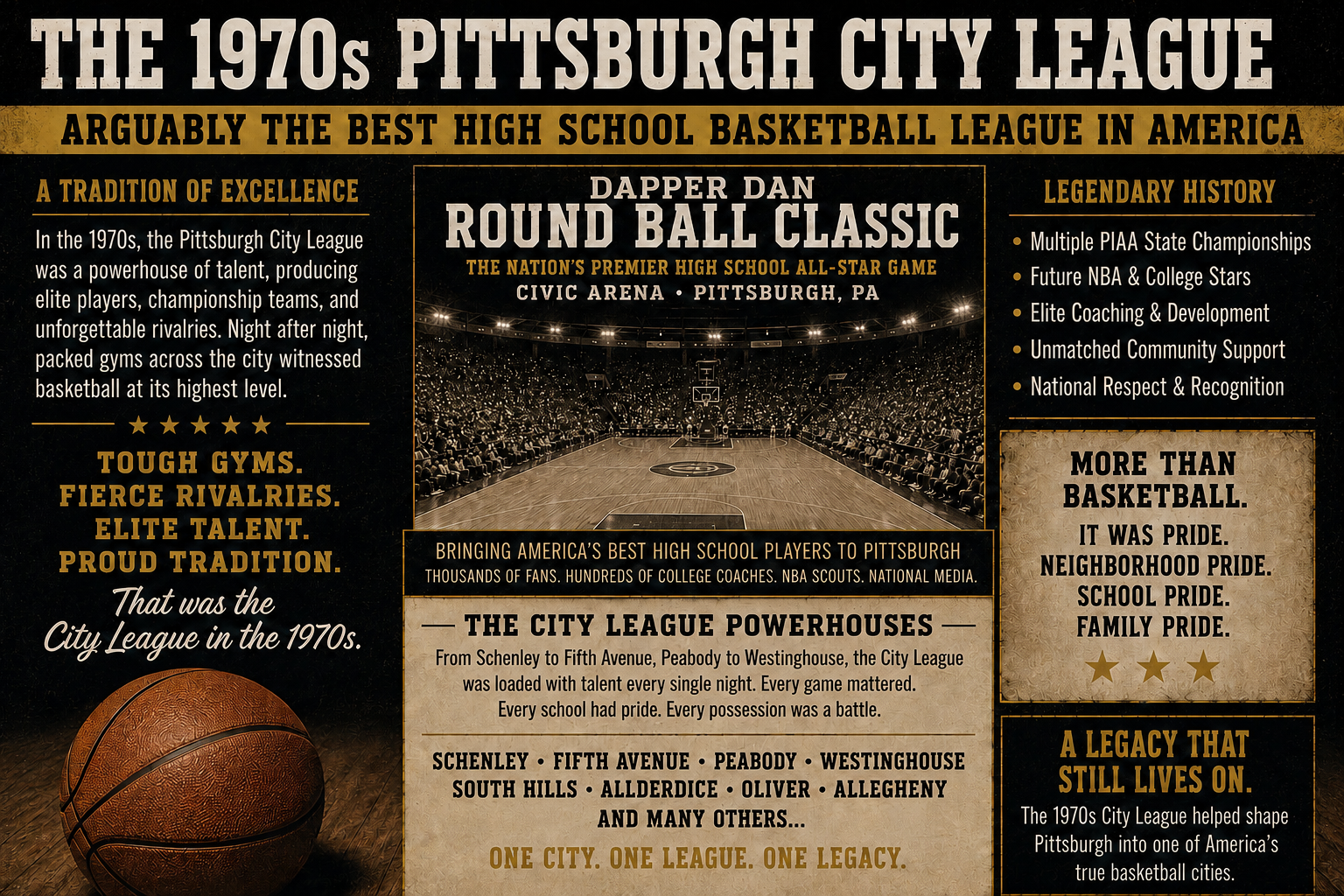
The 1970s Pittsburgh City League. This wasn’t simply a great local league. It was a league that earned national respect.
Every winter, the gyms across Pittsburgh became stages for some of the finest high school basketball players in America. Schools like Schenley, Fifth Avenue, Peabody, Westinghouse, South Hills, Allderdice, Oliver, competed in games that were packed with talent, pride, and fierce neighborhood rivalries.
Back then, there were no social media highlights. No AAU circuits. No national recruiting websites. If college coaches wanted to evaluate elite talent, they came to Pittsburgh. And they rarely left disappointed.
Schenley Set the Standard
No program represented the City League’s excellence better than Schenley. The Spartans became a national powerhouse, winning multiple City League championships and several PIAA state titles. Their 1971 team, led by future NBA champion Maurice Lucas alongside Robert “Jeep” Kelley, and Ricky Coleman, is still considered one of the greatest teams in Pennsylvania basketball history.
That team wasn’t just beating opponents. It was overwhelming them. Many longtime basketball observers still believe that Schenley squad could have competed with the best high school teams anywhere in the country.
Fifth Avenue’s Perfect Season
If Schenley established the standard, Fifth Avenue proved there was another powerhouse waiting. The 1976 Fifth Avenue team, led by future Pitt basketball great, NFL player Sam Clancy, finished undefeated, won the City League championship, and captured the PIAA state title.
Clancy wasn’t just one of the best players in Pittsburgh. He became one of the greatest athletes Western Pennsylvania has ever produced, later starring in both the NBA and NFL, an accomplishment almost unheard of.
To this day, many basketball historians place that Fifth Avenue team among the greatest high school teams Pennsylvania has ever seen.
The Depth Was Unmatched
What made the City League different wasn’t just that it had one or two dominant teams. It was the depth. On any given night, you could walk into a City League gym and watch future Division I players battling in front of packed crowds.
Peabody consistently developed outstanding talent including Melvin Bennett who played at Pitt and later played in the ABA. Westinghouse was always dangerous. Oliver had elite athletes. South Hills, Allderdice, and other schools could beat anybody on the right night.
There were very few easy games.
Every neighborhood produced players who believed they were the best in the city. And they weren’t afraid to prove it.
The Roundball Classic Put Pittsburgh on the National Map
Perhaps nothing symbolized Pittsburgh’s basketball reputation more than the Dapper Dan Roundball Classic. Beginning in 1965, Pittsburgh hosted what became the nation’s premier high school all-star basketball game.
The biggest names in America came to the Civic Arena. Future NBA Hall of Famers. Future Olympic champions. McDonald’s All-Americans before the McDonald’s All-American Game even existed. Thousands of fans packed the arena every year while hundreds of college coaches and NBA scouts filled the seats.
That wasn’t an accident.
Pittsburgh had earned that respect through decades of producing elite basketball. The City League helped make Pittsburgh one of America’s true basketball cities.
More Than Basketball
The City League wasn’t simply about wins and losses.
It represented neighborhoods. Families. Communities. When Schenley played 5th Avenue… When Peabody battled Westinghouse… When Oliver faced Allegheny…. The entire city paid attention. These games created memories that have lasted for generations.
Long before livestreams, highlight tapes, and viral clips, Pittsburgh basketball built its reputation the old-fashioned way with packed gyms, great coaching, unbelievable talent, and fierce competition.
A Legacy That Still Deserves More Recognition
Today’s generation knows about powerhouse programs from New York City, Chicago, Philadelphia, Los Angeles, Baltimore and Washington, D.C.
They should also know about Pittsburgh. Because during the 1970s, the Pittsburgh City League wasn’t just producing great basketball. It was helping define high school basketball in America.
You can debate whether it was the greatest league in the country. But one thing is certain: If you were fortunate enough to play, or even sit in the stands during that era, you witnessed one of the greatest chapters in Western Pennsylvania sports history.
1970s City Champions
1970- Schenley
1971- Schenley (PIAA champs)
1972- Westinghouse
1973- 5th Avenue
1974- Schenley
1975- 5th Avenue
1976- 5th Avenue (PIAA champs)
1977- Brashear
1978- Schenley (PIAA champs)
1979- Schenley