
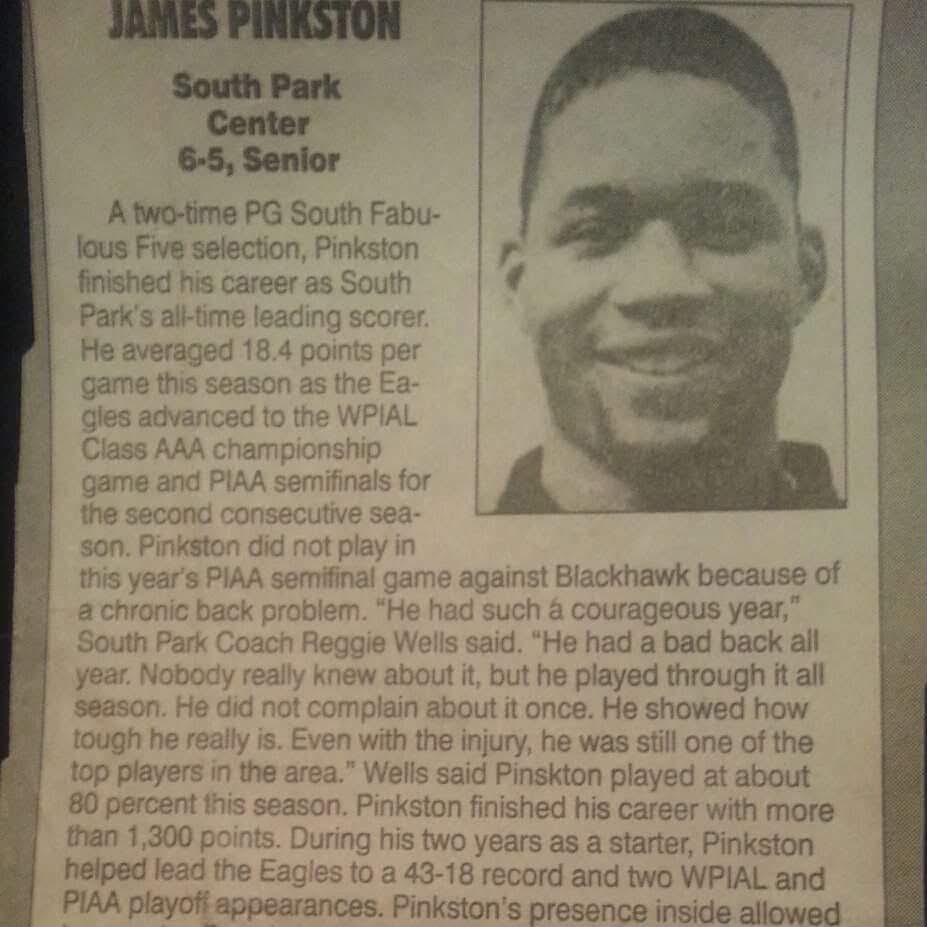
When conversations begin about some of the best basketball players to come through Western Pennsylvania during the late 1990s, certain names are mentioned repeatedly.
But every era also has players who were tremendously talented and productive yet never seem to receive the recognition they deserve.
James Pinkston falls into that category.
The former South Park standout was one of the area’s most skilled and effective big men during an era when Western Pennsylvania basketball was loaded with talent.
At a time when the game was much more physical and post players were expected to battle inside every possession, Pinkston established himself as a force in the paint.
He possessed the size, strength, and toughness needed to compete with anyone, but what separated him from many players his size was his understanding of the game. He knew how to use positioning, footwork, and basketball IQ to impact games on both ends of the floor.
Opposing teams quickly learned that slowing down South Park often started with trying to contain Pinkston. Whether it was scoring around the basket, controlling rebounds, setting screens, or protecting the paint defensively, he consistently provided the foundation for his team’s success.
Players like Pinkston often don’t receive enough credit because they did the dirty work that doesn’t always show up in highlight reels. They sacrificed personal statistics for team success and embraced the physical aspects of the game that helped teams win.
Looking back today, it’s clear that James Pinkston was one of the more underrated frontcourt players of his generation. His contributions helped shape South Park basketball during a memorable period and left a lasting impression on those who played with him, coached him, and competed against him.
As time passes, it’s important to recognize the athletes who helped build the rich tradition of WPIAL basketball. For those who watched him play, James Pinkston was far more than just another player.
He was one of the toughest and most underrated big men of his era. And that’s exactly why he deserves to be remembered.
What are your favorite memories from your days playing basketball at South Park?
Just being around my brothers, grinding and sharpening each other’s skills.
How would you describe your playing style to younger fans who never got the chance to watch you play?
I was a physical, back-to-the-basket player who could also step out on the wing and score when necessary. On defense, I was a shot blocker and one of the best rebounders around.
Who were some of the toughest players you competed against during your high school career?
Drew Schifino, Jason Brown, Brad Midgley, Henry Kliner, Tim O’Rourke, and Mike Kirkland.
What made late-1990s WPIAL basketball so competitive?
There was talent everywhere. Kids weren’t transferring out of their neighborhoods to team up with other players.
What was your favorite game or performance at South Park?
I’d have to say the playoff game against Pine-Richland in the 1998 playoffs. I can still hear the crowd chanting, “Let’s get violent!” We had one of the biggest lineups in 3A that year. The atmosphere was unmatched.
Which coach had the biggest impact on your basketball journey and why?
Coach Wells. He challenged me to be better at everything—as a student, a young father, a teammate, and a leader.
What do you think people most overlooked about your game?
I think a lot of people overlooked how strong I was because I only weighed 190 pounds.
Do you feel you received the recognition you deserved during your playing days?
Nah, I don’t. But I don’t mind it. I went to a little school in the South Hills that nobody had ever heard of, and we made back-to-back WPIAL championship appearances, along with back-to-back state Final Four runs.
What lessons did basketball teach you that still help you today?
Basketball taught me the value of hard work and being willing to do the little things to create the best possible outcome.
How much pride do you take in representing South Park and your basketball era?
Up until this year, I was the boys’ all-time leading scorer, and we were the last team to win a section title in 1998. Shoutout to Luke Scarff for breaking my record and leading the boys to their first section title in 28 years. It was an amazing time back then.
What was the atmosphere like playing in WPIAL gyms during that time?
I can’t remember a game that wasn’t sold out. There was a real sense of pride in the communities, and it showed up on Thursday and Friday nights. It was a beautiful thing.
If you could play one game from your career over again, which would it be?
The 1998 WPIAL Championship against Chartiers Valley. I wouldn’t foul out.
Who were some of your favorite teammates, and what made those relationships special?
Nate English, Reggie Wells, Ryan Wells, Kirk Evanov, and Greg Marx. Playing with those guys freed me up to do more because they could score. Teams couldn’t sag off and double- or triple-team me the entire game.
How do you think your game would translate to today’s style of basketball?
I think I would’ve been too much for a lot of these kids because I played with my back to the basket so much.
What advice would you give young post players trying to develop their game today?
Stay active in the paint. Don’t get caught floating around the three-point line. You have to have the mentality that every ball coming off that rim belongs to you, and you’re going to go get it by any means necessary.
What has life been like for you after basketball?
I made some choices as a young adult that took me away from the game early, and regrettably, I never looked back.
Looking back, what accomplishment are you most proud of from your basketball career?
Holding the scoring record for 27 years.
When people talk about James Pinkston years from now, what do you hope they remember most?
I hope they remember me for giving back to the kids.