
Open social media on almost any day, and you’ll likely see another heartbreaking story about a young person who lost their life.
A shooting. A fatal crash. A homicide. Another grieving family. After seeing post after post, it’s understandable why so many people believe violence is worse than it’s ever been.
But here’s the question: Is crime actually increasing, or has our perception changed because of how we consume information?
The answer is more complicated than many people realize.
Two Things Can Be True
First, every young life lost is a tragedy. Every victim leaves behind parents, siblings, children, friends, classmates, and an entire community forced to grieve. No statistic should ever make us numb to that reality.
But at the same time, we also have to be honest about what the data shows.
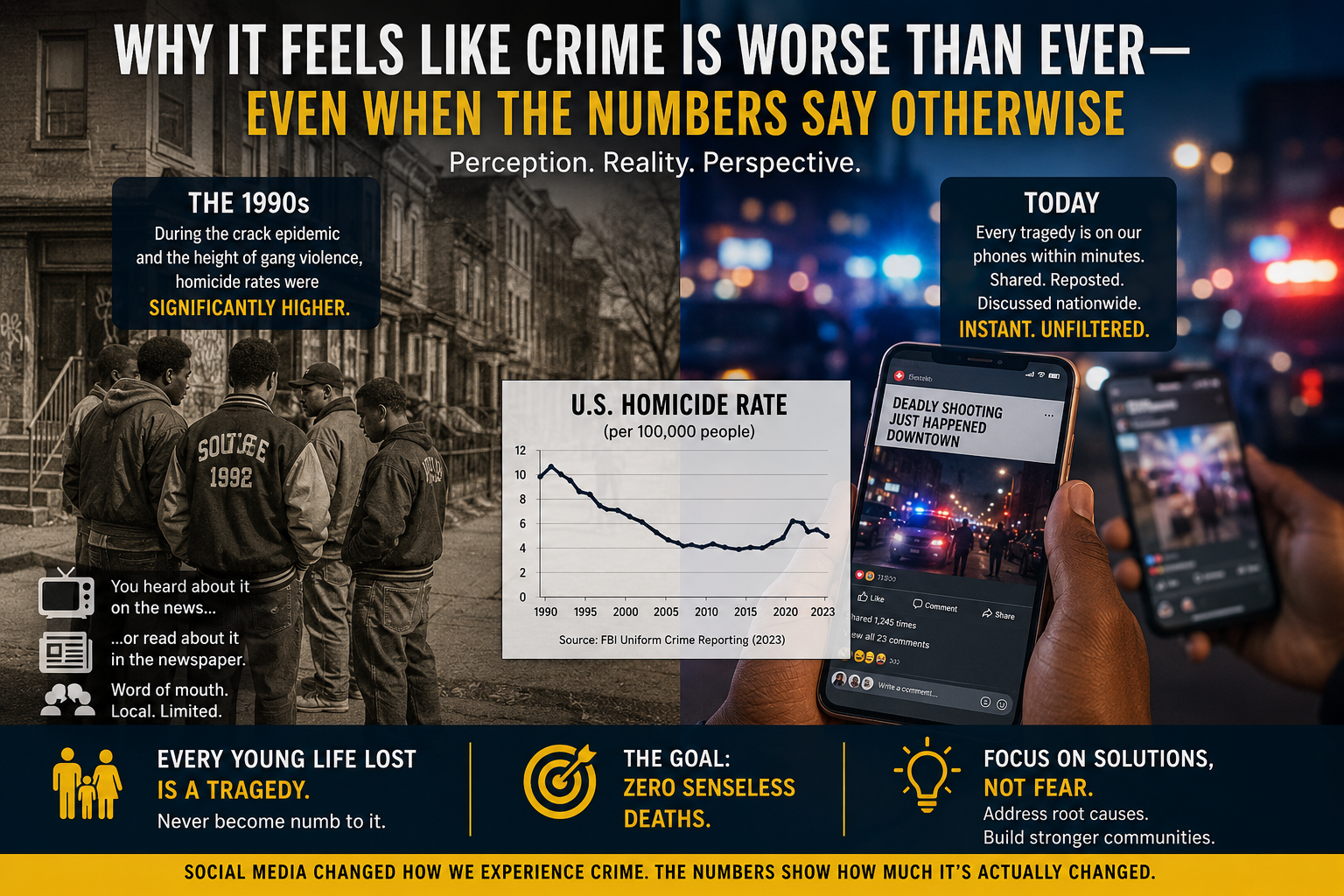
In many American cities, homicide rates today remain well below the historic peaks of the late 1980s and early 1990s during the crack epidemic and the height of gang violence. Even compared with the pandemic-era spike that began in 2020, many cities have experienced meaningful declines in recent years.
That doesn’t mean violence has disappeared. It means our perception of it has changed.
Growing Up in the 1990s
Many people who came of age in the 1990s remember losing classmates and friends. Communities across America were dealing with the crack epidemic, territorial gang conflicts, and record-breaking homicide rates.
The violence was real. The pain was real. The funerals were real. The difference was how we learned about it.
If something happened across town, you might hear about it from a friend at school. Maybe it appeared on the evening news. Maybe it was mentioned in the newspaper the next morning. Many tragedies remained local.
Social Media Changed Everything
Today, tragedy spreads faster than ever. Within minutes of a shooting, photos appear online. Videos begin circulating. People share memories. News pages post updates. Friends repost them. Community groups discuss them. Even if the incident happened hundreds of miles away, it shows up on your phone as if it happened next door.
By the end of the day, you’ve seen stories from Pittsburgh, Philadelphia, Chicago, Atlanta, Houston, and Los Angeles. Your brain doesn’t naturally separate local crime from national crime. It simply registers repeated exposure to violence.
Psychologists call this the availability heuristic, our tendency to judge how common something is based on how easily examples come to mind. When violent events are constantly visible, they feel more common, even if overall crime is lower than it was decades ago.
Perception Isn’t Always Reality
Social media has made the world feel smaller. It has also made tragedy feel constant. That’s why many people genuinely believe crime is at an all-time high. Not because they’re ignoring the facts. Because they’re consuming more information than any previous generation ever has.
The emotional impact is real, even when the statistical reality tells a different story.
We Should Focus on Solutions
Recognizing this difference doesn’t minimize anyone’s loss. It doesn’t excuse violence. It doesn’t suggest we should accept any level of crime.
The goal should always be the same: Zero senseless deaths.
Instead of allowing fear to shape our understanding of society, we should focus on the issues that actually reduce violence: strong families, better education, economic opportunity, mental health resources, effective policing, community engagement, and positive role models for young people.
Every life matters. Every victim deserves to be remembered. But if we want to solve the problem, we have to understand it accurately. Because while social media has changed how we experience crime, it hasn’t always changed the reality of crime itself.
Sometimes the numbers tell a different story than our newsfeeds.