
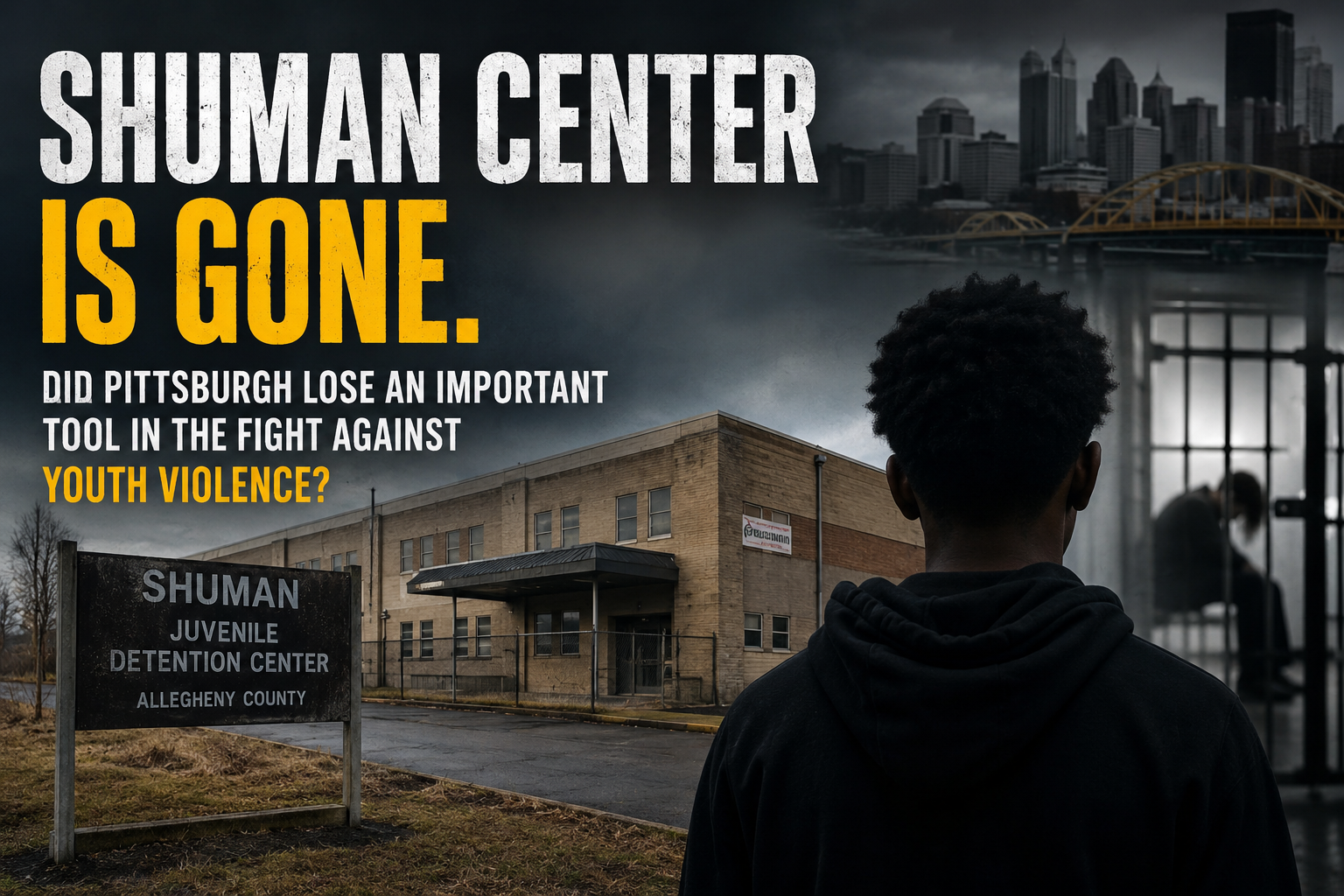
For decades, the Shuman Juvenile Detention Center was a major part of Allegheny County’s juvenile justice system.
Located in Pittsburgh’s East End, Shuman housed young people accused of crimes while they awaited court proceedings or placement. To some, it represented accountability. To others, it symbolized a juvenile justice system in need of reform.
In 2021, Shuman closed its doors following a series of investigations, licensing issues, and concerns about conditions inside the facility. Since then, the building has sat empty, while the debate surrounding its closure has continued.
At the same time, Pittsburgh has experienced growing concerns about youth violence. Large disturbances involving teenagers, violent crimes involving juveniles, and questions about accountability have become frequent topics of discussion throughout the region.
The question many residents continue to ask is simple: Did the closure of Shuman create a gap in the juvenile justice system? There is no easy answer.
Some believe the closure removed an important tool for judges and law enforcement officials dealing with repeat juvenile offenders. They argue that without adequate detention options, the system has fewer ways to hold dangerous young offenders accountable while also protecting the community.
Others argue that detention alone was never the solution. They point to deeper issues such as poverty, family instability, mental health challenges, educational struggles, and lack of community resources as the real drivers of youth violence. From that perspective, simply reopening a detention center would not solve the larger problems facing young people.
The reality is that accountability and rehabilitation do not have to be opposing ideas.
Most people agree that communities deserve safety. Most people also agree that young people deserve opportunities to change the direction of their lives before one bad decision defines their future forever.
Finding that balance remains one of the biggest challenges facing Pittsburgh today.
To better understand the role Shuman played in the community, I spoke with former employee Ray Chambers, who spent years working directly with the young people housed inside the facility.
His perspective offers a firsthand look at what happened behind the walls of Shuman and what lessons Pittsburgh should take from its closure.
Tell readers about your role at Shuman and how long you worked there.
I worked at Shuman Center as a Youth Development Counselor/Staff Member for several years. My role was to provide supervision, structure, guidance, and support to young people placed in detention while helping maintain a safe and secure environment.
What was a typical day like inside the facility?
A typical day involved supervising residents, conducting room checks, assisting with meals, recreation, school activities, and counseling programs. Staff worked to maintain order while also building positive relationships with the youth and encouraging them to make better decisions.
What are some of the biggest misconceptions people have about Shuman?
Many people believe Shuman was simply a jail for violent youth. In reality, staff worked hard to provide structure, education, counseling, and opportunities for rehabilitation. It was much more than just confinement.
What types of young people were housed there?
The facility housed youth from various backgrounds who faced different challenges. Some committed serious offenses, while many others made poor decisions and needed guidance and support.
Were most of the kids violent offenders, or were many simply young people who made mistakes?
Most of the youth I encountered were not hardened criminals. Many were young people who made mistakes, struggled with difficult circumstances, and needed positive direction.
What challenges were these young people facing outside of the facility?
Many dealt with poverty, unstable home environments, lack of positive role models, substance abuse, mental health issues, trauma, and exposure to violence in their communities.
Did you witness success stories where detention helped a young person change direction?
Yes. I saw young people return to school, graduate, find employment, and become productive citizens. Some later came back to thank staff for providing structure and holding them accountable when they needed it most.
What were the biggest challenges staff members faced while working there?
The biggest challenges included dealing with youth trauma, staff shortages, safety concerns, and balancing discipline with compassion. Staff often worked long hours under stressful conditions.
What was your reaction when Shuman was ordered to close?
I was disappointed because I knew many dedicated employees genuinely cared about the youth. While improvements were needed, I believed the facility still played an important role in the community.
Do you believe Pittsburgh has felt the impact of the closure? Why or why not?
Yes. The closure created challenges in finding placements for youth and removed a local resource that provided accountability and services. Communities have struggled with how best to address youth crime and rehabilitation.
In your opinion, what role does accountability play in reducing youth violence?
Accountability is essential. Young people need to understand that actions have consequences, and consistent discipline helps teach responsibility and decision-making.
What role does rehabilitation play?
Rehabilitation is just as important. Counseling, education, life skills, and mentorship can help young people change their behavior and become productive adults.
What do people misunderstand about juvenile crime and juvenile offenders?
People often think young offenders cannot change. I believe many youth are capable of turning their lives around when given support, guidance, and opportunities.
If you could change one thing about the juvenile justice system today, what would it be?
I would increase access to mental health services, family support programs, mentoring, and community resources so young people can receive help before they enter the system.
Looking back, what do you think Shuman’s legacy will be in Pittsburgh?
I believe Shuman’s legacy will be remembered through the many staff members who dedicated their careers to helping young people and the countless youth whose lives were positively impacted. While no system is perfect, Shuman represented accountability, structure, and the belief that young people deserve an opportunity to change.