
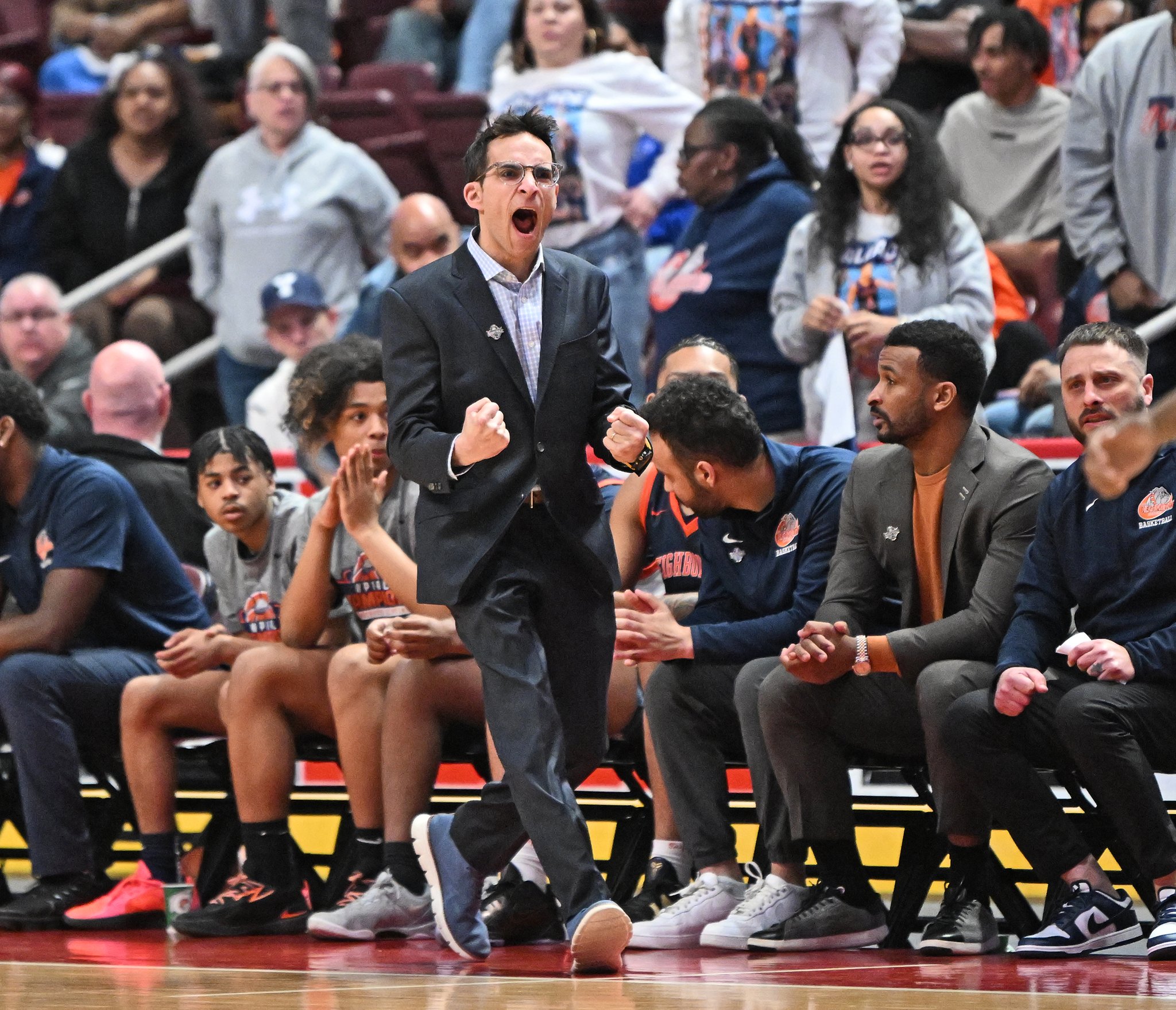
Some coaches inherit winning programs. Others have to build them.
Jordan Marks built one.
When Marks accepted the head coaching position at Neighborhood Academy, there weren’t many people predicting championships. In fact, many wondered why he would even take the job. The school was still establishing itself in the WPIAL, and few outside the program believed it could compete with Western Pennsylvania’s traditional basketball powers.
Jordan Marks saw something different. He saw potential. He saw a culture waiting to be built. Most importantly, he saw young men who simply needed someone to believe in them.
Over the next several seasons, that’s exactly what happened. Neighborhood Academy didn’t become successful overnight. It became successful because the standard changed. Players bought into accountability. They defended. They shared the basketball. They trusted one another. Most importantly, they believed they belonged.
The results followed. The Bulldogs quickly emerged as one of the top programs in Class 1A, capturing WPIAL championships before making history by winning the school’s first PIAA state basketball championship.
That’s no accident. That’s culture.
Before leading Neighborhood Academy, Marks learned the game at one of college basketball’s highest levels while serving as a video coordinator under former Pitt coach Jamie Dixon. That experience taught him preparation. Attention to detail. Game planning. The value of every possession.
Those lessons have carried over into his own program.
But what separates Jordan Marks isn’t just X’s and O’s. It’s relationships. Talk to the players who have played for him, and they speak about more than basketball. They talk about family. Opportunity. Growth. Belief.
The best coaches understand that basketball eventually ends. The lessons don’t.
Today, Neighborhood Academy isn’t viewed as an underdog anymore. It’s a destination. It’s a program opponents respect. It’s a program players want to join. That transformation didn’t happen by chance. It happened because one coach believed something special could be built long before everyone else did.
Jordan Marks deserves tremendous credit for changing the perception of Neighborhood Academy basketball. In a city rich with basketball history, he’s quietly building one of Western Pennsylvania’s newest success stories.
Q: What made you take the head coaching job at Neighborhood Academy when many people questioned the opportunity?
A: I got a few calls from Brent Jernigan and Dr. Anthony Williams. Brent and I go way back, and Dr. Williams is one of the best people I have ever met. Both are phenomenal leaders. They wanted to establish a basketball program for their core group of eighth graders who were coming into high school, along with a few current high school players, and compete in the WPIAL. When I met with Dr. Williams and Brent and heard Courtney Wallace’s name—as his son was in the eighth grade at the time—along with Shamar and a few other guys, it was a no-brainer. We knew we had a special group, along with Coach Raj and Coach D.
Q: When you first arrived, what vision did you have for the program?
A: Like any successful program, you want to establish trust first and foremost, along with a strong work ethic. Courtney lived in the gym, and a lot of the guys followed his lead. Hard work pays off, and “no regrets” is something we continually preach. Surrounding the players with the right people is huge. Nick Rivers, who played at Pitt; Chris Warzu, who has been with me for years; Jackson Blaufeld, a former Fab 5 player who went on to play at Dartmouth; and Yoni, who is a true student of the game, all make my job easier. Coach Raj, Coach D, and Courtney Wallace Sr. also help out and spend time in the gym. I’m very fortunate to be surrounded by them. Letting players hear different voices while surrounding them with great people goes a long way.
Q: What were the biggest challenges in building a new basketball culture?
A: The biggest challenge is time. It takes time to learn how to win and understand what it takes to be successful. When all of the guys came in as freshmen, they continually improved and put in the work. Just as importantly, they became very close and genuinely cared about one another. When your best player is also your most unselfish player, everything else falls into place.
Q: How much did your time working under Jamie Dixon at Pitt influence your coaching philosophy?
A: Working under Jamie taught me how meticulous and prepared you have to be. Coach Dixon watched more film than you could ever imagine. Our scouting reports were incredibly detailed. We knew the opposing team’s sets inside and out, and the assistant coaches Barry Rohrssen, Brandin Knight, Orlando Antigua, Coach Lombardi, and others, were phenomenal.
Q: What does “Neighborhood Academy basketball” stand for today?
A: “We > Me” is our motto. Beyond that, I’d say hard work defines us. The culture was built by that original class and a few other guys, and it continues today as we head into our sixth season.
Q: How do you balance winning games with developing young men?
A: Winning is important, but it’s secondary. Developing young men and emphasizing academics are more important at The Neighborhood Academy. With a 100% college acceptance rate, grades always come first. I always tell the guys that the ball stops bouncing someday, and I want them to become better people above all else.
Q: What was the turning point when you realized this program could compete for championships?
A: When Courtney, Shamar, Syn, and Junior entered their junior year, I knew we had something special. Courtney developed into one of the best players in the state and became the first player in more than 15 years to average a triple-double. He made everyone around him better. Everyone spent more time in the gym, prioritized winning, matured, and improved tremendously.
Q: Winning the first state championship in school history had to be emotional. What was going through your mind after the final buzzer?
A: I was truly happy for my staff and the kids, especially our four seniors. They put in so much work. My first thought was, “I love these guys, and I’m going to miss them.” I couldn’t have been happier for those seniors, my staff, and the leadership at the school.
Q: How important has player development been to your success?
A: Player development is vital. I have a great group of assistants, and every one of them is integral to our success. Without player development and allowing players to become versatile, you won’t reach your goals. Having four coaches with college basketball experience who understand what it takes to reach that level is incredibly valuable. Courtney had a key fob and would be in the gym at 6 a.m. and again at 10 p.m. Now Kedron Gilmore, Dante Wright, and Trey McMurray all have key fobs. The culture has been established.
Q: What qualities do you look for in a point guard?
A: We always preach attacking the paint to create opportunities for others. Courtney made our job as coaches much easier, and now Kedron has embraced that role as well. Dante will be the same way. We want to average around 18 assists per game, play fast, and maximize possessions. We also expect our point guard to play great defense, apply pressure on the ball, and run the team. We want him to push the pace, create transition opportunities, get into the paint, and finish at the rim. A point guard who can do those things becomes extremely valuable and dangerous.
Q: How has the Pittsburgh basketball community embraced your program over the past few years?
A: Winning two WPIAL championships, reaching three straight WPIAL title games, winning a state championship, and returning to the state finals the following year has put both our school and program on the map. Having veterans like Coach Raj, Coach D, and Big Court around has been invaluable. We like to call ourselves “Pittsburgh’s Team.” Nick and Jackson played at a high level and still compete with our players, while Chris and Yoni each bring something unique to the program. Yoni especially loves scouting and helping us prepare. Everyone contributes in their own way. Whether we’re playing Allderdice or in showcase games, we’re going to defend, play unselfishly, and play the game the right way. Thankfully, the Pittsburgh basketball community has embraced us. My staff makes my job much easier. Most importantly, our players always represent both themselves and The Neighborhood Academy in a positive way.
Q: What advice would you give a young coach hoping to build a championship program from the ground up?
A: Hard work and unselfishness. Without those two things, you’ll never build a successful program. Giving players freedom while emphasizing defense and teamwork has been huge for us. If you can make your defense—forcing turnovers and creating long rebounds—your best offense, you’ll be in great shape.
Q: What has been the proudest moment of your coaching career so far?
A: Seeing Courtney go to Yale, Shamar to La Roche, and Derick to Penn State, nearly all on full scholarships, has been incredibly rewarding. Now Kedron Gilmore and Trey McMurray are receiving a lot of interest and scholarship offers. Watching these young men earn scholarships and grow into outstanding people is all I could ever ask for.
Q: Who are some coaches you’ve learned the most from throughout your journey?
A: I worked for Jamie Dixon, Brandin Knight, Coach O, and Slice for years, and they’ve all been instrumental in my development as a coach. I also had the opportunity to work with Andy Toole and Mike Rice for a year. You try to learn as much as you can from winning programs.
Q: Finally, what message would you like to share with the students, parents, alumni, and supporters of Neighborhood Academy who have believed in this vision from the beginning?
A: I’d simply like to thank them. The kids build the program, we just have to prepare them and give them the tools to accomplish great things. Everyone believed we could build a successful program while keeping academics first. Maintaining a 100% college acceptance rate has been huge. Our goal is for every student to arrive as a ninth grader and leave as a great young man, and so far, we’ve been able to do that. None of it would be possible without my staff and the leadership of the school.