
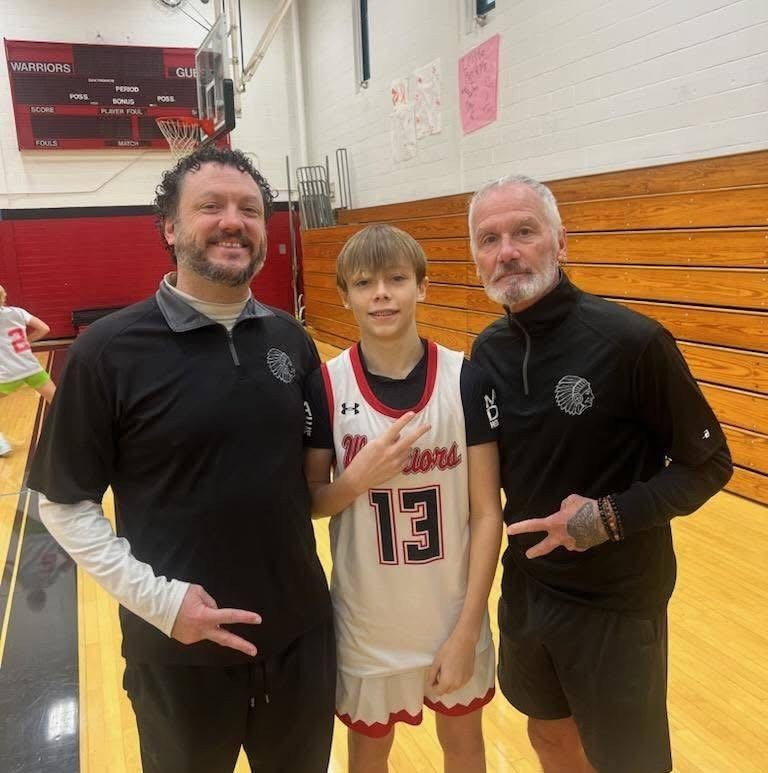
Basketball has given Nolan Larry the opportunity to impact lives far beyond the scoreboard. As the head coach at Elizabeth Forward, Larry has earned respect throughout Western Pennsylvania for his commitment to developing players, building culture, and teaching lessons that extend well beyond the game.
In today’s world, where high school athletics continue to evolve, Larry remains focused on the fundamentals that never go out of style: discipline, effort, accountability, and teamwork. His approach has helped create an environment where players are challenged to grow as athletes while preparing for success in life.
Say Less Media caught up with Coach Larry to discuss his journey in basketball, the changes he has seen throughout his coaching career, and what it takes to build a program that players, parents, and the community can be proud of.
What made you want to get into coaching?
I used to follow my dad around when I was 3 years old when he was playing old man basketball leagues in Greensburg and Vandergrift. When I was 6 years old, I became the manager at Greensburg Salem for the boys’ basketball team because his best friend was the coach. I basically grew up in the program, and I thought Coach Sapotichne (who is now once again the coach at GS) had the best job in the world. He became and is still a second father to me. Although my dad never coached me, he was always a coach at some level within the program. Once I graduated high school, he became Coach Paul’s assistant. Those two have everything to do with me wanting to be a coach.
How has high school basketball changed over the last 20 years?
I think basketball has changed quite a bit over the last 26-27 years since I played in high school. It seems as if we are moving more in the direction of college basketball. The rules seem to be blending between all levels of basketball. No one is sure what a travel is anymore. Although a gather step does not exist in high school, it’s difficult to identify that distinction with the current speed of the game. And certainly, transferring is way more prevalent now than it has ever been for both public and non-boundary schools.
What attracted you to the Elizabeth Forward job?
I taught and coached at Sto-Rox high school in various capacities for 14.5 years. I loved it there but the hour drive, the daily mental toll, and not being present enough for my wife and children ran its course. I was fortunate enough to find a teaching job at Elizabeth Forward. It just so happened they had a 7th grade coaching position available that I jumped on immediately. The following year, the high school coach left for a new position, and I was hired shortly after. It was finally a stroke of luck after being passed up for some other coaching jobs over the years.
What culture are you trying to build within the program?
Over the past 4 seasons as head coach at EF, I have tried to instill a passion and respect for the game while at the same time explaining the importance of education, teamwork, and self-actualization. I don’t expect every player or coach surrounding me to love the game as much as I do, so my focus is how I can teach life lessons within the game of basketball.
How do you balance teaching and coaching?
I think most of my colleagues would agree I probably don’t do a great job of balancing. My life outside of school is consumed by basketball with my EF team, AAU basketball, training and my 3 children’s basketball endeavors. Don’t get me wrong, I enjoy teaching, but they all know I LOVE basketball. But during the day, I do my job teaching Chemistry, Environmental Science, and a Sustainable Agriculture course I designed. I might sometimes use my planning period and study hall to design practices and watch some film.
What lessons from your playing days still influence your coaching?
I believe I have carried my passion for the playing the game and converted it into the same principles while coaching. I would always rather be playing but coaching has now become my purpose. Also, I was never one to take a play off and I never wanted to come out of the game. So, I try to get my players to understand to seize every moment and take nothing for granted.
What role does accountability play in your program?
Accountability means everything in my program, and I have always believed that as a player and a coach. I always tell my guys when you want to start pointing fingers, find the closest mirror and start there.
How has social media changed recruiting and player development?
Although I am not a big fan of social media for some of negativity it spreads and the haters that follow, it is almost a requirement at this point in athletics. I use it as a tool to share about our team and our accomplishments and failures. I believe it is important to acknowledge both. I think it is a fantastic way to self-promote and share highlights. However, buyer beware. Anyone can create a highlight film nowadays as well. It is not going away so my thought is as long as it is being used in a positive manner, it’s a great tool to implement.
What advice would you give young players who want to play in college?
I would tell young players the same thing I tell my current players looking to continue their basketball careers: It doesn’t matter what level you play at next; it’s going to be harder than you thought. The game will be faster. Players will be bigger, stronger and faster. You must be willing to grind and work at EVERY aspect of your game. You must stretch. You must train core. You must do plyometrics. You must work on basketball skills. You must work and be mindful of your mental health because it is what matters most. You must make certain sacrifices. If you are willing to do all those things, you have a chance of succeeding.
What do you hope people say about the Elizabeth Forward program when your coaching career is over?
I have never really thought that far ahead about the legacy I would like to leave behind. I have never really been someone who gets caught up on what people have to say. Obviously, no one likes to hear negatives, but coaches either have or build thick skin over the years. It’s almost a must in today’s day and age. I am blessed to have been given this opportunity and at the end of the day, I am thankful for that. I hope to leave behind a collection of student-athletes that enjoyed their time we shared together, cherish both the highlights and times of adversity, and became better people because of the EF basketball program under my tutelage.