
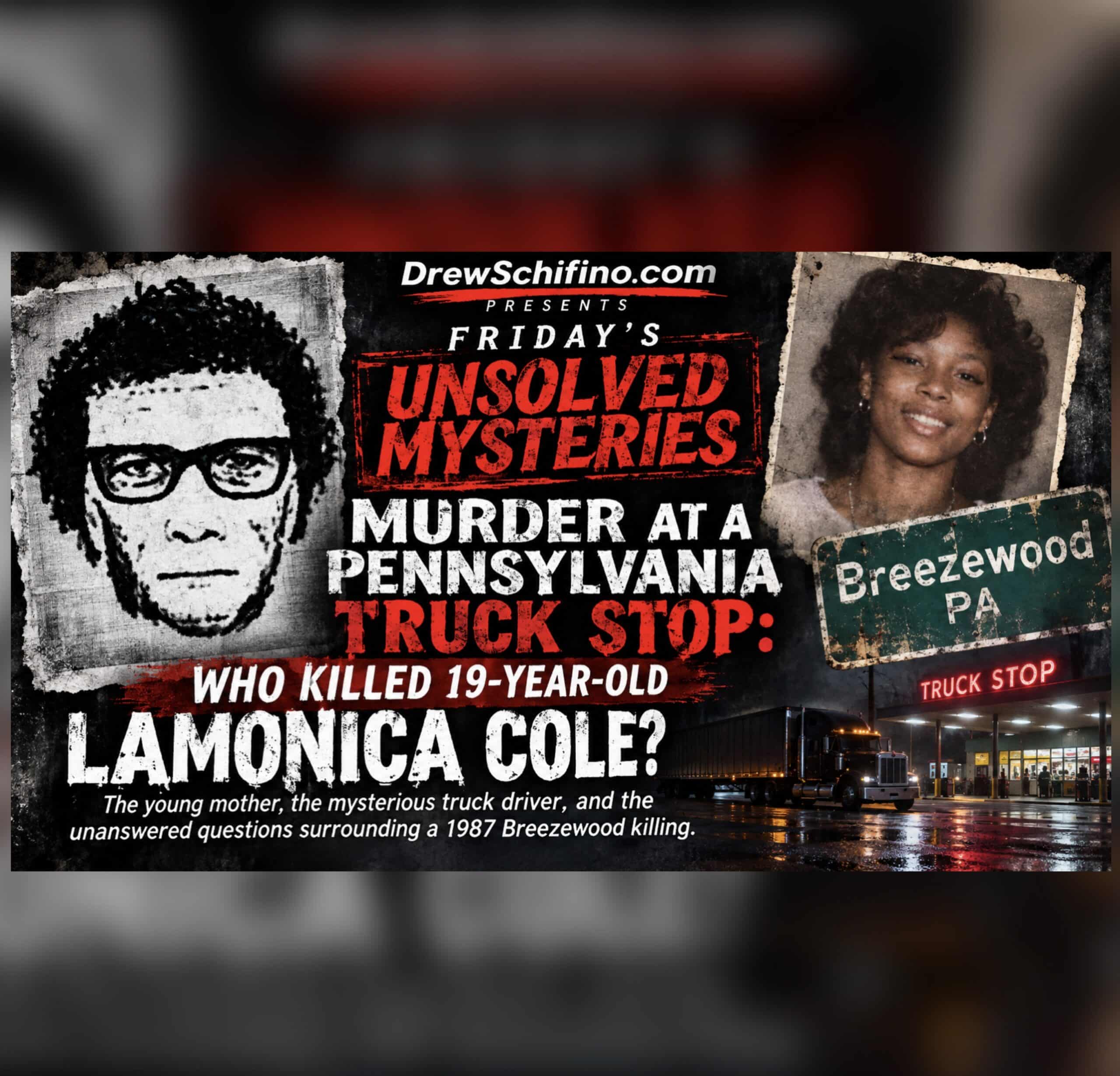
The young mother, the mysterious truck driver, and the unanswered questions surrounding a 1987 Breezewood killing.
Millions of people have traveled through Breezewood, Pennsylvania, over the years. If you’ve ever driven across the Pennsylvania Turnpike or Interstate 70, there’s a good chance you’ve passed through this small Bedford County community.
Gas stations. Restaurants. Motels. Tractor-trailers.
For generations, Breezewood has been a stopping point for people traveling across the country. But there’s a dark chapter in this town’s history that I suspect many Pennsylvanians have never heard about.
On November 22, 1987, the body of 19-year-old Lamonica Cole was discovered near a truck stop in Breezewood.
She had been murdered. Her killer was never conclusively identified. And investigators eventually considered whether her death was connected to a suspected serial killer known as “Dr. No.”
But after looking into this case, I found myself asking a different question.
Did the search for a serial killer overshadow the investigation into who actually murdered this young woman?
Because there’s something about Lamonica’s story that deserves far more attention than a mysterious nickname.
She was 19 years old. She had a nine-month-old daughter. And somewhere along a Pennsylvania highway, her life came to a violent end.
A Young Mother Traveling America’s Highways
Lamonica Cole was originally from Ohio.
According to published accounts, she had been traveling between states and working around truck stops.
By November 1987, she was staying at a motel in Breezewood with her infant daughter and a man named Derrick Mims, who was described in reports as both her boyfriend and pimp.
Her daughter, Chavelle, was just nine months old.
That’s one detail I can’t get past.
When we read about murders from the 1980s, particularly cases involving sex workers, victims are often reduced to descriptions of their lifestyles.
But Lamonica wasn’t simply another woman found near a highway.
She was somebody’s daughter. Somebody’s sister. And a mother whose little girl would grow up without her.
Whatever circumstances brought Lamonica to Breezewood, she didn’t deserve what happened to her.
The Truck Driver Who Disappeared
According to accounts of the investigation, Lamonica went out during the early morning hours of November 21, 1987, to meet a customer.
Mims reportedly told investigators that the man was driving a blue tractor-trailer with white stripes. Some accounts describe the vehicle as a Freightliner.
A truck driver using the CB radio handle “Dragon” was also investigated as a possible lead.
That detail is especially interesting.
In the 1980s, CB radios were a major form of communication among truck drivers. Drivers used nicknames rather than their real names. They could communicate with people at truck stops without revealing much about their identities.
Imagine trying to identify a murder suspect under those circumstances.
You have a nickname. A description of a truck. And thousands of tractor-trailers moving through the interstate system.
Lamonica reportedly left to meet a customer.
She never returned. The following day, her body was discovered near the Gateway Truck Stop.
Accounts differ on some details of the discovery, including who first located her, but reports agree that she was found near the truck-stop property.
Her death was attributed to suffocation. Some reports describe a cloth item being forced into her mouth or throat.
She was only 19.
Why Breezewood Matters
This is where the geography becomes important.
Breezewood isn’t some isolated town that people have to deliberately seek out. It’s a major transportation crossroads. Interstate 70 and the Pennsylvania Turnpike bring travelers through the area from multiple directions.
A truck driver could travel from Ohio into Pennsylvania, continue east toward Maryland or connect with other major routes.
And in 1987, investigators didn’t have the technological resources available today.
There were no smartphones documenting movements. No widespread network of digital cameras recording every truck entering and leaving. No modern electronic trail automatically connecting a driver to every location he visited.
If the person responsible for Lamonica’s murder was a long-haul truck driver, that mobility could have complicated the investigation tremendously.
But here’s something else.
A truck being seen near a murder victim doesn’t automatically mean the driver was responsible. Investigators still needed evidence connecting a specific person to the crime.
And the publicly available accounts don’t establish that the mysterious driver was ever conclusively identified as Lamonica’s killer.
The Dr. No Connection
During the 1980s, investigators in Ohio were examining a series of murders involving women found near highways and truck stops.
Several victims had been beaten or strangled. Some had clothing missing. A number had worked in sex work.
Investigators considered whether one serial killer was responsible.
The suspect became known as Dr. No, a nickname associated with a man who reportedly communicated with women through CB radio.
When Lamonica was murdered in Pennsylvania, investigators noticed possible similarities.
She had been found near a truck stop. She had been suffocated. Some clothing was reportedly missing. And she had connections to Ohio.
Those details made her death worth comparing with the other cases.
But there’s an important distinction.
Being investigated as a possible victim of a serial killer isn’t the same as proving that serial killer murdered her.
And that’s where I think Lamonica’s case deserves to stand on its own.
What If Her Killer Had Nothing to Do With Dr. No?
This is the angle that interests me most.
Suppose Lamonica’s murder wasn’t connected to the Ohio killings. Suppose the person responsible was someone who had encountered her in Breezewood or along her travels.
Would investigators have approached the case differently? Would they have placed greater emphasis on her immediate surroundings, personal contacts and movements during her final hours?
I’m not suggesting investigators ignored those possibilities. And I’m certainly not accusing anyone who was questioned or investigated of committing her murder.
But once a case becomes associated with a suspected serial killer, that connection can dominate how the public remembers it.
The victim becomes part of a larger mystery. Her individual circumstances become secondary. Instead of asking who killed Lamonica Cole, people begin asking whether Dr. No came through Pennsylvania.
Those aren’t necessarily the same question.
And nearly 40 years later, the difference still matters.
The People Closest to Her
Another detail worth examining is how much investigators learned from the people around Lamonica during her final days.
Mims reportedly provided information about the truck she was believed to have entered. Published accounts also indicate investigators examined people associated with her and pursued other leads.
That’s what detectives are supposed to do.
When somebody is murdered, investigators examine the victim’s last known movements, contacts and circumstances.
But the existence of a lead doesn’t establish guilt.
A witness statement must be evaluated. A vehicle description must be corroborated. And a possible connection to other murders must be supported by evidence.
The public record available to me doesn’t establish who killed Lamonica. That uncertainty is precisely why her individual case remains important.
The Nine-Month-Old Daughter Left Behind
Of everything I’ve read about this case, this might be the detail that stays with me the longest.
Lamonica had a nine-month-old daughter.
Think about that for a moment.
Her daughter was still an infant when her mother was murdered. Too young to understand what happened. Too young to remember the woman who gave birth to her.
For the rest of the world, November 22, 1987, was another Sunday. For Lamonica’s family, it became a date that would change their lives permanently.
And while investigators searched for suspects and explored possible connections to other murders, her family had to live with the consequences.
That’s something I think gets lost in true-crime storytelling.
We become fascinated by killers. Their nicknames. Their methods. Their ability to avoid capture.
But sometimes we spend so much time discussing the person responsible that we barely remember the person whose life was taken.
Lamonica deserves better than that.
Could Modern DNA Technology Finally Provide Answers?
Nearly four decades have passed since Lamonica’s murder.
Forensic science has changed enormously. DNA testing is far more advanced. Investigative genetic genealogy has helped investigators develop leads in decades-old cases. Evidence once considered inconclusive can sometimes be reexamined using newer methods.
But there’s a major question here.
What physical evidence from Lamonica’s murder still exists? Was biological evidence preserved? Could any surviving material be retested? And has her case been reviewed independently of the broader Dr. No investigation?
I haven’t found sufficient public documentation to answer those questions.
But they’re exactly the questions I would want to ask the Pennsylvania State Police.
Because a case being old doesn’t automatically mean every investigative opportunity has disappeared.
One Murder. One Pennsylvania Town. Nearly Four Decades of Questions.
There’s something unsettling about the idea that thousands of people may pass through Breezewood without knowing what happened there in November 1987.
People stop for gas. Grab something to eat. Check into motels. Continue toward Pittsburgh, Philadelphia, Maryland or Ohio.
And somewhere in the history of that highway community is the story of a 19-year-old mother whose life ended violently.
Was her killer a truck driver? Was he connected to the Ohio murders? Did he kill other women? Or was Lamonica’s murder an entirely separate crime that became attached to a larger serial-killer investigation because of circumstantial similarities?
We don’t have enough publicly established evidence to answer those questions.
But here’s what I believe.
Lamonica Cole’s murder shouldn’t have to be connected to a famous unsolved serial-killer mystery to deserve attention.
She deserves an investigation focused on her. Her final movements. The people who encountered her. The evidence collected. And the possibility that modern technology could help provide answers.
Because Dr. No might have been one killer. He might have been several. Or the nickname might have connected murders that never belonged together.
But Lamonica Cole was real. Her daughter was real. Her family’s loss was real.
And somewhere, someone knew what happened at that Pennsylvania truck stop in November 1987.
The question isn’t simply whether Dr. No killed Lamonica Cole. The question is whether investigators can still identify the person who did.