
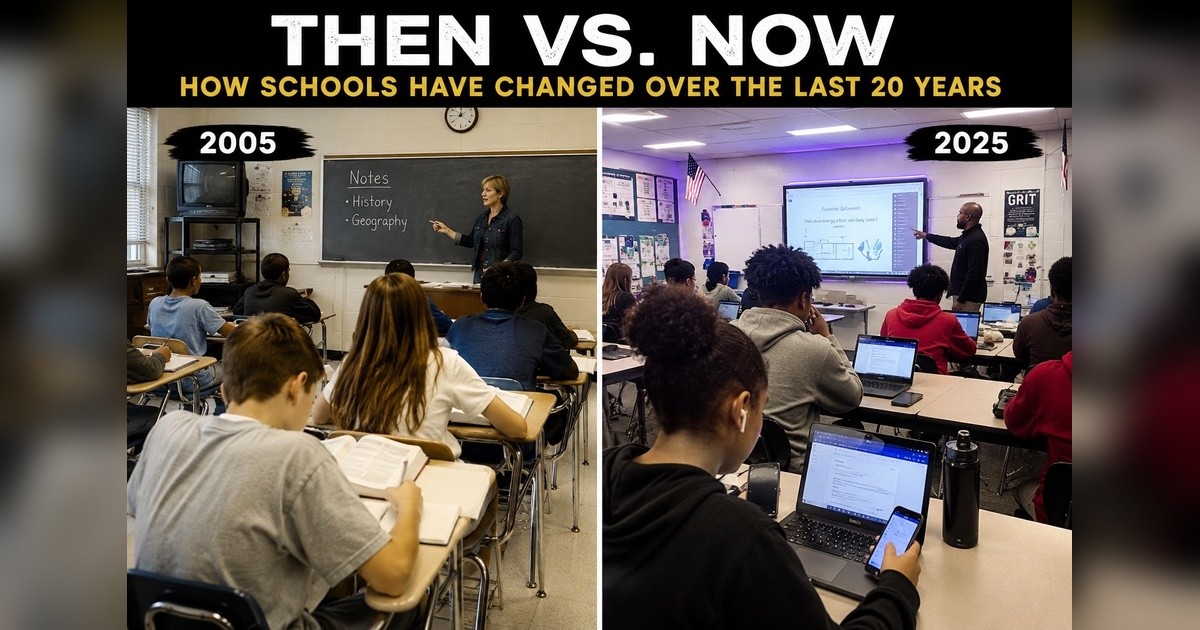
Ask almost any veteran educator, and they’ll tell you the same thing: Schools aren’t what they used to be. The buildings may look similar. Students still sit in classrooms. Teachers still stand at the front of the room. But beneath the surface, education has changed dramatically. From social media and smartphones to school safety concerns, changing classroom environments, and evolving student behavior, today’s schools look very different than they did 10, 15, or 20 years ago.
To better understand those changes, I sat down with a longtime Penn Hills School District employee to discuss what has changed, what has improved, and what challenges educators face today. One of the biggest differences? Technology… Years ago, students primarily used textbooks, notebooks, and classroom lectures. Today, many classrooms incorporate laptops, tablets, digital assignments, online learning platforms, and instant access to information.
While technology has created new learning opportunities, it has also created new distractions. Social media has become one of the biggest factors influencing student behavior, confidence, attention spans, and even mental health. Teachers now compete not only with traditional classroom distractions but also with TikTok, Instagram, Snapchat, YouTube, and whatever trend goes viral next.
School safety has also changed significantly. Twenty years ago, security procedures looked very different. Today, many schools utilize security officers, controlled entrances, cameras, visitor protocols, emergency drills, and heightened awareness of potential threats.
Educators are often asked to wear multiple hats. They’re not just teachers. They’re mentors, counselors, conflict mediators, and role models. Many believe today’s students face pressures previous generations never experienced. Yet despite the challenges, many educators remain optimistic. They continue showing up each day because they believe in helping young people succeed. The tools may have changed. The challenges may have changed. But the mission remains the same: Preparing students for life.
How long have you worked in education, and what first attracted you to the profession?
I have worked in the same school district for 24 years, and before that I worked in childcare. Teaching is honestly the only thing I ever wanted to do. When I was little, I used to make my sister sit in front of a giant chalkboard at our desk, and I would bring home extra papers from school so I could “teach” her. She was my first student. I even taught her how to read before she started school. That love for helping children learn has always been part of who I am.
What is the biggest difference between students today and students 20 years ago?
Schools feel completely different today, not only compared to 20 years ago, but even compared to before COVID. I often say that if someone has not taught in a classroom since COVID, they may not fully understand what teaching looks like now. Years ago, there was a different level of respect for teachers, and when we called home, families were usually very supportive. Today, that is not always the first response. Too often, the question becomes, “What did the teacher do?” instead of, “How can we work together?” Another major difference is accountability. Grade inflation, chronic absenteeism, and the pressure to pass students forward have changed expectations. I have seen students miss 40 or 50 days of school and still move to the next grade. That concerns me because students deserve support, but they also deserve honest preparation for the future.
How has social media changed the school experience for students?
Social media has had a major impact on school life, and much of it has been negative. Many conflicts that begin at home or online come into the school building the next day. Fights, bullying, arguments, inappropriate messages, and harassment often start on social media because children have access to phones and platforms without enough adult monitoring. Students record fights, spread rumors quickly, and feel pressure to perform for an online audience. I also think social media has changed the way many students see themselves and each other. They are exposed to things far beyond their age, and it shows up in their language, behavior, and interactions. It has also made focus much harder. Students are used to short videos, quick entertainment, and instant gratification, so staying engaged in a lesson or reading something deeply can be a real challenge.
Has social media made teaching more difficult? Why or why not?
Yes, social media has made teaching much more difficult. Teachers now have to be aware that they could be recorded at any moment, even when they are simply trying to manage a classroom or redirect behavior. We are human, and no one works perfectly every second of the day, but social media can take a moment out of context and turn it into something much bigger. It has also created destructive trends that students bring into school, some of which are disrespectful or unsafe. Beyond that, social media has affected students’ attention spans. Many students struggle to read longer passages, work through multi-step problems, or stay with a task that requires patience. They are used to quick clips and immediate feedback, and school requires a different kind of thinking.
What impact have smartphones had inside the classroom?
Smartphones have become one of the biggest distractions in schools. I understand why parents want to be able to reach their children, especially in an emergency, but phones have created serious problems inside the classroom. Students use them to cheat, take pictures of assignments, search for answers, or rely on AI without understanding the work. Phones have also increased bullying through group chats, texts, screenshots, and online posts. Some of the things students say to each other in those spaces are disturbing, and then those issues spill into the school day. Phones also keep many students up late at night, which affects their mood, focus, and ability to learn. I support schools that set clear limits on phones because learning and safety have to come first.
How have classroom teaching methods changed over the years?
Classroom teaching has changed tremendously. When many of us were in school, classrooms were often arranged in rows, and learning focused heavily on memorization and following procedures. Today, instruction is much more collaborative because students need to communicate, problem-solve, and work with others in the world they are entering. In math especially, we have moved away from simply memorizing algorithms. Students still need fluency, but it is more important that they understand why a strategy works and how numbers make sense. Homework has also changed. Many schools give less homework because we recognize that it can be inequitable. Some students have adults at home who can help, while others do not. Grading practices have changed too, including policies that do not allow grades below 50 percent. I understand the reasoning because recovering from a zero can feel impossible, but I also understand why teachers struggle with giving credit when no work has been done. Like many things in education, there has to be balance.
What role does technology play in education today compared to when you first started?
Technology plays a much larger role now than it did when I first started. Today, many students have an iPad or Chromebook, and that has completely changed the classroom. Technology can be useful because it allows teachers to personalize practice, provide interventions, and give students access to resources quickly. At the same time, I do not believe technology should replace paper, pencil, conversation, and hands-on learning. Research and classroom experience both remind us that students often think more deeply when they write, show work, and physically engage with the learning. I especially dislike that state assessments are taken on computers because I think it limits how students show their thinking and encourages some students to click through instead of working carefully. My hope is that education moves toward a healthier balance between technology and traditional learning.
How have school safety procedures changed over the last 10–20 years?
School safety procedures have changed completely. Years ago, I remember opening the door and letting students run out to their families at dismissal. Today, that would never be acceptable. Parents need identification, students have dismissal numbers, doors are locked, and every procedure is much more controlled. I also remember students doing things like going outside to bang erasers or propping open a door, which would be a major safety concern now. The biggest change is the reality of active-shooter drills and lockdown procedures. When I was younger, weather drills were the main safety concern. Now schools have to prepare for situations that are heartbreaking to even think about. It makes me sad because schools once felt more open and community-based, but I also understand and appreciate why these procedures are necessary.
Do students face more pressure today than previous generations?
In some ways, students face less academic pressure than previous generations because expectations around grades, deadlines, attendance, and consequences have become softer in many schools. Students are often given multiple chances, extended time, and opportunities to pass even when effort or attendance is inconsistent. That part worries me because it can send the wrong message about responsibility. However, I do believe students face a different kind of pressure that we did not experience as children. Social media creates constant pressure to look a certain way, act a certain way, be accepted, and avoid embarrassment. Everything can be recorded, posted, shared, and judged. That kind of pressure is real, and it affects their confidence, behavior, and mental health.
How has student discipline changed throughout your career?
Student discipline has changed significantly, and there are both positive and negative parts to that change. I strongly believe in positive reinforcement. I will never support humiliating children or using fear as discipline. When I was young, adults sometimes thought it was acceptable to shame students, put them in corners, or use harsh punishments. I am grateful that schools have moved away from that. I believe in PBIS, and I serve on our PBIS team because I truly believe students need to be taught expectations, not just punished after they make mistakes. I also believe restorative practices can be powerful when they are done correctly. The problem is that terms like PBIS and restorative justice are sometimes used without real follow-through. Students still need boundaries and consequences. Respecting children does not mean allowing unsafe, disrespectful, or harmful behavior. We need a better balance: teach expectations, protect student dignity, repair harm, and still hold
students accountable. If we do not help children understand that actions have consequences, we are not preparing them to become responsible adults.
What challenges do teachers face today that didn’t exist 15 or 20 years ago?
Teachers today face challenges that were not as common 15 or 20 years ago. Social media, smartphones, being recorded, online conflicts, and the constant distraction of devices have all changed the job. Another major challenge is the lack of support teachers sometimes feel from families and the larger community. There was a time when teachers were generally respected and trusted. Now, teachers are often blamed first, even when they are doing everything they can to help children. That wears people down because teachers enter this profession to support students, not to be treated like the problem.
Have parents become more involved or less involved in education?
Overall, I believe parents have become less involved in education. When I first started teaching, open houses were full, PTA events were well attended, and parents wanted to be part of the school community. Today, many schools struggle to get even a small number of parents involved, even with large student populations. What makes it difficult is that some parents seem to place full responsibility on the school while also saying they do not trust the school. When teachers call about a concern, the response is sometimes, “Why are you telling me?” or “What did you do about it?” I believe schools and families have to work as a team. Children do best when the adults in their lives communicate, show up, and hold consistent expectations.
What misconceptions do people have about educators today?
One of the biggest misconceptions is that teachers are out to get students. That is simply not true. Teachers are not targeting children. We are trying to educate them, support them, and help them become successful. Student achievement matters to us professionally, but their happiness, confidence, and safety matter to us personally. People also sometimes think teachers choose this career for summers off, but that is not why people stay in education. We stay because we care about children. We want them to learn, grow, and believe in themselves.
What gives you hope when you look at the next generation of students?
What gives me hope is how accepting many students are. I see students who are much more open to differences than previous generations. They are often accepting of race, disability, learning differences, and different identities in a way that feels refreshing. They have grown up around more diversity and inclusion, and I think that has helped many of them become more compassionate. Even with all the challenges schools face, that acceptance gives me hope.
If you could give one piece of advice to parents raising school-aged children today, what would it be?
My advice would be to help your child build a positive peer group. The friends children choose can influence their confidence, behavior, values, and choices for years. Encourage them to spend time with peers who have strong morals, healthy goals, and families who share similar expectations. I would also tell parents to show up. Be present. Know your child’s teachers. Build a relationship with the school. Teachers want to work with families as a team, and children benefit when they see the adults around them communicating and supporting one another.
What do you believe schools will look like 10 years from now?
That is a hard question because education keeps changing so quickly. My hope is that 10 years from now, schools have found a better balance between technology and human connection. I hope students still learn how to collaborate, communicate, think critically, and be part of a community. Devices may continue to be part of learning, but I hope they do not replace relationships, discussion, teamwork, creativity, and hands-on experiences. The best version of school will prepare students for the future while still honoring what children need most: connection, structure, purpose, and belonging.
Despite all the changes, what has remained the same about students over the years?
What has remained the same is that students want to be successful. Even the students who seem the toughest or most difficult usually want to please someone, feel capable, and know that they matter. A lot of frustration, attitude, or avoidance comes from years of not feeling successful. That is why the teacher’s role is so important.
We have to help students experience success, sometimes in small steps, so they can begin to believe in themselves again.
What keeps you passionate about education after all these years?
Children keep me passionate about education. I believe children are deeply shaped by their environment, and when they are supported, encouraged, and believed in, they can become amazing human beings. Some children have to carry adult responsibilities at home, and that is not fair. School should be a place where they feel safe, valued, and allowed to be kids. I want to be someone students can trust and count on. I want them to know that I believe in them, that I expect great things from them, and that if they put in the work, they can be successful. Being part of that growth is what keeps me committed after all these years