
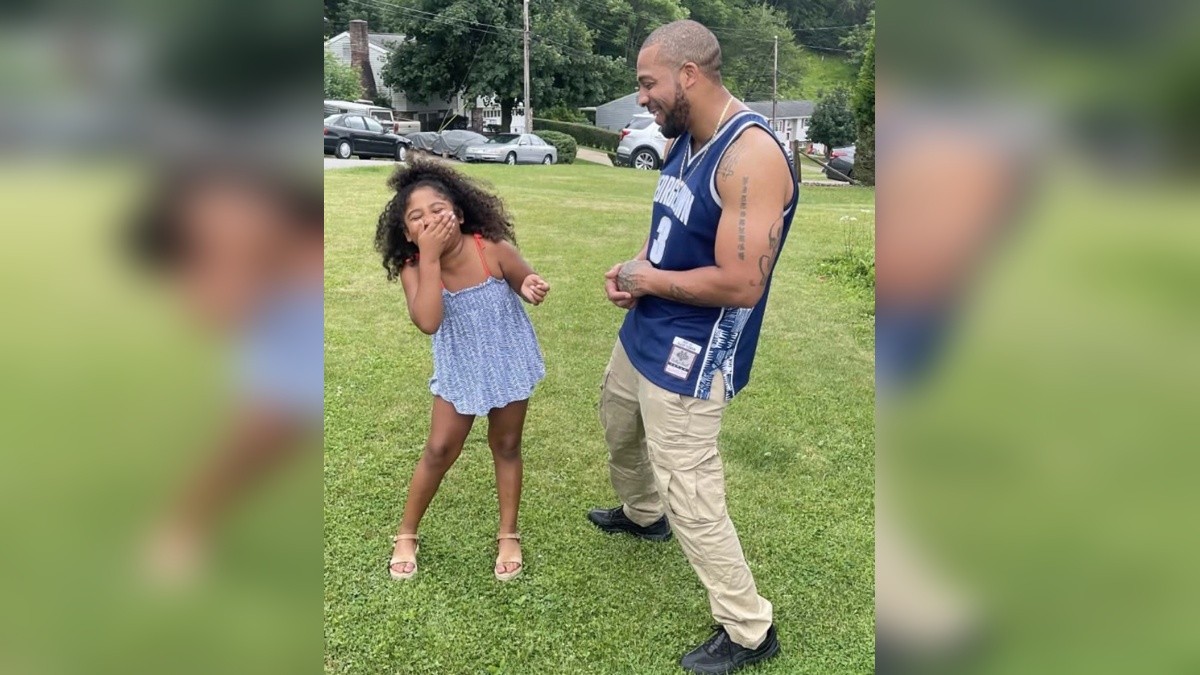
Some stories are about perfection. Others are about survival, choices, consequences, and the environments that shape people long before the public ever hears their name. Aaron Williams’ story falls into the second category.
Born and raised on Chaske Street in Penn Hills, Aaron grew up in a household that looked normal from the outside but carried a lot behind closed doors. His mother and father both came from Homewood and had children from previous relationships before having him together. His father worked hard — something Aaron still respects — but he also admits the household was filled with intense physical discipline that left emotional scars.
“For a long time, I thought that amount of discipline was normal,” Aaron said. “It gave me a lot of aggression at a young age.”
That aggression pushed him outside more than inside. Like many kids growing up in tough neighborhoods, the streets became both a playground and a classroom. On Chaske Street, temptation was never far away.
“As you already know on this particular street, you can get into just about everything you can get into in the hood,” he said.
Football became his escape before he even realized it. Summers at the YMCA in Homewood helped shape not only his game, but his toughness and personality. “You had to be tough to keep up. That’s all I’ll say.”
By the time he arrived at Penn Hills, Aaron had developed into one of the area’s top football players. He started varsity for three years and dominated on both sides of the ball. During his senior season, he led the team in both rushing and tackles — a rare combination that showed how complete of a player he was.
His performances earned him recognition as a finalist for the prestigious Maxwell Award, given to the top football players in Western Pennsylvania. He also earned Pittsburgh Post-Gazette Fabulous 22 honors while helping lead Penn Hills to the 2006 Quad-A championship game against Upper St. Clair.
“Me and Terrelle Pryor were the only two Black finalists,” Aaron recalled. Like many standout WPIAL athletes of that era, college opportunities came fast. Toledo and Akron quickly emerged as his top choices. Toledo already had several familiar Pittsburgh names — Terrell Herbert, Archie Donald, and Barry Church — which made it feel comfortable.
But Aaron says the final decision became more complicated. “My dad really pushed Akron,” he said. “The idea was we could start our own pipeline there.” Aaron also says former Penn Hills teammate Joe Rash played a major role in steering him toward Akron as well. At the time, Akron already had Penn Hills standout Dave Harvey coming off a freshman All-American season, and Aaron believed the trio could build something special together. “Me, Dave Harvey, and the rest of the Pittsburgh guys — we thought we could really turn Akron into something.”
Even now, years later, Aaron says he and his father still occasionally revisit the decision. “He apologized for forcing me to go somewhere I didn’t really want to go.”
Then came October 18, 2009. During a game against Buffalo, Aaron broke his forearm — but finished the game anyway. “I played the whole game,” he said proudly. The injury changed more than just his season. After surgery ended his year, deeper issues began surfacing. Academics — something he openly admits he never took seriously — finally caught up to him.
“Even in high school I never cared about academics. It came back to haunt me in college.” Placed on academic probation while recovering from injury and prescribed Vicodin, Aaron admits he lost focus completely. “I skipped a lot of school and hung out with a lot of women,” he joked.
Then the coaching staff that recruited him got fired. College football can be brutal business, and new staffs often clean house quickly. Players struggling academically become easy cuts because incoming coaches have no loyalty to previous recruits. “That’s exactly what happened,” Aaron said. At first, he didn’t fully grasp the gravity of it. “I thought because I was talented, I could bounce back easily.”
One former Akron coach helped him get an opportunity at Slippery Rock University, offering him another chance to continue his career. But Aaron admits pride got in the way. “In my mind, there was no way I was going Division II.”
While debating his next move, he drifted back toward the same environment he had briefly escaped. That eventually led to a felony case tied to an incident near Clarion University.
Slippery Rock supported him during the legal process and even wrote a letter on his behalf, helping him receive probation instead of harsher punishment. But the scholarship opportunity disappeared, and with it, the version of football life he once imagined.
“That was it for football as I knew it.” After that, Aaron says he leaned deeper into the streets. He made money, bought a car, got a place for his family, and tried to build stability. He thought his past was behind him.
Then came the phone call that changed everything again.
While at work, his probation officer informed him there was a warrant for his arrest connected to alleged drug sales from 17 months earlier. Aaron says his probation officer warned him carefully because he feared Aaron might run. “He told me if I turned myself in, he’d let me bond out. That’s all I needed to hear.”
Once arrested, Aaron learned he was facing serious drug charges tied to an undercover task force operation. Instead of immediately accepting a plea deal, he hired attorney Wendy Williams and decided to fight.
As he reviewed the case, he became convinced the prosecution lacked physical evidence. “No video. No audio. No drugs recovered from me. No marked money. No text messages. Nothing but officers saying they saw me.”
The case dragged on for years. According to Aaron, multiple district attorneys changed throughout the pre-trial stages of the case. But the judge overseeing the process remained the same the entire time: Judge Mark V. Tranquilli. Aaron says many of the motions filed by his defense during the preliminary and pre-trial phases were denied. “He shot down pretty much every motion we filed,” Aaron said. “Even requests involving the confidential informant.”
Eventually, the case landed before Tranquilli at trial — a controversial judge later removed from the bench amid allegations involving racist conduct and judicial misconduct. Aaron believes the courtroom was never level.
In the summer of 2019, Aaron went to trial for the first time. The result: a hung jury.
For Aaron, that mattered deeply. “That means somebody thought I was innocent and wouldn’t move off it.” But the case wasn’t dismissed. Prosecutors retried it later that year.
This time, the jury convicted him on three of four alleged sales. Even in defeat, Aaron points to the mixed verdict and earlier mistrial as proof, in his view, that the case was far from airtight. Instead of accepting an earlier plea offer reportedly worth two years, he received a sentence of 63 months.
Today, Aaron speaks about his life with a level of honesty many people avoid. He doesn’t present himself as perfect, nor does he pretend every bad outcome came from nowhere. Instead, he talks openly about environment, pride, trauma, missed opportunities, and decisions that slowly snowball.
His story is ultimately bigger than football. Bigger than one case. Bigger than one neighborhood. It’s about how talent alone doesn’t save everyone. How environments can shape people long before adulthood. And how sometimes the hardest thing a person can do is tell the truth about their own life — even when parts of that truth are painful.