
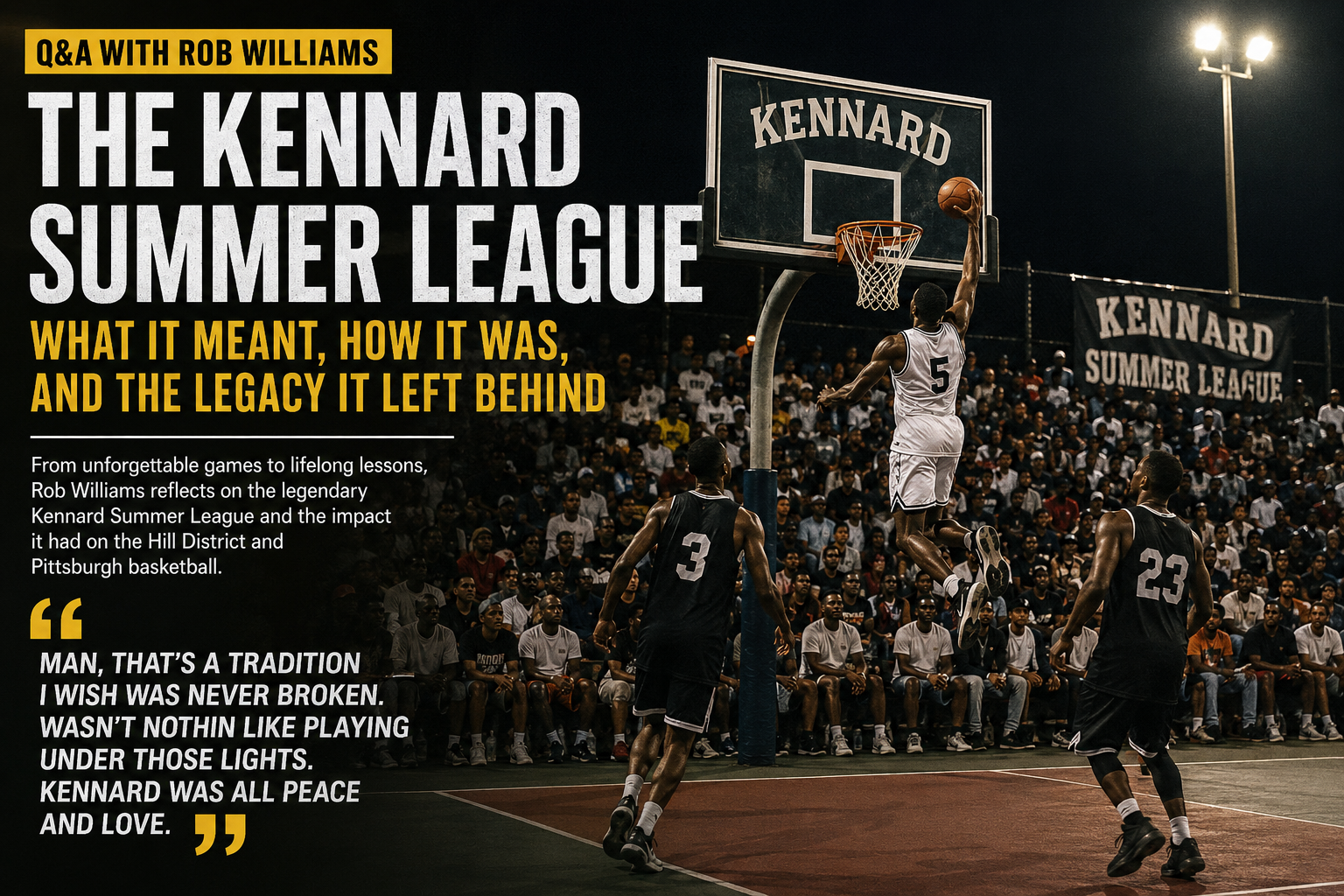
If you got buckets at Kennard, you were certified.
There was a time when summer basketball in Pittsburgh wasn’t played for Instagram highlights, mixtapes, or social media followers. It was played at Kennard.
For years, Kennard Park in Pittsburgh’s Hill District served as one of the city’s premier summer basketball destinations. On any given night, fans packed the sidelines to watch some of the area’s best talent compete. High school stars tested themselves against college players. College players battled former pros. Future professionals sharpened their games against Pittsburgh’s toughest competition.
If you wanted respect in Pittsburgh basketball circles, you earned it at Kennard. The league became known as a proving ground where reputations were built and challenged. Players didn’t care about followers or rankings. They cared about getting buckets against the best competition available.
What made Kennard special wasn’t just the talent. It was the atmosphere. The Hill District community embraced the league. Families came out. Neighborhood legends returned. Young players got to watch older players they looked up to. It felt like a basketball reunion every summer.
For me, Kennard was more than a summer league. In 2008, I was fortunate enough to win MVP at Kennard, and to this day it’s one of the basketball accomplishments I’m most proud of. Not because of a trophy, but because of what it took to earn respect there. Kennard wasn’t for the mentally weak. If you couldn’t handle pressure, the crowd would expose you. If your game wasn’t right, the crowd would let you know. If your hoop shoes weren’t on point, they might spend the entire game clowning you from the sidelines.
There were no participation trophies at Kennard.
Every possession felt personal. Every matchup felt like a test. Every game felt like you were playing for your reputation. The crowd knew basketball. They knew who could really play and who couldn’t. They weren’t impressed by rankings, hype, or what somebody did somewhere else.
You had to prove it at Kennard.
High school stars played against college players. College players battled grown men. Former pros showed up. There was nowhere to hide and no easy nights. And if you got buckets at Kennard?You were certified. People respected your game because they knew exactly what kind of environment you had succeeded in. That’s why it’s sad to see the league no longer being played.
Pittsburgh still produces talented basketball players. The city still loves the game. But many longtime basketball fans would agree that something was lost when Kennard disappeared. It wasn’t just a summer league. It was a proving ground. It was where toughness was tested, reputations were built, and respect was earned.
Today, basketball culture has changed. Players can build a following before they’ve ever played a varsity game. Highlights go viral. Rankings dominate conversations. Exposure often comes before accomplishment.
Kennard was different. Nobody cared how many followers you had. Nobody cared what ranking service listed your name. The only thing that mattered was whether you could play.
The bigger question isn’t simply why the league ended. The bigger question is whether Pittsburgh basketball has lost one of the institutions that helped shape its identity. For those who remember those packed summer nights in the Hill District, the answer may already be yes. What are your favorite memories of Kennard Summer League? Which players, games, or moments stand out the most?
Q&A: Rob Williams Reflects on the Legacy of the Kennard Summer League
Q: For people who never experienced it, what made Kennard Summer League different from every other summer league in Pittsburgh?
A: The atmosphere was unlike any other. The crowd was right up on you, and there was no margin for error.
Q: As someone from the Hill District, what did Kennard mean to the neighborhood and the basketball culture of the community?
A: Growing up on the Hill, Kennard was like our NBA. You dreamed about playing under those lights, especially after watching some of the all-time greats down there as a youngin’.
Q: Do you remember your first time playing at Kennard? What stood out to you the most?
A: The first time I played at Kennard, I was 17 going into my senior season. I played with a team called the Flava Unit. Most of the guys were from West Virginia, and Major Harris was running the team. There were a bunch of guys who played at Marshall University, and they gave me a lot of great advice.
Q: Kennard had a reputation for being a proving ground. How much respect came with performing well there?
A: Just know if you didn’t perform at Kennard, you were going to hear about it. You definitely had to earn that respect.
Q: The crowds at Kennard were known for being knowledgeable and vocal. How did that atmosphere impact players?
A: Man, playing in front of those crowds could make or break you. You had EVERYONE watching because that was the marquee place to be, so the margin for error was low. You wanted to go out there and make something happen.
Q: Who were some of the toughest players you faced or watched compete at Kennard over the years?
A: Lamar Castile, aka Black Mar (who I believe is the GOAT), was the first person I saw down there as a youngin’ who made me say, “Whoa, this dude has to be headed to the NBA.” As a player, there were a handful of guys you had to pack your lunch for, including Dre Kane, Darelle Revis, Drew Schifino, Jack Higgins, Scooter Jackson, and Anth Rivers (RIP). Those dudes were tough covers.
Q: What are some games, moments, or performances from Kennard that still stand out in your memory today?
A: Man, I played in the 2006 semifinals: G-Block Ballers vs. the Flack Side Riders. The Flack had one of the best rosters in Kennard history.Their starting lineup was:
C — Herb Pope
PF — DeJuan Blair
SF — Shawn Hawkins
SG — Darelle Revis
PG — Brian McCalister
It was one of the best games I ever played in. Dawk Films recorded the game. We have to get him to release that footage! LOL.
Q: Many people say Kennard helped prepare players for the next level because of the physicality and competition. Do you agree? Why?
A: Yes, absolutely. It helped prepare you for the next level, especially when you were a 17- or 18-year-old playing against grown men. It definitely groomed you.
Q: How important was it for young players to see high school stars, college players, former pros, and neighborhood legends all competing in the same place?
A: I think it was very important because someone like myself started playing at Kennard at a young age, and those older guys showed me the way. They took me under their wing.
Q: Looking back, what did Kennard teach players about toughness, confidence, and earning respect?
A: Again, respect had to be earned, not given. Most of us came from rough upbringings, so the toughness was already instilled. Kennard could also snatch your confidence away if you didn’t perform.
Q: In today’s basketball culture of social media, rankings, and highlight videos, what do you think young players are missing from experiences like Kennard?
A: Man, that atmosphere was unreal. Like I said before, the margin for error was slim because you had EVERYONE watching. One mistake, and the crowd might slaughter you for life. LOL.
Q: Why do you think Kennard Summer League eventually disappeared, and do you think something important was lost when it ended?
A: In my opinion, it ended when kids started complaining about playing on the blacktop. That blacktop grit was lost when the younger generation stopped playing outdoors.
Q: If Kennard returned tomorrow, do you think it would have the same impact on Pittsburgh basketball? Why or why not?
A: No, I don’t believe so. Maybe people from our generation, 39 and older, would appreciate it. But the younger generation wasn’t there for it, so they wouldn’t fully understand.
Q: What do you think Kennard’s legacy is within Pittsburgh basketball history?
A: You can’t mention Pittsburgh basketball history without talking about Kennard. At its peak, I think Kennard was one of the top five summer leagues in the country.
Q: When people talk about the greatest summer basketball traditions Pittsburgh has ever had, where does Kennard rank for you?
A: Kennard is the greatest summer league in Pittsburgh history, by far.
Q: Is there anything else you’d like people to remember about Kennard Summer League and what it meant to the Hill District and Pittsburgh basketball?
A: Man, that’s a tradition I wish had never been broken. There was nothing like playing under those lights. Kennard was going on during some very bad times in the Hill District, but you wouldn’t know it because it was all peace and love once you got down there. Also, for a guy like me who never played college or pro ball, being able to step on the court and compete against guys like Black Mar, Drew Schifino, Darelle Revis, DeJuan Blair, Dre Kane, and so many others, those memories will stay with me for the rest of my life