
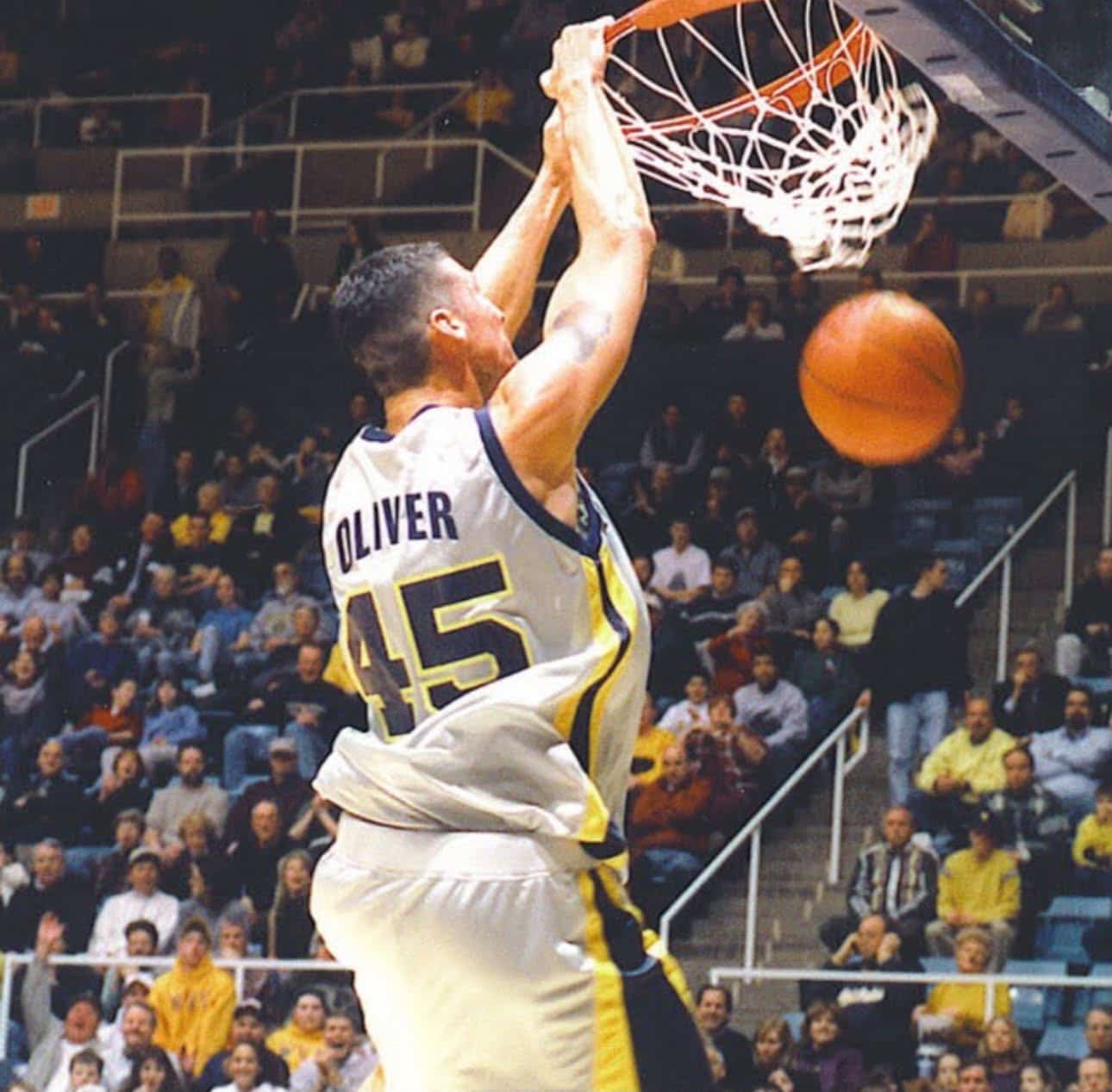
The wins fade. The statistics get forgotten. But the brotherhood lasts forever. One of the best parts of building this platform has been reconnecting with the teammates who helped shape my journey at West Virginia University.
John Oliver was one of those guys.
We shared the same locker room, competed together every day, and experienced what it meant to wear the Flying WV.
Off the court, John had a brand-new Escalade sitting on 24s. He was basically the mayor of Morgantown, everybody knew him. He was the plug, because he was connected with just about everyone, and his personality was larger than life. On the court, if you needed a screen, John’s eyes would light up because he loved setting bone-rattling picks. He brought the toughness and physicality every successful team needs. He rebounded with force, played with an edge, and never shied away from doing the dirty work.
Simply put, he was our enforcer. Years later, that bond is still there.
In this edition of WVU Brotherhood, John reflects on his journey to Morgantown, the memories that have stayed with him, the lessons he learned as a Mountaineer, and how WVU helped shape the man he is today.
Q: Before WVU, what was your basketball journey like, and when did you realize you could play at the Division I level?
A: I was a multi-sport athlete who lettered in four different sports. Ironically, basketball wasn’t my primary sport growing up, it was soccer. I was a standout goalkeeper for many years. As my physical stature changed, I eventually “grew out” of soccer. I had always played basketball during the winter and baseball in the spring, and after stepping away from soccer during my sophomore year, I gravitated toward football, where I played both sides of the ball as a tight end and free safety. I really enjoyed the contact and competition. Growing up in New York, basketball culture is everywhere. As I progressed year after year, recruiters kept telling me that if I wanted to play at the next level, I needed to focus on one sport. Ultimately, that’s exactly what I did, and that sport became basketball.
Q: What stood out about West Virginia during the recruiting process that made you commit?
A: Coming off a 35-0 season at Maine Central Institute (MCI), I was primarily interested in Big East schools because I wanted the opportunity to compete against my hometown team, Syracuse. I actually took my recruiting trip to WVU with my teammate Bobby Smith, who later went on to play at Villanova. He told me Morgantown was a fun school and that we should check it out just to use one of our official visits. I was genuinely surprised by how welcoming and authentic the people of West Virginia were, especially since I had never been to the state before. The 1997 WVU team had just come off a Sweet 16 run and was losing six seniors, and I was told there would be an opportunity for me to come in as a freshman and make an immediate impact. I fell in love with the campus, the community, and the sense of family that surrounded WVU. Ironically, I wasn’t the only player from our championship MCI team who knew the Big East was a beast. My point guard, Erick Barkley, went on to St. John’s, my shooting guard, Kevin Braswell, went to Georgetown, Clinton Sims went to Boston College, and Bobby Smith went to Villanova. In the years that followed, Caron Butler went to UConn and Jaron Brown went to Pitt. It was an incredible era of Big East basketball.
Q: When you think back to your first day on campus, what emotions come to mind?
A: I remember being excited on my first day on campus, moving into my dorm room, meeting my roommate Chris Moss, and seeing the incredible amount of pride people had for the university. From day one, it felt like more than just a school. It felt like a family.
Q: What teammate had the biggest impact on you during your time at WVU, and why?
A: One teammate who had a huge impact on me was Marcus Goree, or as we called him, “Young Buck.” He was an absolute workhorse, strong as an ox and someone who simply had no quit in him. He worked extremely hard in the weight room, had a great sense of humor, maintained a positive attitude, and worked diligently year after year to become one of the more dominant players in the Big East. Marcus embodied toughness, consistency, and hard work.
Q: Every team has stories fans never hear. What’s a funny or memorable locker room moment you can share?
A: There are so many stories, but here’s one that comes to mind. After a turbulent senior season and our head coach stepping down midway through the year for personal reasons, his nephew, Drew, took over as interim head coach. Unfortunately, we didn’t always see eye to eye. During an away game at Pittsburgh, I dislocated a finger. It was my last opportunity to ever play against Pitt, and during halftime, Drew got under my skin a little regarding the injury. Needless to say, I’m not someone who backs down from confrontation, so a few teammates may or may not have had to restrain me from making a very poor decision in the locker room. After cooling off, I decided to check myself into the game and start the second half. Drew didn’t come out of the locker room until the very last minute, probably because he was a little worried about what I might do. Or maybe that’s just the way I remember it all these years later.
Q: How was your relationship with Coach Gale Catlett?
A: It was an interesting relationship. Coach Catlett played at WVU, lived in West Virginia his entire life, and embodied everything you’d expect from a hard-nosed, old-school coach. Deep down, I respected and appreciated his tough demeanor. Looking back, I think he hated to love me because I played the game a lot like he did back in the day, from what I’ve heard. I looked out for my teammates, embraced the enforcer role when needed, and worked extremely hard both on and off the court to help elevate everyone around me.
Q: Looking back, is there one game that you’ll never forget? What made it so special?
A: I don’t know if there’s one specific game I’ll never forget because there were so many memorable experiences. There were incredible moments celebrating wins over Top-10 teams and heartbreaking moments as well, including a buzzer-beater loss at Connecticut against a team that would eventually go on to win the national championship. Those highs and lows are part of what makes college basketball so special.
Q: How did playing at WVU prepare you for life after basketball?
A: My college experience prepared me for much more than basketball. As we all mature and grow, I often think about arriving at WVU as a teenager and leaving as a young man. The relationships, experiences, and personal growth that occurred during those formative years helped shape who I would become and ultimately set me up for success later in life.
Q: What has life looked like since your playing days ended?
A: After attending two successful professional showcase camps—one in Salt Lake City, Utah, and another in North Carolina—I had an opportunity to pursue a professional career as the type of role player every team needs. Dennis Rodman was one of my favorite role players, and I embraced that mentality. Unfortunately, I suffered a career-ending back injury after herniating four discs, and as they say, “that’s all she wrote.” I have to commend WVU because the university offered to cover my graduate education. I returned to Morgantown and earned my master’s degree in Exercise Physiology in just three semesters, graduating magna cum laude. That experience helped me discover my true passion. As a graduate assistant strength and conditioning coach under the legendary Mike Barwis, I found my calling and went on to build a career training athletes, developing a sports performance company, building a highly successful health and wellness facility, creating a nutrition line, developing in-home and travel training systems, working with people like Tony Robbins, and eventually writing a best-selling book.
Q: What advice would you give today’s Mountaineers about making the most of their college experience?
A: Live every single day to the fullest, trust your instincts, and spread love. We all make mistakes. Nobody is perfect, and every experience teaches us something valuable. Perception often becomes reality, so choose your mindset carefully and appreciate the journey because it goes by much faster than you realize.
Q: What does the WVU Brotherhood mean to you all these years later?
A: The WVU Brotherhood is an unexplainable bond. In complete transparency, I distanced myself from the program for several years after college because of how my career ended and how our final season unfolded. I give Coach Huggins a tremendous amount of credit for bringing me back into the fold and helping me realize how important it was to stay connected and involved. Once you’re a Mountaineer, you’re always a Mountaineer.
Q: If you could relive one moment in a Mountaineer uniform, which one would you choose and why?
A: That’s a tough one, but if I had to choose, it would probably be walking out on Senior Night one more time and having that carpet rolled out in the Coliseum. The feeling inside that building was always electric, and the fans never wavered in their support. Hail WVU.