
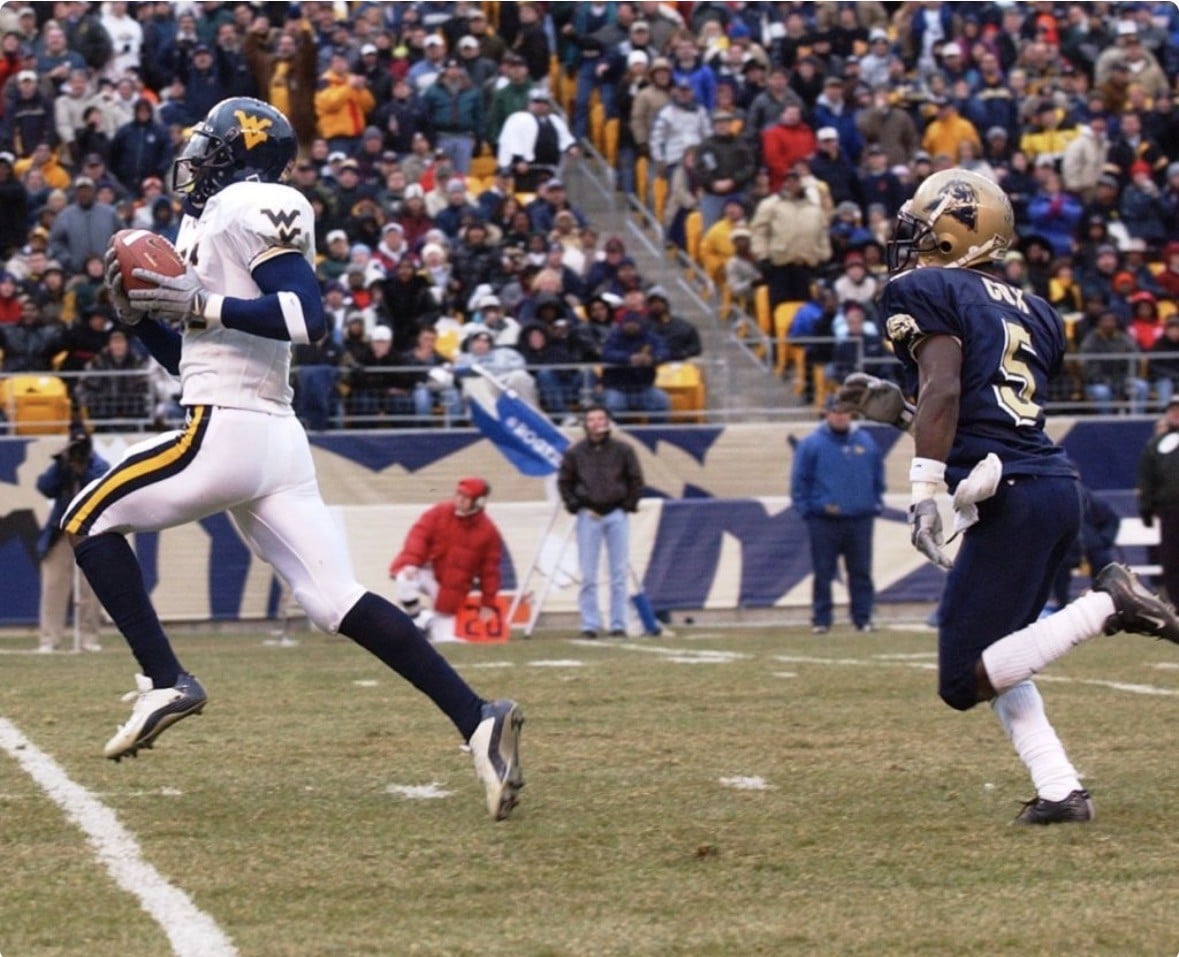
Every generation of West Virginia University football has players whose impact goes beyond the stat sheet. Phil Braxton is one of them.
A standout wide receiver from Connellsville High School, Braxton arrived in Morgantown during one of the most important transitions in Mountaineer football history. He experienced the final years of legendary coach Don Nehlen’s era before finishing his career under Rich Rodriguez, giving him a unique perspective on two influential chapters in WVU football history.
Standing 6-foot-3, Braxton developed into one of the Mountaineers’ top receiving threats. After originally being projected as a defensive back, he found his home at wide receiver while also becoming one of the team’s most valuable special teams players. His versatility, athleticism, and willingness to do whatever the team needed made him a respected figure inside the program.
Braxton’s career included memorable performances against some of West Virginia’s biggest rivals, but none stood out more than the Backyard Brawl against Pitt. Throughout his career, he consistently delivered in one of college football’s fiercest rivalries, including touchdown receptions of 60 and 79 yards against the Panthers. Those performances helped cement his place in Backyard Brawl history.
Despite battling injuries during his time in Morgantown, Braxton finished his career with 55 receptions for 898 yards and five touchdowns while also contributing as a kick returner and special teams standout. His ability to stretch the field and make explosive plays gave opposing defenses problems whenever he touched the football.
Football also runs deep in the Braxton family. Phil followed in the footsteps of his uncle, Jim Braxton, one of the greatest players in West Virginia football history and an All-American before going on to a successful NFL career. Carrying that family legacy while creating one of his own added another layer to Phil’s Mountaineer journey.
Following his playing career, Braxton briefly signed with the Pittsburgh Steelers before dedicating his life to education, becoming a teacher and athletic director while mentoring young people through sports. His impact has continued long after his final game in the Gold and Blue.
The WVU Brotherhood is built on players like Phil Braxton, men who represented West Virginia with toughness, resilience, and pride. Their stories deserve to be remembered, and that’s exactly what this series is about.
Q: What made West Virginia University the right choice for you coming out of Connellsville?
A: Family legacy. I had two uncles play for WVU, and one of them went on to play several seasons for the Buffalo Bills.
Q: What was your first impression when you arrived in Morgantown?
A: I had at least 10 family members attend and graduate from WVU, so I was already familiar with Morgantown. I even got to stay in Braxton Tower my freshman year.
Q: You came in as a defensive back before moving to wide receiver. How challenging was that transition?
A: It was easy for me because I was used to playing both offense and defense. But we had so many great players on defense that I knew I could get on the field right away at wide receiver.
Q: What was it like playing for legendary coach Don Nehlen?
A: Honestly, I wish I could have played for Coach Nehlen all four years. He treated me as a player so much better than Coach Rodriguez ever did.
Q: Which teammate had the biggest impact on your career, both on and off the field?
A: Tough question. Early in my career, it was Khori Ivy and Jerry Porter. My junior and senior years, it was Shawn Hackett.
Q: What is your favorite memory from the Backyard Brawl against the University of Pittsburgh?
A: I had 100 receiving yards and a touchdown every time I played Pitt, but my favorite memory was the 79-yard touchdown that sealed the game.
Q: Looking back, what game or moment best defines your time as a Mountaineer?
A: Probably that 79-yard touchdown against Pitt.
Q: How much did your family’s football legacy motivate you throughout your career?
A: Very much. I was raised by my grandmother, so I grew up in the same house as my uncles. My grandma had a trophy room with more than 300 trophies, including a section dedicated just to WVU trophies. I couldn’t wait to add mine to it.
Q: What did wearing the Gold and Blue mean to you?
A: It was something I always knew I was going to do. It’s a special thing for me and my family.
Q: How has football at West Virginia helped shape the man you are today?
A: A big part of it was meeting people from all over the country. It changed the way I looked at the world.
Q: What advice would you give current WVU players about making the most of their opportunity?
A: You only get five years of college, so make the most of it. Lock in on whatever you do.
Q: What does the phrase “Once a Mountaineer, Always a Mountaineer” mean to you?
A: We live it, bro. It’s a true brotherhood. I’m still great friends with so many people from WVU 20 years later. I’ve talked to at least 20 of them in the last week alone. We truly tell each other, “Love you, bro,” every time we talk.
Q: What has life been like after football?
A: Blessed. I’ve been able to pour into young people ever since. I’ve been a seventh-grade math teacher at MACS for more than 20 years, and I love it.
Q: When you return to Morgantown today, what emotions come back?
A: Every year I meet up with my former WVU roommates and teammates. We go to a few games and reminisce about the old days.
Q: What message would you like to leave for Mountaineer Nation?
A: Country Roads, take me home…