
There’s a lesson in basketball that doesn’t get taught enough anymore. Too many young players believe every great team should have five stars. Social media, AAU basketball, and even some parents have convinced kids that if they’re not the leading scorer or getting the most attention, they’re somehow being overlooked.
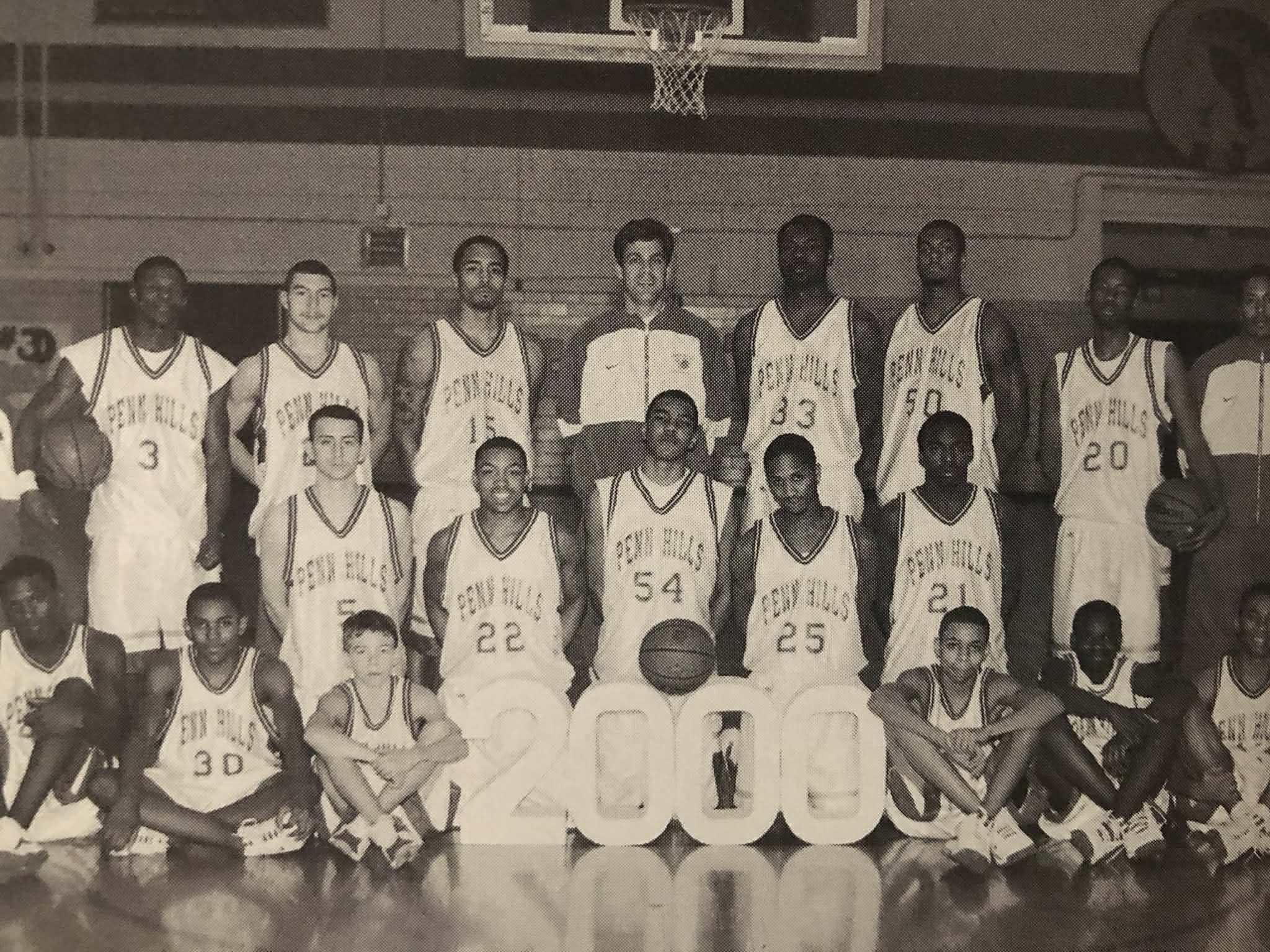
Championship basketball has never worked that way. Our 2000 Penn Hills WPIAL championship team is proof of that.
I was our primary ball handler, leading scorer, and one of the top high school recruits in the country. The offense ran through me because that gave us the best chance to win. That wasn’t about ego, it was about understanding our strengths as a team.
One of the biggest reasons we were successful was my teammate, Nick Ionadi. Nick was our second-leading scorer and one of the best three-point shooters in the WPIAL. He understood something that a lot of players today struggle to accept: every great team needs players who embrace their role.
Recently, Nick shared a message that really resonated with me. He said he’s thinking about writing an essay for high school players who are the “B-tier” or second scorer on a team because too many young athletes are being taught the wrong things. His message was simple. If you’re fortunate enough to play with a truly dominant player, your job isn’t to compete with them for shots or attention. Your job is to complement them. Nick even used our team as the example. He said if there was ever a game where he scored 28 points and I scored 20, something probably went wrong. The formula that made us successful was me scoring 35 or 36 points while he gave us 15 to 20 efficient points, knocked down big three-pointers, defended, and made winning plays.
That’s not sacrificing your game. That’s understanding how to win.
One memory he shared perfectly captures the kind of teammate he was.
Against State College, I scored 36 points while Nick finished with 24. He told me he wasn’t even keeping track of his own points because he never cared about chasing numbers. What he remembers most is me constantly nudging him during the game, smiling and telling him how many points he had because I was genuinely excited for him. That story means a lot to me because people outside our team often said I shot too much or called me selfish.
What they never saw was the trust inside our locker room. My teammates understood our system. They knew we weren’t trying to spread the shots equally. We were trying to maximize our strengths and win basketball games.
After Nick shared those memories, I told him something I’ve always believed. “Basketball has roles, and we both understood ours. You never cared about chasing stats, you cared about winning. That’s why we had the success we did. I’ll always respect you for that, and I’ll never forget how unselfish you were.”
That’s why I wanted to tell this story. Nick Ionadi’s perspective is one that every young basketball player should hear. Not everyone is going to be the superstar. Not everyone is going to be the No. 1 option. But if you embrace your role, earn your teammates’ trust, and put winning ahead of individual numbers, you become just as valuable to a championship team.
Twenty-six years later, that’s still one of the biggest lessons our 2000 Penn Hills WPIAL championship team can teach the next generation.
Q: Looking back, what made our 2000 Penn Hills team so special compared to other teams you played on?
A: For me it is because all of us were there the prior 2 years where we just fell short. We all remember New Castle and just how good they were, but we always felt like we were right there, but just kept falling short in the WPIAL Semis, and then the year before losing to NA in the semis was frustrating. So for us to go through the season we did, but finish exactly where everyone thought, and we thought, we should finish, was extremely gratifying. People say “it is just a high school championship” but back then you didn’t have recruits and guys switching schools. You did it with whatever your community produced. All of us were Penn Hills kids, and we got it done.
Q: You recently said you’re thinking about writing an essay for high school players in the “B-tier” or second-scorer role. What inspired you to share that message?
A: Drew, like you, I have been coaching and following local basketball since the day we were all done playing. I have coached going on 20 years. And it is frustrating to see how selfish a lot of this has become, and how many teams could be great, but because someone is unwilling to proudly accept a role they are meant for, and they end up being a disappointment. It is not only sabotaging teams, but that lack of honesty with themselves is also hurting them as players, and their futures.
Q: Why do you think so many young players today struggle to accept or embrace a role on a team?
A: Look I get it, everyone wants to be the guy, but not everyone is the guy. Basketball is not fair. Just like Life. Shots aren’t equal. Opportunity isnt equal. A player’s leash on the floor isnt equal, and rules aren’t the same for everyone in the sense that some players can make more mistakes or get away with a little more on the floor than another. The issue for me is 3 fold: First it is parental involvement. Too many parents are too involved. They somehow think their child’s lack of playing time or scoring or involvement is somehow a reflection on their parenting. And it isnt. They are at home telling their child at the dinner table they are better than so and show and need to shoot more or do this or that, and that absolutely filters over to the team. Second is AAU. Kids are playing on backyard AAU teams or for organizations that have 400 players and 60 teams. They go these tournaments at the same place out in NA and play against 3 other teams in their organization all weekend and score 20 points vs their organizations C group. Then they come back to their team with this attitude and may have a teammate on their school team who averaged 12 a game on their AAU team, but they’re playing for guys like Tom Droney/Nate Perry on their WildCat teams on the Adidas circuit. Your production isnt the same. You are not the same. One is playing elite comp, you are playing guys who may not even make their 1A high school teams. So, what happens is the 20-point guy thinks he’s better than the 12-point guy, and it just ruins everything. Finally, its social media. Back when we played, you had to earn ink in the newspaper. You had to. Every article, and bit of attention I got had to be earned. There is a reason you were mentioned every other day by the newspaper. Kids today with social media have a friend record their games, upload, and suddenly they are getting attention. It has once again created unrealistic attitudes of kids who think they are the man. All of this creates these situations where guys think they are better than they are, and pout and get upset when they aren’t getting touches and don’t wanna be that B guy because their ego wont allow it.
Q: You said if you scored 28 points and I scored 20, something probably went wrong. Can you explain why that was the formula for our team?
A: If I score 28 and you score 20 we would have had a serious problem. Now first of all that never, ever happened. But I understood at age 15 the issues that created. If I am taking 20 shots a game (I typically got 9-10 on average and depending on the game around 15) that means on an average night that is 10 shots our best player isn’t getting. And just like points scored, shots taken are not all created equally. It isn’t the shot that is the problem, it is what the shot generates and how it affects a defense. For example: When I beat my guy off the dribble, teams rarely sent help. I wouldn’t see a big guy come over and leave our bigs to collapse on to me because I am only 5’10. It basically came down to me making or missing the shot, and if I missed those possessions were typically one and done. There were no opportunities for weak sound rebounding or kick outs because teams simply wouldn’t send the help. When you beat your guy off the bounce it would wreck a defense before you even got to the rim. Bigs were rotating, guys were collapsing off the perimeter, people were trying to double and triple. So now if you miss, our bigs had easy weak side rebounds, there were kick out opportunities, open threes, bad defensive rotations, closeouts. It turned their defense upside down. The more you did this, the more you scored and attacked, the more opportunities we got as a team. So, if I score 28 and you score 20, I bet we score in the high 50s low 60s as a team. If its flipped, and you got 36 and plenty of opportunities and I got my usual efficient 16, I bet we are in the 70s-80s. That’s why we dominated the glass so badly in the playoffs. I think we were averaging like 35 rebounds a game as a team back in a time you didn’t have the number of possessions you have today. Because you’d attack, defenses were desperate to get a stop and everyone just got easy boards. I bet 99 percent of my offensive rebounds that year came directly off your drives. Why? The weak side block was empty because that guy left to stop you. You had to be the focal point. Otherwise, we would stagnate and lose.
Q: How did understanding your role actually make you a better player instead of limiting your game?
A: My understanding of my role let me just be myself. The day I met you in 7th grade I knew unequivocally my game had to change. You played at a level, even then, I simply couldn’t comprehend replicate physically. So, what this did was actually make my life easier. If you remember I was the only freshman on the varsity and started JV and I spent the year pretty much watching you, and getting beat up by Jake in practice but learning from him. And I realized, if I could become a great a shooter my life here is going to be really easy. I could already handle a ball and understood the game, but everyone was bigger than me and faster. I accepted what my role would be until you graduated immediately, so instead of focusing on things I would never do, it let me develop my skills confidently because I was working on things that would benefit me and you and our team directly. Had I been delusional and seeing myself as some slasher scorer 29 ppg guy, I would have spent time working on shit I was never going to utilize, and the things I needed wouldn’t have developed as fully. I am not exaggerating when I say this, I spent the summer between 9th and 10th grade specifically developing my game to compliment yours. I wasn’t stupid. And I wanted to be out there. I shot thousands of shots and free throws a day. Every day. From everywhere. It was that and ballhandling every day. Because you were so good, it let me know who I was and where I fit, and when roles are clearly defined it lets player develop efficiently, like it let me really focus on developing the most pertinent skills I needed. Then the confidence I gained from that time with you, let me have the senior year I had where I averaged 16 a game, and was on preseason players to watch lists and made all section publications and eventually getting into the hall of fame there with you. It was all directly tied to my time playing next to you, fitting my game into yours, understanding your importance to us and playing that role with a lot of pride. To me I was just hooping with my friend, if I didn’t play with you, none of what happened for me, happened, and it’s as simple as that. My success over my 4 years was directly tied to yours. We had teammates over the years who fought that, and they underachieved because they focused on things that were never going to happen and were not ready for the opportunities that did come to them.
Q: What did people outside our team misunderstand about the way we played together?
A: Man, the biggest misunderstanding was that you were this selfish player who didn’t pass the ball or that I should be taking more shots and I would just keep telling them, you don’t understand my job is to make sure Drew’s life is easy as possible. Not the other way around. I am his safety valve. If he needs me in a game, I am there, if not, then I am going to be ready. We played together exactly how we should have. You did your thing, I did mine, and we always knew where the other person was. No egos, no bullshit. Let’s just go get this done.
Q: A lot of people said I shot too much or was selfish. As someone who played beside me every day, what would you tell those people?
A; The shooting too much comments used get me angry because first off, they weren’t true and we were friends, so it bothered me. I always would use this example with them: Imagine you are a player like Drew, and you know you can shoot the ball 50 times a game and score on 35-40 of those times. Literally no one can watch you. You also know if you throw the ball to this other player 30 times, they turn it over 7 times, miss 8 shots, make 2 and throw it back to you immediately the other 13 times, why bother passing. If you want the ball from him you better make your shots count and I was a great example of that. Early in the year I got the ball here and there, and every game you looked for me a bit more and a bit more to the point it was pretty much all we did. But you have to earn that respect, why’s he just gonna toss me the ball if i miss every shot. Do not mistake selfish with wanting to win and understanding what’s happening on the floor.
Q: Tell everyone about the State College game when I scored 36 and you had 24. Why has that memory stayed with you all these years?
A: The State College game lol. That game stands out to me for a few reasons. I think every player at one point or another has that one game where everything clicks and are like, ok I can do this. That was that game for me early in that season. As a player figuring things out and you’re playing with someone like you, who was just so far beyond the rest of us, you want respect from them, and you want accepted by them and want them to notice you can help. I do not care what anyone says. That is a mindset anyone would have, and I am not talking about playing with a good or great player, I am talking about a generational player that your school will never see again. There was a HUGE spotlight on you, and it shined on the rest of us, so you want a chance to be a part of it. That game you started looking for me and trusting me more and more and that was like that “A-ha” moment, I knew exactly what I had to do then. Handle the ball, play defense, get you the ball where you could do damage, make free throws and be ready to hit any shots I got. It was really simple after that, but that was the first game where I felt like I belonged in the backcourt with you, because before that I was like how do I even help someone like this lol.
Q: You mentioned I was more excited about your 24 points than my own 36. What did that say about me as a teammate?
A: I always use that State College locker room after the game as an example because it totally went against the outside narrative that you only cared about you. You just had another one of your ridiculous games, and it was the first time that year I broke 20, I think I had 22 or 24, I don’t remember at this point. But we are in the post-game, we just won, and Roc is talking about the win and you’re laughing uncontrollably, elbowing me, completely ignoring what was being said and telling me how many points I had. I just kept thinking, Drew just scored like a point a minute and is more excited about me than he is for himself. And the second thought I had was, he is paying attention to what we are doing, he is looking for one of us to step up and help him. That’s a teammate. And I thought, he trusts me now. That sent my confidence through the roof. People don’t get it. Yeah, you got on guys that couldn’t play but that was really culture of our team, we used to get on each other in practice a LOT but it was a competition thing, we had a lot of guys who could play, but if you thought we could play? Then you had our back 100 percent.
Q: As one of the best shooters in the WPIAL, how much confidence did it give you knowing I’d always trust you to take a big shot?
A: Any time the best person trusts you it makes you confident. Especially when that person is top 1 or 2 in the state. You aren’t afraid to miss, and you start to believe in yourself more than you actually should. My confidence was much higher than it should have been. Little things, there were games you’d skip it to me and would turn around with your arms up before I shot. That does a lot of positive for teammates. I try to explain that to kids I coach now. You gotta hype up your teammates especially when you are “the guy”, you have no idea what it does to that player who isn’t as good as you. I know, I lived it.
Q: Do you think AAU basketball and social media have changed the way kids think about winning versus individual success?
A: YES! And I touched on that question above, it’s crazy how we think alike lol. It has made a mess of everything. Again, think about how you got attention back when we played, you had to earn ink in the newspaper. If you didn’t do anything, no one hears about you. No one. There was no self-promotion. You had to. Every article, and bit of attention I got had to be earned. There is a reason you were mentioned every other day by the newspaper. Guys like you, and Dave, and Fuss, and Epps getting into the Fab Five, you had to literally do that through your play and attention your play generated. Not only that, WE heard about other players in other areas or sections because of their play, not some social media post. It wasn’t like it is today, I had no connection to anyone in Butler but I knew who Epps was, I knew who you were before I even got to Penn Hills. All of that was word of mouth and newspaper print because of YOUR play and article written by some random newspaper guy who thought you deserved the attention. Not social media hype. Kids today with social media have a friend record their games, upload, and suddenly they are getting attention. It has once again created unrealistic attitudes of kids who think they are the man.
Q: How important is trust between the best player and everyone else on the team?
A: It is critical. If the best player doesn’t trust everyone it will erode everything because it kills everyone’s confidence. Now that is not to say the best player should not be challenging guys and digging in their ass when they are playing well, because that’s part of it. But when the Alpha trusts the rest of the pack it becomes way more than the sum of its parts. It’s like the old phrase, the strength of the pack is the wolf, and the strength of the wolf is the pack. The only thing I think it’s important to note is that you have to earn that trust. When you are playing with elite teammates, they aren’t going to understand why you cant just catch the damn ball and not throw it away. If you want that trust and want a bigger role you better be ready to excel at the other stuff, great players aren’t just going to respect you just because. This question made me think back to my freshman year. Every day on that scout team I would guard Jake, who by the way I always thought was a top 5 or 6 guy and could have been Fab Five. I don’t think he said two words to me from November to December, who talks to the only freshman on the team. But every day I guarded him, every day he destroyed me, and every day I guarded him. And over time he started helping me, answering questions, I even remember a few times when he got taken out at the end of a blowout he would tell Roc to toss me in for 5 or 6 minutes. That stuff matters to teammates, but you have to be ready to earn it somehow.
Q: What advice would you give a high school player who’s the second or third option but wants to help his team win championships?
A: I would tell that kid just do you and be proud of that role. You think I cared what anyone thought? I cared what you, my teammates and coaches thought. Why do I care about the person who doesn’t even play. Find that role, be great in that role, and more opportunities will come and you will be successful and you will get whatever recognition you want. You cannot be delusional, you cannot fight it or think you deserve more. No one deserves a thing. No one. If you aren’t willing to accept that role, it’s going to be hard on you. It is going to be hard on the team. They need to think of it this way. I was chosen to do this. There are 15 other guys on the team, but coach chose me for this role. You could be the kid that doesn’t play! Listen, and I can say this from experience. It is ok not to be the best player, it is ok not to be Fab Five, it is ok not to be the one everyone remembers. I worked hard, every day, and not matter how hard I worked I was never going to be Fab Five, not with the guard play in that era, nor better than you. But I never worked hard for that. I worked hard so I could help my team win and be as good a player as I could and work within the physical skillset I had. My senior year I got to step into that role to a degree of the best/most experienced player and got more touches and averaged more points and all that. We came in second in the section, made playoffs and had a good year. I 100 percent would have traded it for one more season as your running mate and second fiddle to see what we could do. The people who matter will remember your contributions. Just be great at what your chosen to do. The rest takes care of itself.
Q: Looking back more than 25 years later, what does that 2000 WPIAL Championship and the brotherhood we built mean to you today?
A: Those are my guys. All of you. In terms of personal relationships, those were the best 4 years of my life. To be surrounded by people who are exactly like you, same interest, same everything. We were all different but all the same. That 2000 team, after that run, it is like Coach Blundo said to his guys a couple years ago, no one can take that away from us. People can say what they want but we were number one at the beginning, and the end, and damn near won a state title. Being a part of a team where when you’re out there you know everyone’s behind each other, and they’re you’re friends? That is the best part. Kids today complain about practice or offseason stuff but for us it was just hooping with our boys, and that particular group, especially the ones who were there from my freshman year onward like you, they will always be guys who I support and have their backs. They’re family. Always will be.