
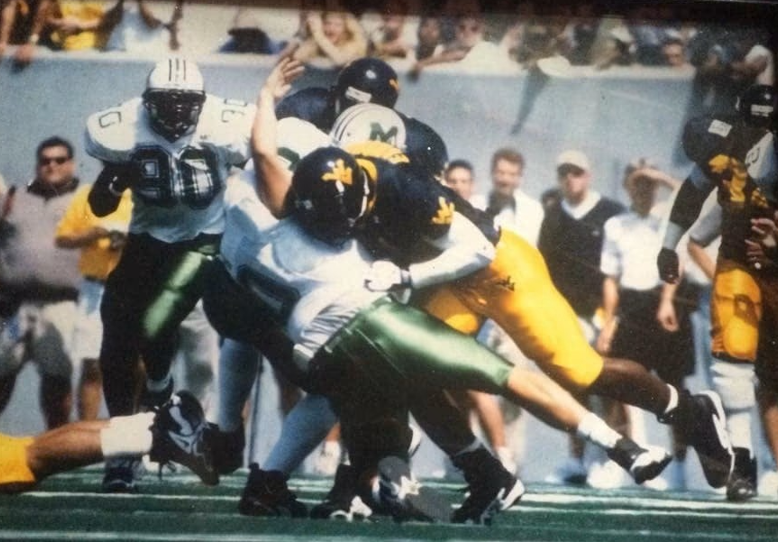
Western Pennsylvania has produced some of the nation’s toughest football players, and few programs have done it better than Woodland Hills High School. Among those standouts is former West Virginia University linebacker Chris Edmonds, whose journey took him from Atlanta to Pittsburgh to Morgantown and eventually to the National Football League.
A Woodland Hills product, Edmonds joined the Mountaineers in the late 1990s, bringing size, toughness, and versatility to WVU’s defense. Standing 6-foot-4 and weighing around 245 pounds, he developed into a physical player who embodied the hard-nosed style that Mountaineer fans have always appreciated. He lettered at West Virginia from 1997 through 2000 before pursuing his dream of playing professionally.
Although he went undrafted in 2001, Edmonds refused to let that end his football career. He signed with the Cincinnati Bengals, where he displayed his versatility by contributing at multiple positions, including tight end, fullback, and on special teams. He later continued his professional career with Frankfurt Galaxy in NFL Europe, proving that persistence often matters just as much as talent.
But perhaps Edmonds’ greatest impact has come after football.
Back home in Pittsburgh, he has dedicated himself to giving back through his nonprofit, Athletic Trauma Unit. His organization provides food drives, toy giveaways, free fitness programs, and mentorship opportunities for young people throughout communities including Swissvale, Braddock, and Rankin. He has also coached at his alma mater, Woodland Hills High School, helping develop the next generation of student-athletes.
Chris Edmonds represents what the WVU Brotherhood is all about. The brotherhood doesn’t end when the final whistle blows. It continues through leadership, service, and investing in others. His story is a reminder that success isn’t measured only by games played in the NFL. It’s also measured by the lives you impact once your playing days are over.
For Mountaineer fans and football fans throughout Western Pennsylvania, Chris Edmonds remains another example of the pride, toughness, and commitment that define the WVU Brotherhood.
Q: What was it like playing in the Woodland Hills vs. Penn Hills rivalry back in the ’90s?
A: Crazy enough, I didn’t grow up here. I grew up in Atlanta. My mom shipped me here my junior year after I got shot twice to live with my aunt. She just happened to live in Turtle Creek. So I didn’t even start playing football until the middle of my junior year of high school. I really only played against Penn Hills one time.
Q: Why did you choose West Virginia University over your other college options?
A: I chose WVU because Mike Logan was my host, and I’ll leave it at that. I saw some things, and some money was being invested way before NIL, we were still getting it! Don Nehlen told me when I was 16 that I was going to the NFL if I came there. After those four games my junior year, I committed to WVU.
Q: What are some of your favorite memories from your time as a Mountaineer?
A: My favorite WVU memory was seeing that couch burn in real time while hearing “Country Roads.”
Q: Which coaches or teammates had the biggest influence on your life during your WVU career?
A: Coach Donnie Young (RIP) was my linebackers coach, and he taught me everything.
Q: What did wearing the Old Gold and Blue mean to you?
A: The Old Gold and Blue means everything! I even got that WV tattooed on my back!
Q: You played several different positions during your football career. How important was versatility to your success?
A: Playing multiple positions helped me a lot. It was like playing against myself. Studying both sides of the ball was like having a cheat code.
Q: What was your “welcome to the NFL” moment?
A: Man, my welcome-to-the-NFL moment was self-inflicted. I went there with an attitude after my draft status dropped because I had played so many different positions. I chose violence every single practice, and it actually became the key to my success because guys were scared of what I might do in practice. Eventually, they had no choice but to start me.
Q: Looking back, what accomplishment in football are you most proud of?
A: Looking back, I really didn’t think much about my career. But when my sons became better football players than I was, it made me happier than anything I accomplished myself.
Q: After football, you focused on giving back through Athletic Trauma Unit. What inspired you to start the nonprofit?
A: Starting ATU was just an idea. I wanted to give back, and then it got big. I was like, “What the hell am I going to do now?” But we’re still here.
Q: What did it mean to return to Woodland Hills and help mentor young athletes?
A: Going back to Woodland Hills was humbling. I was just honored that Novak and Tim even thought of me.
Q: What problems do you see young athletes facing today that your generation didn’t deal with?
A: The biggest problem today is the money. There’s a lot invested in these kids, and they all feel like they deserve it. A lot of them do not. They want more while working less.
Q: What advice would you give a talented kid who has the ability but lacks focus?
A: I’d tell any young athlete to find a mentor they trust, someone who can guide them based on experience and help them avoid the mistakes they’ve already made.
Q: Looking back on your journey to West Virginia, what’s one thing you wish you had done differently before you arrived in Morgantown?
A: Man, I definitely would have worked harder in the weight room before I got to WVU. I was a Parade All-American, and I thought that was going to be enough, but I was definitely wrong. I’m glad they were patient with me and allowed me to redshirt so I could develop.
Q: If someone has never been to Morgantown, what would you tell them?
A: I always say, “Have you been to Motown?!” If you have, you understand. If not, GO ASAP!
Q: When you think about the WVU Brotherhood, what makes it so special years after your playing career ended?
A: I still keep in contact with the guys I came in with, and even players who came after me. And that was back in 1996. Those are lifelong brothers.
Q: Finally, what message would you like to share with Mountaineer Nation and the people of Pittsburgh who have supported you throughout your journey?
A: I just want to thank Mountaineer Nation and everyone in Pittsburgh and Western Pennsylvania for all the love and support throughout my journey. Wearing the Old Gold and Blue was an honor I’ll never take for granted. I’ll always be proud to be a Mountaineer.
Let’s Go Mountaineers!